Generic benefit lists already crowd most search results. The question a nervous first-timer types at 11 p.m., half-convinced and one click from closing the tab, rarely gets a good answer. We think that gap is where clinics earn patients. Your front desk already hears these questions daily, so the research is half done.
Most practitioners trained to treat people. Nobody trained them to run an editorial calendar, and writing a blog post after a full day of patients is exhausting.

Each entry below pairs a practical action with an honest caveat. One caveat covers all twelve: health-claim wording rules vary by licensing board and region, so check yours before publishing.
TL;DR: What Your Clinic Blog Should Cover First
- Pre-booking questions outrank generic benefit posts.
- Condition pages need wording matched to evidence strength.
- Plain-language explainers of traditional Chinese medicine (TCM) concepts build credibility with skeptics.
- Aftercare and progress posts are the acupuncture blog ideas that keep patients returning.
- Validate demand before writing by checking which keywords people search for each topic.
Before the First Needle
A prospect who is unsure about needles won’t read a condition page closely. They leave, or they call, and your intake staff answers the same worry one phone call at a time. What does your front desk hear most often right before someone books?
1. A Plain Walkthrough of the First Visit
Uncertainty is often the real barrier to booking, though skepticism gets the blame. A step-by-step post describing a first appointment at your clinic removes that uncertainty. Specificity carries the value; a generic “what to expect” page could belong to any clinic and does little to reassure.
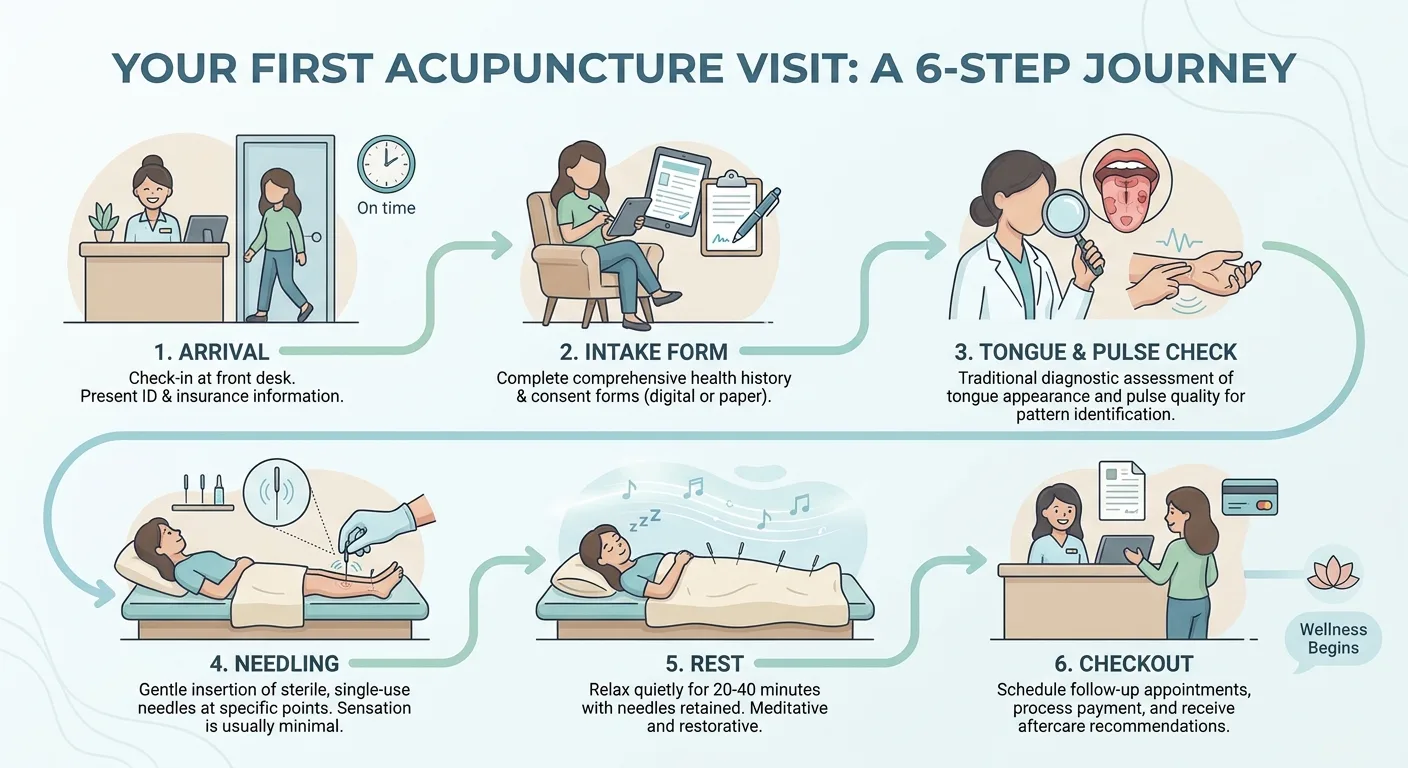
Lay the steps out in order, using your own room setup, typical session length and intake form:
- Arrival and intake paperwork
- Consultation about health history and goals
- Tongue and pulse assessment (looking at the tongue’s color and coating, then feeling the pulse at the wrist)
- Needling, including how the patient is positioned
- Rest time with the needles in place
- Checkout and scheduling
Beneath the steps, add a photo of your real treatment room or intake area. People want to see the room they’ll lie down in. Keep timing ranges honest, too: never publish a session length your schedule can’t keep.
2. “Will It Hurt?” Answered Without Sugarcoating
Fear of needles is one of the most common hesitations about acupuncture, and HuffPost reports it is the number-one reason people choose to forgo it. “It doesn’t hurt at all” is a risky answer, because the moment a patient feels something, the promise breaks and some of their trust goes with it.
Candor builds trust with skeptics. Collect the words your patients use after sessions (heavy, tingly, dull ache, warmth) and build the post around them. Describe the needles as thin and solid, and leave gauge numbers out unless you link a source. Individual experience varies, so skip any percentages about how many people feel what.
What would you want to know if you’d never seen an acupuncture needle up close?
Describing De Qi in Words Patients Recognize
De qi is the sensation practitioners often seek once a needle reaches a point. Translate it into what patients report: heaviness, spreading warmth, a dull ache. Traditions describe and pursue it differently, and your post should say so. Don’t present de qi as proof that treatment is working unless a linked source supports that framing.
3. What to Eat, Wear, and Skip on Treatment Day
Prep posts are the kind readers bookmark and reread the night before, and they can reduce day-of rescheduling.
A short checklist in your clinic’s voice does the job:
- Clothing: loose layers that roll up easily over arms and legs, where many common points sit
- Food: whatever your clinic advises; many ask for a light meal beforehand
- What to bring: a current medication list and the completed intake form
- What to mention: anything unusual about the day, from poor sleep to a new symptom

Advice involving alcohol, caffeine, fasting or medication timing needs a linked medical source. If you have no source, the fallback is “ask your practitioner.”
4. The Money Post: Pricing, Packages, and Insurance Questions
Cost is the question many readers won’t ask out loud, and many clinic sites dodge it. Hidden prices can push price-sensitive readers toward clinics that publish theirs. Other fee-based fields handle this openly; many accounting blog topics tackle pricing head-on.
Publish your actual price ranges, package structure and cancellation policy. Give readers a short script for calling their insurer: Does my plan cover acupuncture? Is there a visit limit? Do I need a referral? (Talking about money feels awkward for many practitioners. The patient guessing at your rates feels that awkwardness too.)
General claims about insurance or US health savings account (HSA) or flexible spending account (FSA) eligibility don’t belong here. Coverage varies by plan and region, so point readers to their plan administrator.
What’s stopping you from publishing prices?
Condition Content That Holds Up to Scrutiny
Readers who clear those hurdles start asking whether acupuncture fits their specific issue. Condition posts draw people in active discomfort, which raises the duty of care for any acupuncture content you publish. Like blog topics for financial advisors, condition posts are written under advertising rules, so review your board’s guidance first.
5. Condition Pages That Say What the Evidence Supports (and Stops There)
Headaches, back pain, stress, fertility support: these pages meet high-intent searches. Their overlooked strength is restraint. Honest limits make your positive claims believable.
Give every condition page three parts:
- What research suggests
- What remains uncertain
- When to see a physician first
Link every efficacy statement to a primary source in the same paragraph, and make fact-checking every efficacy statement a pre-publish step; an unsourced claim doesn’t run.
Keep one condition per page. Stacking several into a single post blurs the evidence and sets your own pages up to compete.
Matching Wording to Evidence Strength
Every study has a scope, and your wording should stay inside it. A study in the European Journal of Medical and Health Sciences describes pressing acupuncture points selected using ChatGPT and, in its title, a “Particularly Good Pressing Effect.” Notice the limits: the method involved pressing points (acupressure), not needling, in a single study. A result like that supports “one study reported” at most. It never supports “acupuncture treats pain.”
| Evidence level | Phrasing to use | Phrasing to avoid |
|---|---|---|
| Consistent research support (linked primary source in the same paragraph) | “Research suggests acupuncture may help with…” | “Acupuncture cures…” or “guaranteed relief” |
| Mixed or limited support (small or single studies, conflicting results) | “One small study reported…” or “results so far are mixed” | “Proven to relieve…” or “clinically shown to fix…” |
| Anecdotal or traditional use only | “Traditionally used for…” or “some patients report…” | “Effective treatment for…” or “works for everyone” |
6. Acupuncture Alongside Your Doctor’s Plan
Some cautious readers assume choosing acupuncture means abandoning their physician. A coordination post corrects that, positions your clinic as a cooperative partner and supports referral relationships with local doctors.
Offer a short list of questions patients can bring to their doctor:
- Should my acupuncturist know about any of my diagnoses?
- Does anything about my medications matter for treatment?
- How should we time sessions around my other care?
Explain what your intake form asks about medications and conditions, and encourage patients to share one current medication list with both providers.
Specific drug interactions or contraindications need an authoritative citation. Otherwise, send readers back to their physician.
7. When Acupuncture Isn’t the Right Call Today
Many clinics skip this post, which is why it can signal professionalism. Explaining when a practitioner may delay, modify or decline treatment tells readers your clinic puts their safety ahead of a booking. Skeptical readers look for that clinical judgment.
Walk through what your intake screening covers and why each question exists.

Frame the post around red-flag symptoms that call for urgent medical care first, and name a condition only with a linked medical source in the same paragraph.
Making the Practice Make Sense
Once safety is clear, many readers want to understand the system behind it. Many arrive curious and skeptical, and dismissive or overly mystical explanations lose them. The right tone respects tradition and stays clear for newcomers. How do you explain qi to someone who’s never heard the word?
8. Qi, Meridians, and Pattern Diagnosis in Everyday Language
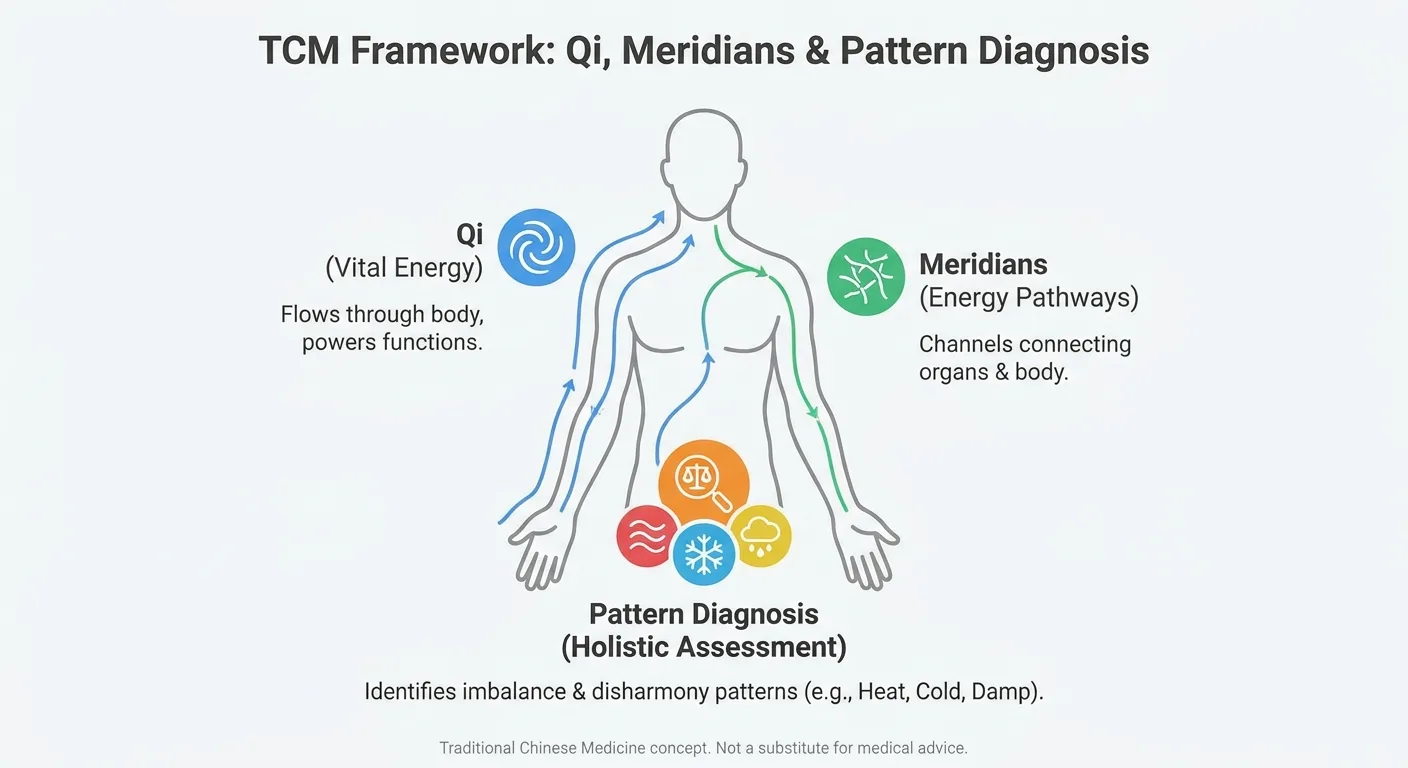
Patients hear these terms on the table and don’t always ask what they mean. Give each one or two sentences:
- Qi: the traditional concept of vital energy and function moving through the body
- Meridians: the pathways along which qi is said to flow in the traditional framework, with acupuncture points mapped along them
- Pattern diagnosis: grouping signs and symptoms into patterns, such as damp or deficiency patterns, to organize treatment
Follow each definition with how it shapes a practitioner’s choices, such as why a deficiency pattern changes point selection.
Practitioners vary in how literally they read these concepts (some treat them as working reality, some as a useful map, and plenty sit in between). Keep the traditional framework separate from scientific claims, and don’t present meridians as anatomically established without a source.
9. Cupping, Moxa, Gua Sha, and the Tools Beyond Needles
Many readers have seen cupping marks on an athlete’s back or heard of moxa without knowing what either involves. A short bullet per modality covers what it is, what it feels like and what’s visible afterward. Include only what your clinic offers:
- Cupping: cups create suction on the skin; patients may notice a pulling or tight feeling, and round marks are often visible afterward
- Moxibustion: dried mugwort burned usually just above, but sometimes directly on, the skin over acupuncture points (Merck Manual)
- Gua sha: a smooth-edged tool stroked across the skin, often leaving temporary redness
- Electroacupuncture: a mild current passed between needles, often described as tapping or pulsing
- Ear seeds: small seeds taped to ear points that patients press at home
Place a clinic photo beside each bullet with descriptive alt text. Cite a source for any modality’s efficacy; visible effects can be described as commonly observed. Each bullet can later grow into its own post.
10. How to Vet an Acupuncturist (Including You)
Teaching readers how to judge clinics feels counterintuitive. It can work because a clinic that publishes vetting criteria it meets earns credibility and attracts patients who value standards.
Give readers questions to ask during a consult:
- Are you licensed, and by which body?
- Where did you train, and for how long?
- Do you use sterile, single-use needles?
- Which conditions do you see most?
- How do you build a treatment plan?
- What happens if I don’t notice progress?

Answer every question yourself on the page: credentials, years in practice, specialties. Licensing requirements differ from state to state and can change between application cycles, so link your local licensing body or describe requirements in general terms (ccatcm.ca).
Would your own bio pass this checklist?
The Part After the Session
These last two acupuncture blog topics serve people who’ve already been on the table, and their job is retention. Returning patients have different questions, and the unanswered ones are how treatment plans quietly get dropped.
11. What Feels Normal After You Leave the Table
Questions about after-effects often arrive after hours. An aftercare post answers them when the clinic is closed, can reduce anxious calls and helps patients tell ordinary after-effects from something worth reporting.
Structure it as a two-part list:
- Commonly reported: what your patients tell you after sessions, phrased as patient-reported experience
- When to contact us or a doctor: warning signs sourced in the same item, or a plain “contact us if anything concerns you”

Close with your after-hours contact guidance: who answers, which number to use and what to expect in reply.
12. How Many Sessions, and How You’ll Know It’s Working
Practitioners often recommend a series of sessions, and patients often wonder why. Explain how your clinic structures treatment plans and where reassessment points fall; scheduled check-ins are a sign of good practice.
Session counts and timelines for specific conditions stay off the page. Plans vary by person and condition, and no published number should appear without a source behind it.
A symptom journal turns vague impressions into trackable notes and gives patients a fair way to judge results. Offer this template as a download or embed it directly:
| Date | Symptom | Intensity (0 to 10) | Sleep | Stress |
|---|---|---|---|---|
Choosing Which Post Goes Live First
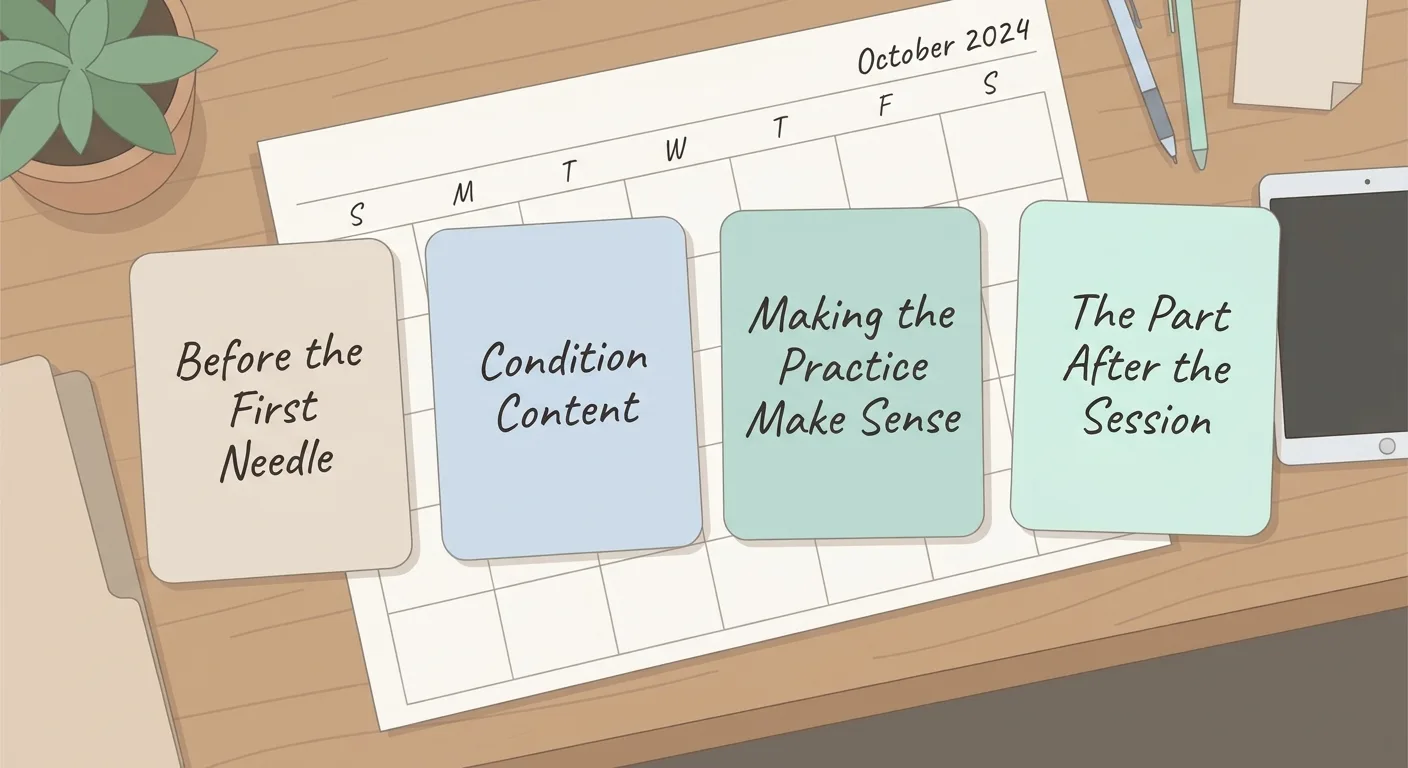
Four pain points usually stall the decision:
- Limited writing time. Clinic hours leave little room to draft.
- Unclear demand. Some topics draw steady searches; others draw none.
- Overlap. Grouping related searches with keyword clustering tools shows when two planned posts would chase the same question.
- Sourcing. Condition and safety posts need the most verification.
We order the groups by sourcing effort, an editorial judgment and not a ranking formula:
| Topic group | Entries | Who it serves | Main job | Sourcing burden | Suggested order |
|---|---|---|---|---|---|
| Before the First Needle | 1 to 4 | People deciding whether to book | Remove hesitation and logistics friction | Low; mostly your own clinic facts, prices and policies | Publish first |
| The Part After the Session | 11 to 12 | Current patients | Keep treatment plans on track | Moderate; any warning signs need a linked source | Second |
| Making the Practice Make Sense | 8 to 10 | Curious skeptics | Build credibility | Moderate; licensing details need local links | Third |
| Condition Content That Holds Up to Scrutiny | 5 to 7 | Readers in active discomfort | Meet high-intent searches responsibly | High; every efficacy and safety claim needs a primary source | After source review |
Vee3.ai handles the research and verification side of an acupuncture clinic blog in one workspace that covers crawl, research, plan, write, fact-check, publish and measure. Start building and map your clinic blog topics before your next draft.
Frequently Asked Questions
How often should an acupuncture clinic publish new blog posts?
Pick a pace you can sustain for a full year, such as twice a month, and treat that as an example, not a rule. Plan quarterly, and at each review check a few simple SEO KPIs to see which posts earn visits and inquiries. Refreshing older posts counts as real work, and no cadence guarantees rankings.
Should the acupuncturist write the posts or hire a writer?
A hybrid model is often the most practical option: the practitioner supplies expertise, and a writer handles drafting and editing. Use how fact-checkers verify claims as the model so every clinical statement traces back to a source. Show credentials in the author bio. The licensed practitioner should approve all health content, no matter who drafts it.

How long should each acupuncture blog post be?
Write until the reader’s question is fully answered, then stop. Answer-first structure also supports visibility in AI search, so there’s no reason to pad toward a word count. A cost or prep post can be brief and complete. Condition and explainer posts run long because every claim needs a source and an honest caveat beside it.
Where to Start This Week
Tomorrow’s first step is small. Ask your front desk which question they field most before a first booking, match it to one of entries 1 through 4 and publish that post before anything else. A single honest page about pain, cost, prep or the first visit is likely to do more for you than a polished benefits list.
The rest of your acupuncture blog topics can follow as your sourcing allows. The patients reading late at night don’t need perfection. They need a clinic willing to answer plainly. Give them that, and they’re more likely to arrive already trusting you.