
You’ve probably read dozens of glossy case studies by now. Each one had a hockey-stick chart, a confident headline, and nothing you could rerun on Monday morning. Headline numbers rarely transfer between sites, while methods usually do. Each pattern below is judged on three tests: a checkable baseline, one isolated change, and a method that holds up on another site.

The twelve search engine marketing examples below span paid search, technical fixes, local pages, ecommerce, off-page authority, and visibility in AI answers. Entry 12 is a failure, included on purpose. So tell us: what was the last thing you copied from a case study, and did it work?
TL;DR
The Filter Every Case Had to Pass
This list puts transferability ahead of the size of the win. A search engine marketing case study pattern belongs here only if its method holds up whatever the result.
Fill in a form for an SEO case study PDF, wait for the email, then open a chart with no method behind it. Running a case study search engine query with filetype modifiers and industry terms turns up plenty of material too, but volume doesn’t equal rigor.
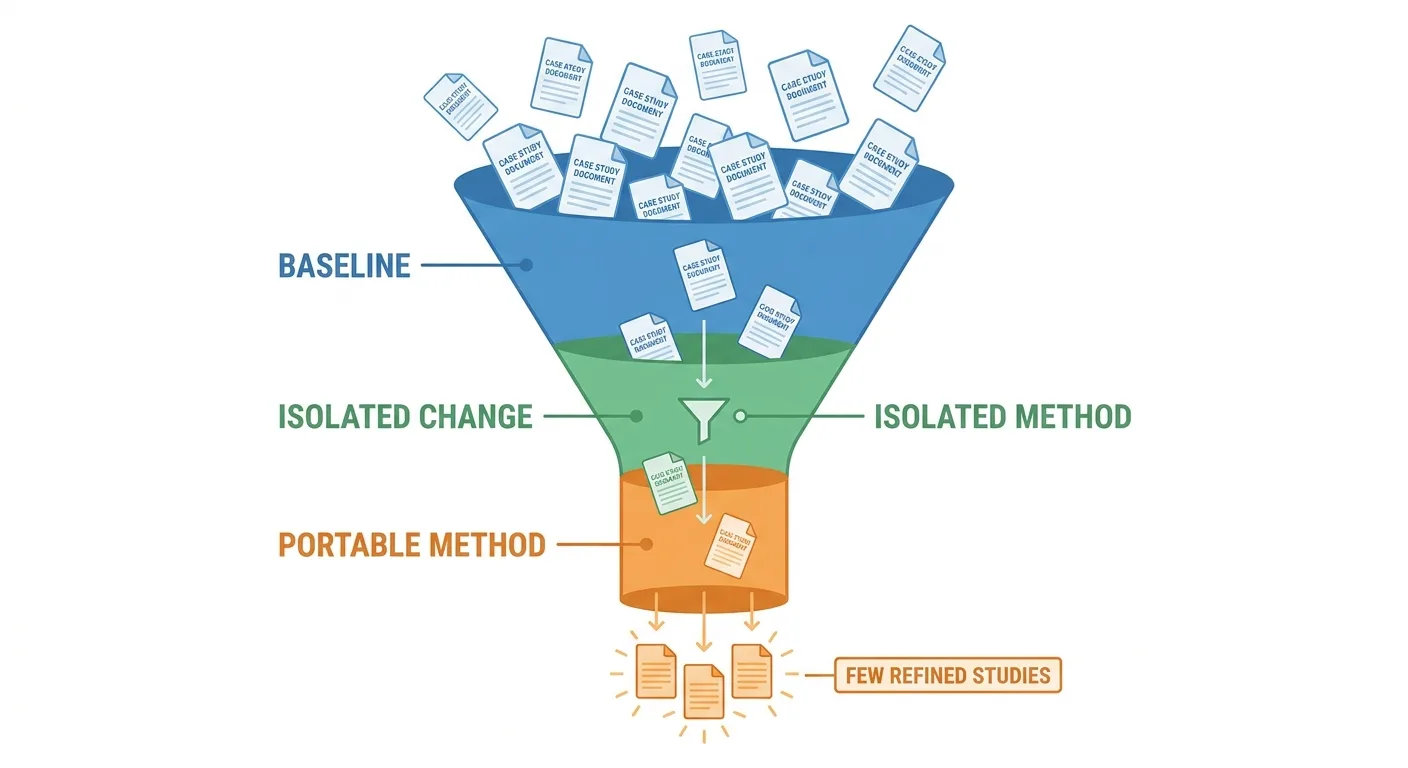
Three tests apply.
A Baseline You Can Check
Any case worth copying says where things stood before the change. Look for a fixed date range tied to one of the SEO KPIs worth tracking, so anyone can check the before number later. Year-over-year windows guard against seasonal swings; month-over-month windows often fall for them.
One Change, Clearly Isolated
A search engine marketing case study that stacks a redesign, a migration, and a content push into one chart can’t tell you which action caused the lift, so treat it as untestable. Holdout groups and staggered rollouts make a case stronger.
A Method That Survives Outside the Original Site
Does the method still work on a smaller site, in another niche, or on a tighter budget? Every SEO case study example below names the condition where it stops working.
Paid Search Spend, Audited Line by Line
The list covers the main types of search engine marketing: paid search (PPC), organic SEO, local search, shopping and ecommerce search, and answer engine optimization. Paid search goes first because spend data exposes intent problems fast.
1. The Search Terms Report That Showed Who the Ads Were Really Paying For
Broad and phrase match campaigns often spend money on queries the advertiser never meant to target.
The fix starts with an export. Pull search terms over a stable window, then tag every query by intent: buy, research, wrong product, job seeker, or competitor. Add negatives at the account, campaign, or ad group level, depending on how wide each problem runs.
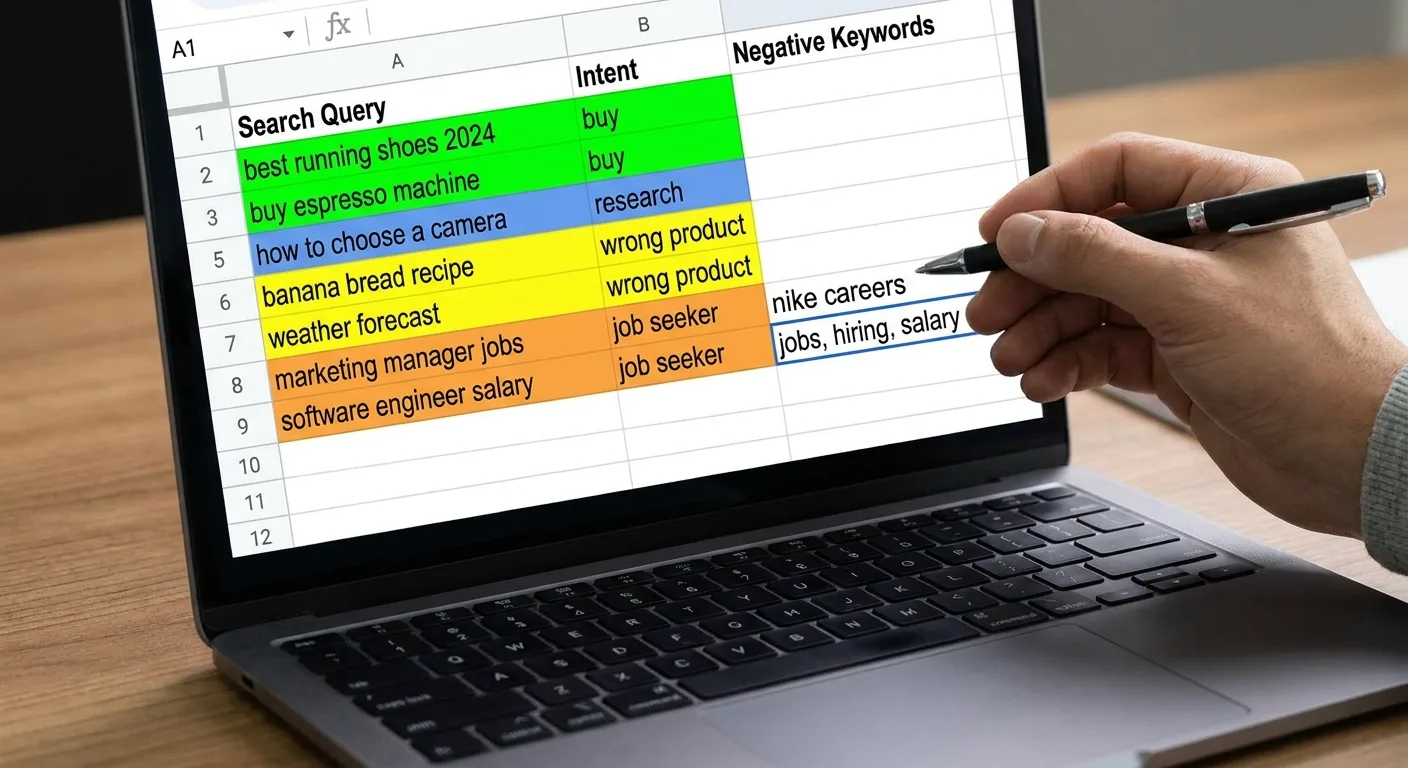
The intent-tagging step is the part to steal. The negative list is only its output. Tagging reveals patterns you’d miss scrolling raw queries, such as a cluster of job seekers clicking because your brand name doubles as an employer search.
Where it breaks: aggressive negatives can choke discovery. Review the list every quarter, because a one-time purge can block queries that start converting next season.
2. Turning Off Branded Ads to See What Was Truly Incremental
Do you know what share of your branded clicks would happen anyway? A brand holdout test answers that by pausing branded campaigns in selected regions or time blocks, then watching how much traffic organic results capture on their own.
Pick matched geos or alternating weeks and pause branded ads in the test group only. Track total branded clicks, paid plus organic, along with conversions. Paid clicks always drop when ads go dark, so measuring them alone misreads the test.
Where it breaks: competitors bidding on your brand can flip the result. Check auction insights before and during the test, and lean on broader competitor analysis for marketing to learn which rivals bid on your brand terms. (Some brands rightly keep branded ads running purely to control the SERP, and that’s a legitimate call.)
3. Splitting the SERP Between Paid and Organic Without Bidding Against Yourself
Teams that run PPC and SEO in separate silos often bid on non-branded terms where they already hold strong organic positions. The gaps where they rank nowhere get ignored at the same time.
Join paid keyword data with Google Search Console query data, then sort every term into three groups: organic strong, organic weak, and no organic presence. Sorting terms this way only holds up with consistent rank tracking behind the Search Console data, since averaged positions can hide daily swings. Budget then shifts toward the weak and absent groups.
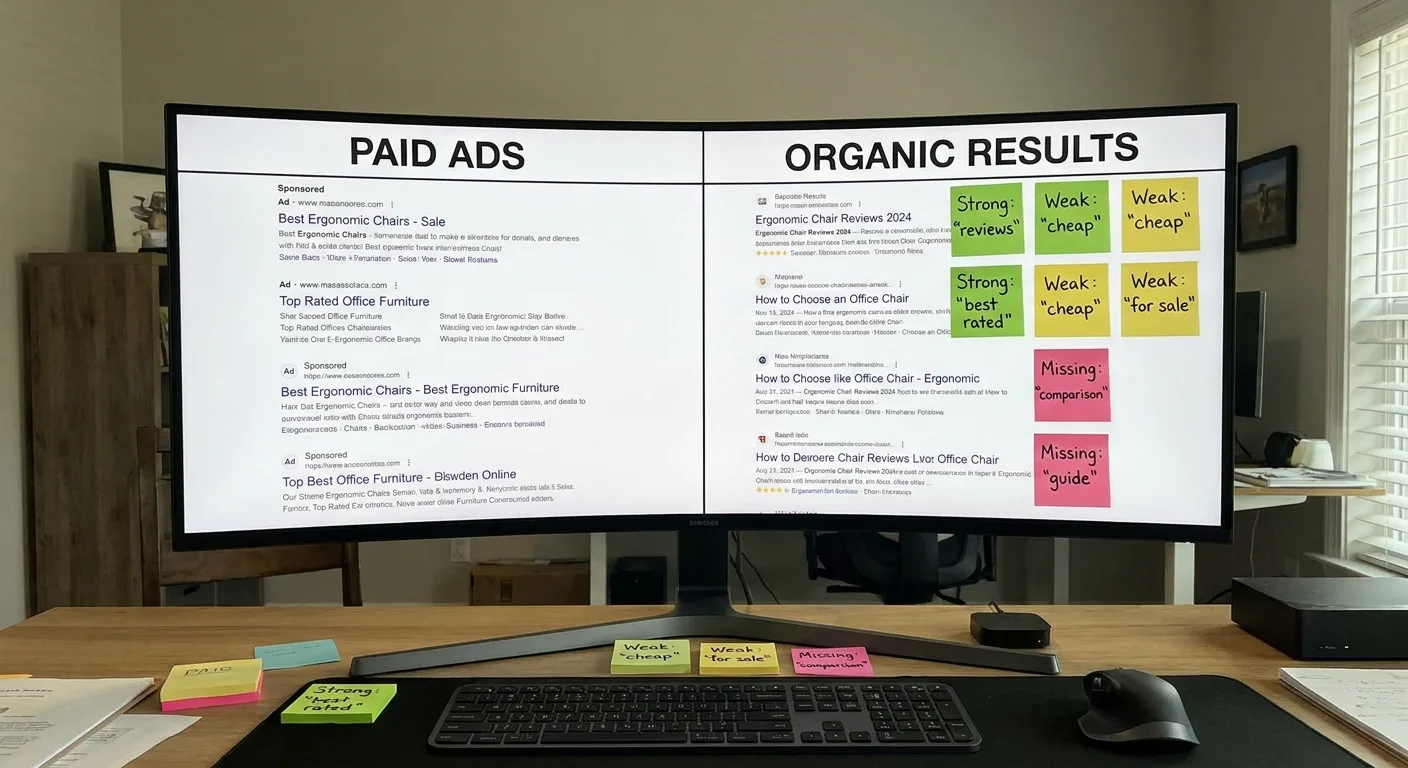
Build one shared keyword map. The map also turns paid search into a fast test bed for organic page topics: run ads on a theme and you learn whether the clicks convert before anyone writes a page.
Where it breaks: high-intent commercial terms can justify paid coverage even with the top organic spot secured.
Technical Fixes That Didn’t Need a Single New Page
Tired of hearing “publish more” every time traffic stalls? Many published case studies credit new content. The three below work by removing, relinking, or merging pages that already exist.
4. Pruning the Index Until Search Engines Saw Only the Pages Worth Ranking
Thin tag pages, parameter URLs, and stale archives pile up quietly. This technical SEO case study pattern audits, consolidates, and noindexes that bloat so crawlers spend their time on pages that earn traffic.
Crawl the full site first and join every URL with impressions, clicks, conversions, and backlinks. Then use the matrix to assign each URL one of five outcomes.
| URL condition | Action | Why it holds up |
|---|---|---|
| Earns clicks or conversions and matches its intent | Keep | Proven value, even when traffic is low |
| Right topic, but thin or outdated | Improve | The intent is worth serving; the page isn’t yet |
| Overlaps another URL’s intent | Merge into the stronger page, then 301 | Consolidates signals onto one URL |
| Low value, but holds backlinks | Redirect to the closest relevant page | Keeps link equity working |
| Low value, no links, still useful for site navigation (tags, parameters) | Noindex and drop from the XML sitemap | Users keep the page; crawlers skip it |
Copy the matrix itself, and treat the backlink row as non-negotiable: a linked page gets redirected, never simply deleted.
Finish by cleaning the XML sitemap so it lists only kept and improved URLs.
Where it breaks: pruning everything in one pass invites broken redirect chains and hides which removal caused any drop, so work in batches.
5. Rebuilding Internal Links After Menus Inflated the Count
Navigation, footers, and sidebars repeat the same links on every page, which makes internal link totals look healthy. A priority page can show hundreds of inlinks and still sit nearly invisible, because almost none of them come from body content.
Strip template links out of the count first; skip that and every audit says the site is fine. What’s left are editorial links, and the list of pages with zero or near-zero editorial inlinks becomes your orphan report. Add contextual links to those pages from topically related articles, using descriptive anchors that say what the destination covers.

Where it breaks: dozens of identical exact-match anchors pointing at one URL can look manipulative, and they read awkwardly for humans too, so vary them.
6. Merging Two Pages That Kept Stealing Each Other’s Rankings
Keyword cannibalization happens when two or more pages on the same site target the same keyword and search intent, leaving Google to pick between them (Nightwatch).
Confirm it in Search Console. Filter by the query and check which URLs receive impressions over time; URLs that keep swapping places signal the problem. Choose the survivor based on intent fit, backlinks, and conversions. Fold the best content from the losing page into it, then 301 the old URL.
Where it breaks: shared keywords alone don’t prove cannibalization. A buying guide and a product page can both rank for a product term because they serve different searchers, and they should coexist. Glance at the live SERP as a tiebreaker: results showing both guides and product pages mean search engines welcome both intents.
Local Pages and Online Stores Built on Structure
In local and ecommerce search, page structure and real-world proof decide visibility more than word count.
7. Location Pages That Earned Their Place in the Map Pack
This local SEO case study pattern replaces templated city pages with genuinely local ones for multi-location businesses.
Build one page per real location with details nobody else could write: the staff, the services offered at that site, nearby landmarks, and reviews from local customers. Keep the name, address, and phone number consistent across every listing, and complete each location’s Google Business Profile in full.
Link each location page to its matching profile. Point every profile at its own location page so both reinforce the same address.
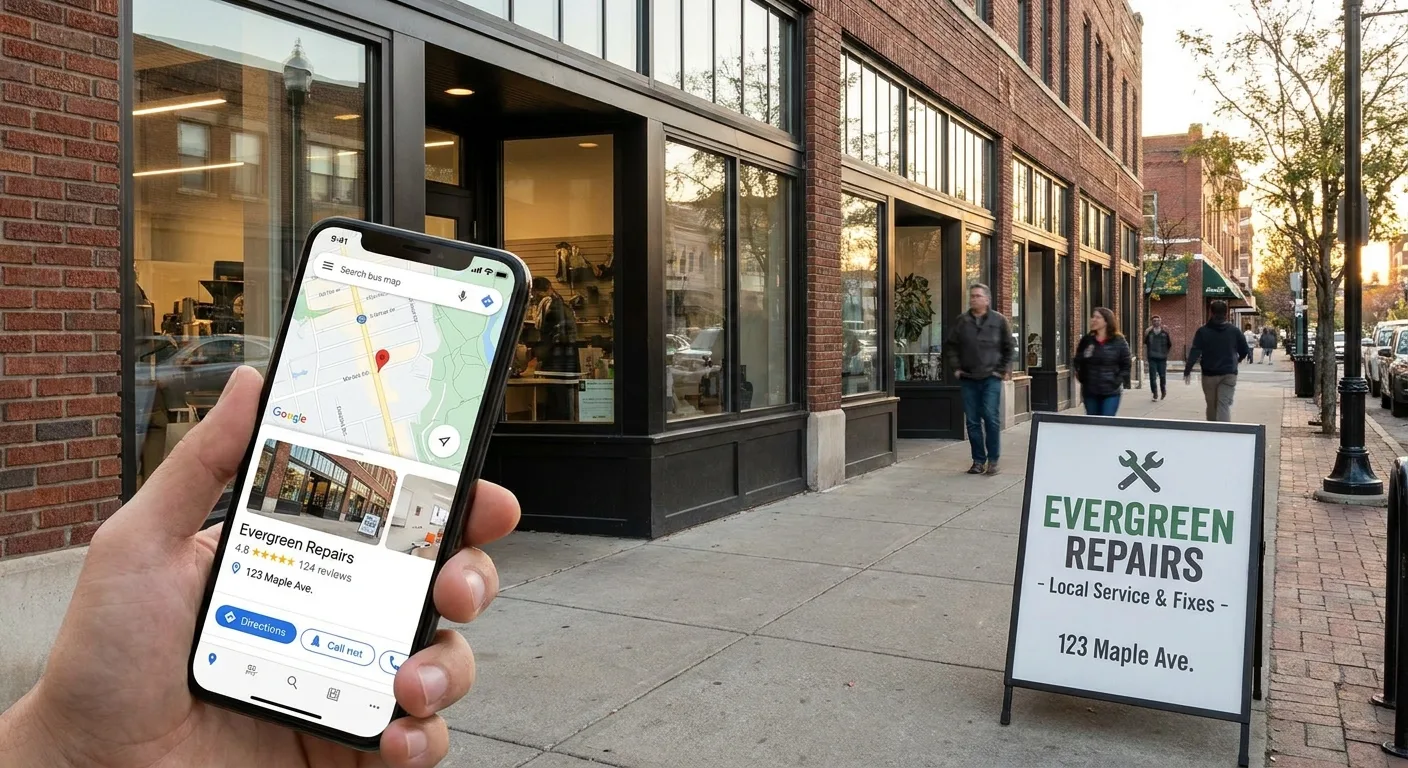
Where it breaks: pages for cities with no physical presence rarely hold up, and creating business profiles for locations you don’t operate can violate Google Business Profile guidelines and put real listings at risk.
8. Category Pages Rewritten for Shoppers Who Haven’t Picked a Product Yet
Category pages often target broad commercial queries yet carry little beyond a product grid. That gap is the target of this ecommerce SEO case study pattern.
Add short buying guidance that addresses the choices shoppers face, such as size, material, or use case. Keep it compact so the grid stays visible.
Faceted navigation needs firmer rules. Allow indexing only for filter combinations with real search demand, and canonicalize or block the rest. (A site: search with a filter parameter on your own domain shows whether filter pages are indexed.)
Where it breaks: long text blocks pushed above the products can hurt conversion, so test placement. Shoppers came to browse, and copy that buries the grid answers a question they didn’t ask.
9. Product Schema and the Out-of-Stock Problem Nobody Plans For
Product pages can lose rich results when their structured data is incomplete: items missing required properties are not eligible for rich results (Google Search Central). Both sit at the center of e-commerce SEO case study work.
Complete the Product structured data with price, availability, and reviews where they’re genuine. Validate it with Google’s Rich Results Test, then set a decision path for stock changes:
- Temporarily out of stock: keep the page live and update availability.
- Permanently discontinued: redirect to the closest replacement or the parent category.
- No equivalent product: let the URL return a 404 or 410, and remove internal links to it (dev.to).

Write the stock rule down before the problem arrives. The worst time to debate redirects is the week a bestseller disappears.
Where it breaks: review markup must reflect real reviews shown on the page; marked-up ratings visitors can’t see break structured data guidelines.
Authority, AI Answers, and One Instructive Failure
The final three patterns cover external links, visibility inside AI-generated answers, and a campaign that didn’t work.
10. Earning Links Straight to the Pages That Convert
Link building often piles authority onto blog posts that never feed commercial pages. Fixing that is what this off-page SEO case study pattern does, in three moves:
- Build assets that commercial pages can host or link to directly, such as original data, calculators, or tools.
- Pitch those assets through digital PR.
- Add internal links from the asset that earns links to the target product or service pages.
Plan the internal path from the asset before outreach begins. Bolting it on afterward usually leaves links landing on a page with no route to revenue. Map which rival pages attract links in a competitor analysis chart before deciding which asset to build. Where do your best backlinks point right now?
Where it breaks: the pattern depends on an asset people actually cite; if it earns no links, the internal path has nothing to pass along.
Paid links that pass ranking credit and excessive link exchanges can fall under Google’s link spam policy (BlueTree).
11. Writing Pages That AI Answers Choose to Quote
AI Overviews now answer the whole query at the top of the page, with Google composing a summary from several sources instead of showing ten links (scandiweb). Direct answers, key-facts blocks, and FAQ content make a page easier to extract, though no format guarantees a citation.
Open each section with a concise direct answer, add a scannable key facts block, and include FAQ content with matching structured data. Keep entity names consistent, so a product, person, or brand carries the same name everywhere.
Log which queries trigger AI answers that cite you or a competitor, treating tracking AI visibility as its own report separate from rankings, because a page can rank well and still go unquoted.

Where it breaks: measurement tools here are young, and citations fluctuate, so don’t promise anyone stable visibility. Answer-friendly structure tends to help ordinary readers as well. Write for people first.
12. The Campaign That Flopped and Still Earned a Write-Up
Picture a content cluster launched without checking existing rankings or real search demand. The pages competed with each other and targeted terms almost nobody searches. We’d argue this version of a search engine marketing case study is the most transferable lesson on the list, because any team can make this mistake.
The writing wasn’t the problem; three checks got skipped:
- No demand validation for each target term, leaving pages aimed at searches that barely exist.
- No overlap check against existing URLs, which set up the rotation problem from #6.
- No SERP review before writing, so nobody saw which intent the results already rewarded.
A failure pays off once it becomes a written pre-launch rule. Put every cluster through a three-step gate before it ships:
- Confirm demand for every target term.
- Check overlap with existing URLs, using keyword clustering tools to group terms by shared intent before any page gets assigned.
- Read the live SERP to see which intent wins.
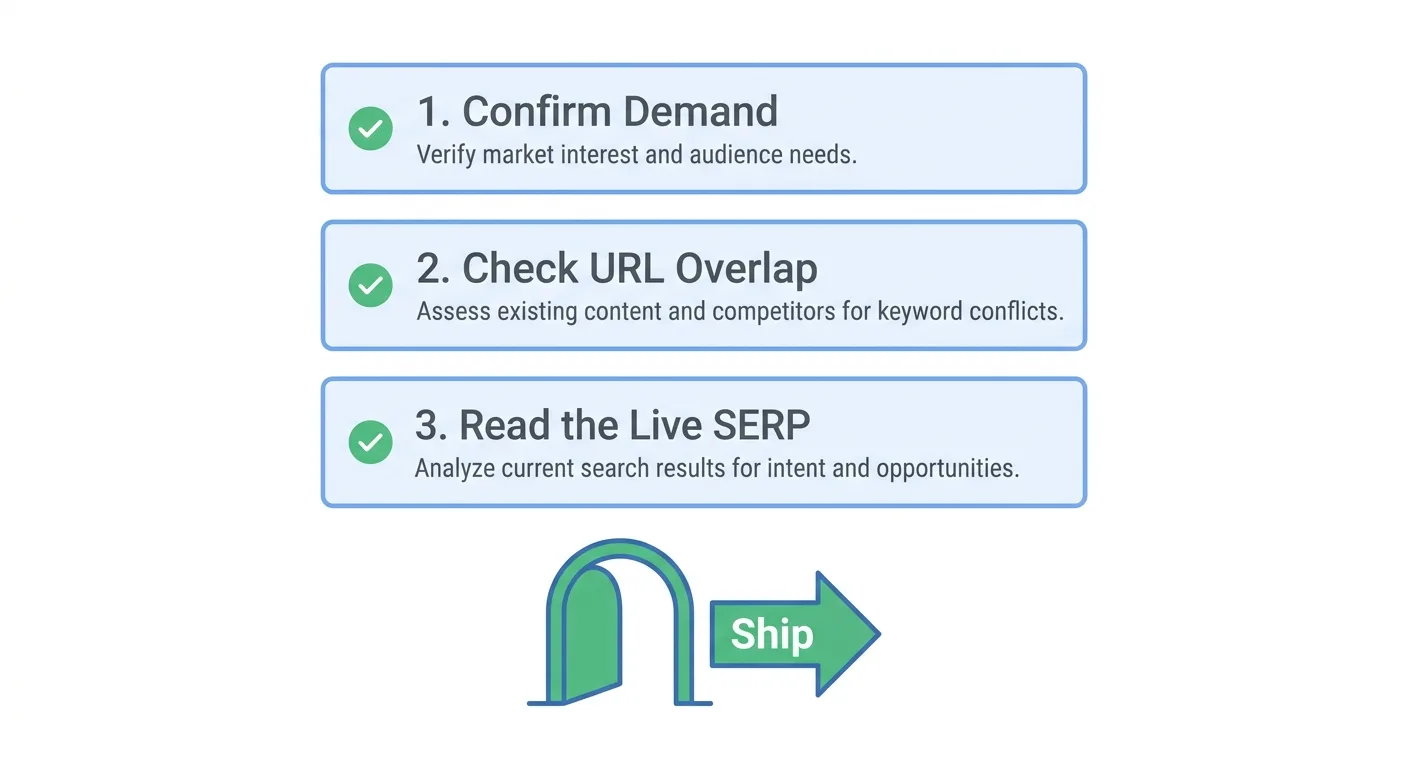
Write the gate into the brief template, so the check happens every time and nobody has to remember it.
Where it breaks: gates slow launches slightly, and that tradeoff is worth stating plainly to whoever owns the deadline.
Write Your Own Case Study Before Anyone Asks for One
A documented test becomes the reference for your next one and gives clients or leadership something credible to read. This SEO case study template records the filter’s three tests plus result and follow-up fields:
| Field | What to record |
|---|---|
| Baseline (metric and date range) | The starting number and the exact window it covers |
| Change made | The single intervention, described so someone else could repeat it |
| Measurement window | Start and end dates, plus the comparison period used |
| Result | The measured outcome against the baseline |
| Where it might break | Site size, niche, budget, or season where the method could fail |
| What we’d change next time | One adjustment for the follow-up test |
Your search engine marketing tools fill each row: Search Console, analytics, ad platform reports, and a crawler. Teams that automate SEO reporting spend less time copying numbers, though the habit of recording still comes from the team.
Keep the template short enough that the team keeps filling it in.
Stopping the Next Flop Before It Ships
The pre-launch gate is easy to agree with and hard to run by hand across hundreds of keywords. Manual demand checks, overlap spreadsheets, and re-verifying numbers in AI drafts eat the hours meant for strategy.

We built Vee3.ai, our SEO automation from crawl to rank workspace, for exactly that bottleneck. Per Vee3.ai’s product overview, it covers crawling, research, planning, writing, fact-checking, publishing and measurement in one workspace.
Put your next content cluster through the gate before it goes live. Start building with Vee3.ai.
Frequently Asked Questions
How long should I wait before judging a search engine marketing test?
Judge a paid test once conversion volume stabilizes, and an organic test only after search engines have recrawled and re-ranked the changed pages. Avoid ending any test the week traffic spikes, and compare against the same period last year to rule out seasonality. No fixed number of days fits every site.
Do I need paid software to run these case patterns?
No, most of the twelve patterns run on free data from Google Search Console, analytics, and ad account reports. A comparison of free and paid SEO tools can help you decide when a paid crawler earns its cost, such as on large-site audits. Tools surface the data; the decisions still belong to you.
Is formal training worth it before testing on a live account?
Formal training is worth it for platform mechanics and vocabulary, but judgment comes from running small, isolated tests. A good search engine marketing course teaches testing and measurement alongside platform setup. Start with low-risk patterns, such as a search terms audit or internal link fixes. Save brand holdouts and index pruning for later, since those put revenue on the line and reward a solid documentation habit.
Pick One Pattern and Record Its Baseline
Pick the one entry closest to the problem on your desk right now, record the baseline today, and change one thing. You don’t need to fix the whole account this month. Your own search engine marketing case study will follow, written by the person who knows the site best.
Which pattern are you starting with?