The field is still standing, though it’s taking hits. The Duke Reporters’ Lab 2026 census describes fact-checking losses that continue amid funding pressure, while most projects persist.
We’re the Vee3.ai team. Publishers and directories handle lookup jobs; the Vee3.ai Fact Checker, listed first, handles draft verification.
Four of our six tests decide reliability: certification, transparent method, coverage, and whether the outlet still publishes. The fact checkers below all had to show signs of life, and one famous name couldn’t. The criteria section explains why.
TL;DR: Match the Fact Checker to the Job in Front of You
- Checking figures in your own drafts before publishing: Vee3.ai Fact Checker
- A meme or hoax your uncle just shared: Snopes
- US political claims and campaign promises: PolitiFact and FactCheck.org
- International news from IFCN signatories: Reuters Fact Check and AFP Fact Check, both operated by international media agencies and listed as IFCN signatories by Wikipedia
- A fast claim search box: Google Fact Check Tools (limited evidence)
- Hunting for a regional checker anywhere in the world: Duke Reporters’ Lab
- Claims about UK politics and public life: Full Fact
- Cost: we found no paywalls; donation prompts and free starts were the only cost signals.
Comparison Table: All 9 Fact Checkers Side by Side
The six middle columns match the criteria explained in the next section.
| Pick | Certification and independence | Transparent method | Coverage | Active in 2026 | Access and cost | Workflow fit | Sources |
|---|---|---|---|---|---|---|---|
| Vee3.ai Fact Checker | IFCN certifies publishers, not tools, issuing a certification to publishers who pass its audit, according to Wikipedia; operator disclosed | Opens original page or PDF, logs an evidence ledger | Your own drafts | Live product as of October 2026 | “Start building free” | Verify drafts before publishing | Vee3.ai, About Vee3 |
| Snopes | Certification not verified in our research | Documents its sources | Memes, urban legends, news, politics | Not confirmed in our research | No price found | Look up viral claims | CSI Library at CUNY, Princeton University Library media literacy guide |
| PolitiFact | States independence as a core principle | Truth-O-Meter ratings, stated transparency | US politics, promises, trending misinformation | Dated promise updates in September 2026 | Donation-supported, no paywall seen | Look up political claims | PolitiFact |
| FactCheck.org | A project of the Annenberg Public Policy Center at the University of Pennsylvania, according to FactCheck.org | Monitors ads, debates, speeches, releases | US politics, science via SciCheck | Article dated October 5, 2026 | Donate option, free weekly newsletter | Look up claims or ask a question | FactCheck.org, Washington State University Libraries guide |
| Reuters Fact Check | IFCN signatory | Method detail not retrieved | International | Not confirmed in our research | No price found | Look up international claims | Wikipedia’s list of fact-checking websites |
| AFP Fact Check | IFCN signatory; the Duke database includes all IFCN signatories, according to Duke Reporters’ Lab | Method detail not retrieved | International | Not confirmed in our research | No price found | Look up international claims | Wikipedia’s list of fact-checking websites |
| Google Fact Check Tools | No certification evidence | Not shown on retrieved page | Not shown on retrieved page | Search page live as of October 2026 | Sign-in shown, no price found | Quick claim search | Google Fact Check Tools |
| Duke Reporters’ Lab | Publishes inclusion criteria | Database with map and list views | Global directory | 2026 census published | No price found | Find a regional checker | Duke Reporters’ Lab, UC Berkeley Library guide |
| Full Fact | Independent team, certification not retrieved | Asks people to correct the record | UK | Publishes an annual report, with a recent edition in 2026 | No price found | Look up UK claims | Full Fact Report 2026 |
Criteria Breakdown Summary: Six Tests Every Pick Had to Face
We judged every pick, Vee3.ai included, against the same six criteria, with text verdicts only.
- Certification and independence. Has an outside network vetted it, or does it at least state its independence? IFCN, EFCSN and Duke’s inclusion criteria are the main outside screens; details are in the callout below.
- Transparent sourcing and method. Does it show its sources and explain how it reaches a rating? The Wright State University Libraries guide recommends that readers “read upstream” to the original source and “read laterally” across other outlets. A good checker makes both easy.
- Topic and geographic coverage. Which subjects and regions does it handle well, and where does it go quiet?
- Active publishing in 2026. Is there dated work from this year? A brilliant archive that stopped updating can mislead you about anything that happened since.
- Access and cost. We recorded only what we found: donation prompts, free newsletters, free starts. We invented no prices.
- Workflow fit. Are you searching published checks or verifying your own drafts? The same Wright State guide advises checking whether “someone has already investigated the claim,” which is a lookup job. Verifying your own numbers is a different one.
Here’s the grounding for criteria 1 and 4:
Library guides such as one from Williams College Libraries still list the Washington Post Fact-Checker as a resource, describing it as in-depth and focused primarily on political facts.
No accessible community review source turned up for any pick, so this article carries no review claims, ratings or quotes.
Vee3.ai Fact Checker Verifies the Figures in Your Own Drafts
Best fit: verifying claims and figures in your own drafts before you publish.
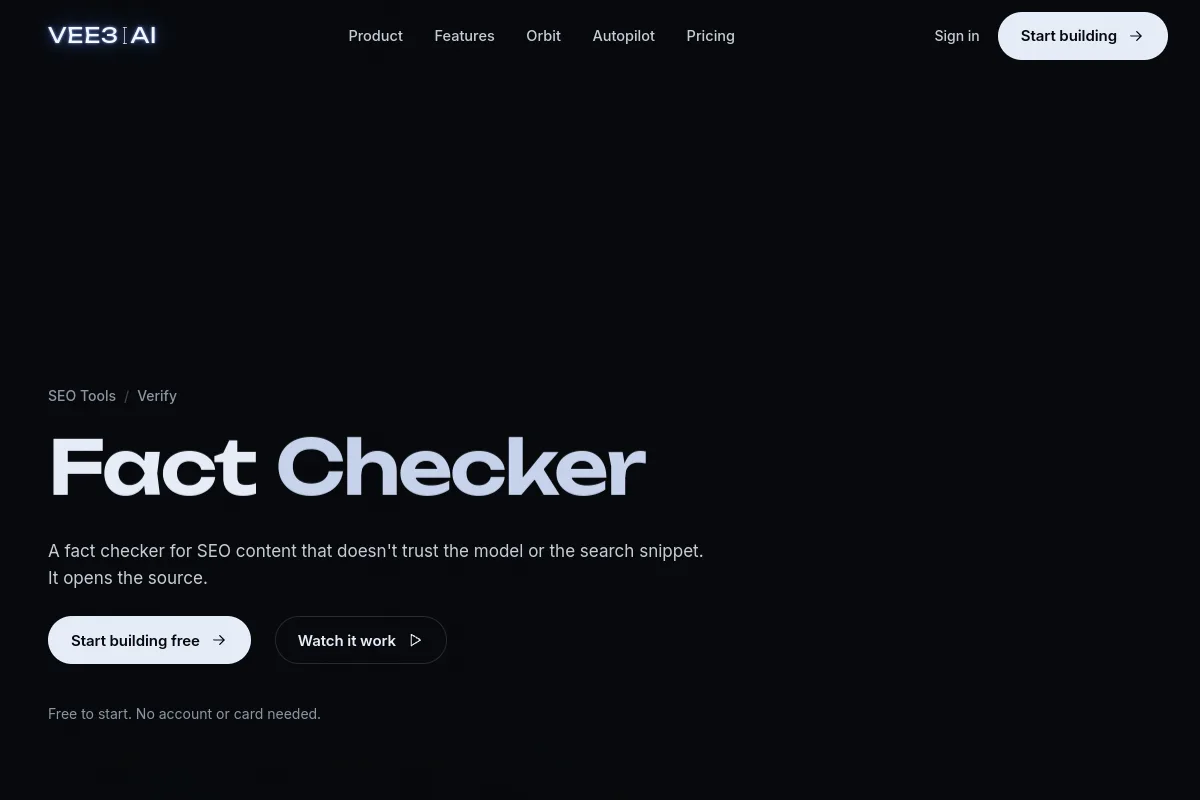
*Vee3.ai’s homepage positions fact-checking inside one SEO workspace.*
Its job is narrow on purpose. The Vee3.ai homepage positions the product around tracing every number to its source. Rather than summarizing what the web says about a claim, as some AI fact-checkers do, Vee3.ai opens the original page or PDF behind it and looks for the exact figure.
Key features, all from Vee3.ai’s own homepage:
- Three verdicts: Supported, Not substantiated, Research incomplete
- Two different searches run before anything is called unsupported
- An evidence ledger inside briefs records what was found and where
- Finished drafts can publish to connected CMS platforms, including WordPress, Webflow and Shopify
Pros: verdicts sit beside the draft in a single workspace. A flagged claim gets fixed right where it sits, since writers can edit drafts in one place without copying text between tools.
Cons: it isn’t a public archive of debunks. Unlike the publisher fact checkers below, it won’t tell you whether a viral meme was already checked.
Transparency: the About Vee3 page discloses that The Marketing Agency Inc. in Ontario, Canada, operates the product, and that Anthropic may process queries and performance evidence for Copilot analysis.
Criteria verdicts
- Certification and independence: outside certification doesn’t exist for tools, so the meaningful signal is disclosure. The operator and data processor are both named.
- Transparent method: strong. Each verdict points to the page or PDF that earned it.
- Coverage: whatever claims sit in your draft.
- Active in 2026: live and taking new users as of October 2026.
- Access and cost: a free start.
- Workflow fit: pre-publish verification, a job none of the other eight are built for, based on what we retrieved.
Price context: “Start building free,” per the Vee3.ai homepage. No plan prices stated here.
Where to find it: Vee3.ai Fact Checker.
Snopes: Best for Tracing Viral Memes and Urban Legends
Best fit: viral memes, hoaxes and urban legends.
David Mikkelson founded Snopes, which got its start in 1994 investigating urban legends, hoaxes and folklore, and was publishing online before most people were connected to the internet, according to CSI Library at CUNY. The same guide notes that Snopes documents its sources and quotes its self-description as “the oldest and largest fact-checking site online.” That’s Snopes talking about Snopes; we haven’t verified the ranking.
The Princeton University Library media literacy guide describes its range as running from “memes and urban legends to current news and politics.” A snopes fact check can show whether a meme that fact checkers already debunked is resurfacing.
Pros: wide topic range and documented sources.
Cons: thin verified evidence beyond library guides.
Criteria verdicts
- Certification and independence: not confirmed in our research, so it rests on reputation alone.
- Transparent method: a genuine strength, since readers can follow the cited sources themselves.
- Coverage: broadest on internet folklore, with politics and news included.
- Active in 2026: not confirmed in our research; note the date on any snopes fact check.
- Access and cost: not found.
- Workflow fit: lookup of claims that have already gone viral.
Price context: we found no price information.
Where to find it: Snopes.com, as named in the CSI Library at CUNY guide.
PolitiFact, the Pick for US Political Claims and Campaign Promises
Best fit: US political claims and campaign promise tracking.
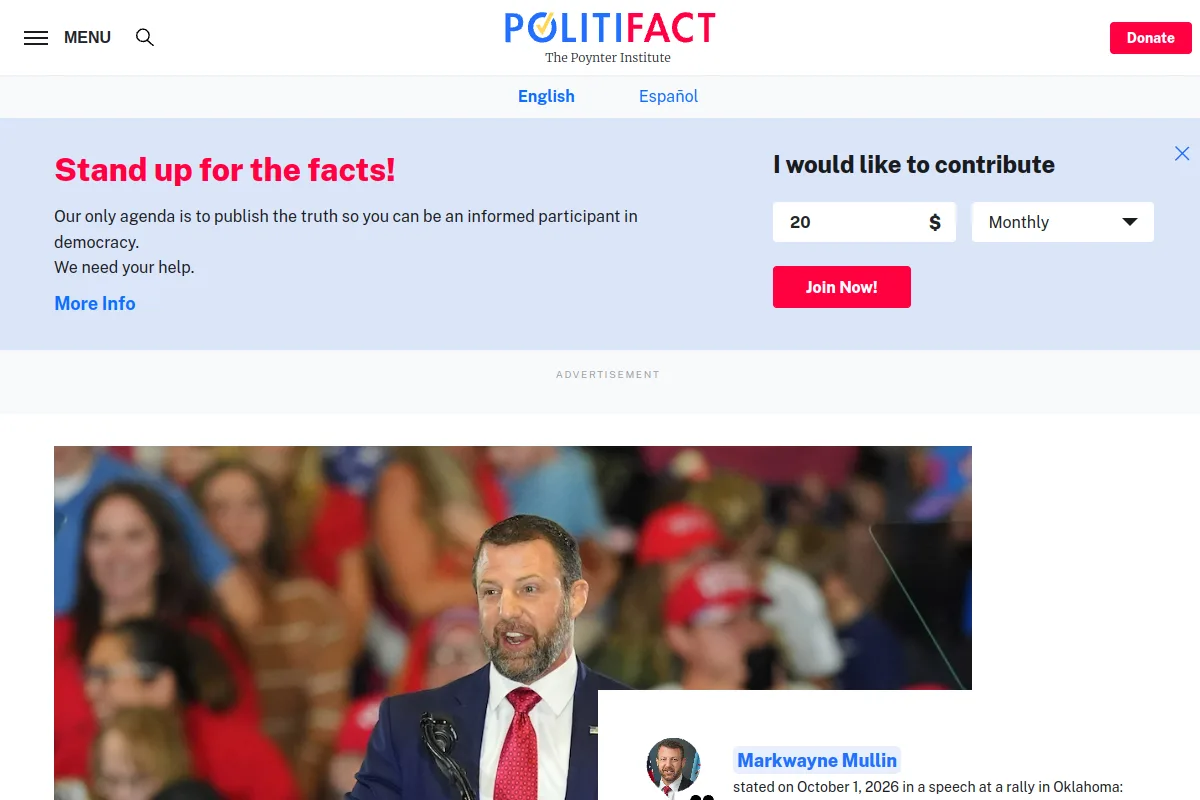
*PolitiFact pairs political ratings with a promise tracker.*
The Truth-O-Meter is the signature here: PolitiFact rates the accuracy of claims by elected officials and others on that scale, and it is part of The Poynter Institute, according to Poynter. The UC Berkeley Library guide describes it as Pulitzer Prize winning.
Key features, per PolitiFact:
- Promise tracking: according to PolitiFact, its MAGA-Meter tracks the development of Donald Trump’s promises from the 2024 campaign.
- A “Trending Misinformation” section that includes TikTok claims
- Stated core principles of independence, transparency and fairness
Pros: promise tracking paired with fresh checks on what’s trending.
Cons: its coverage centers on US politics, so it won’t help much with a claim out of Lagos or Lyon.
Criteria verdicts
- Certification and independence: stated principles count for something, but self-declared values carry less weight than review by an outside network. IFCN status not confirmed in our research.
- Transparent method: a public rating scale makes its reasoning easy to scrutinize.
- Coverage: deep on US statements, promises and social video claims; thin elsewhere.
- Active in 2026: yes, with dated promise work.
- Access and cost: free, donation-supported.
- Workflow fit: lookup, especially for anything a candidate said or pledged.
Price context: PolitiFact offers one-time, monthly and yearly donation options, according to PolitiFact. We saw no paywall.
Where to find it: PolitiFact.
FactCheck.org Brings the Deepest Toolkit for US Politics and Science
Best fit: US political speech plus science claims, with a way to submit your own question.
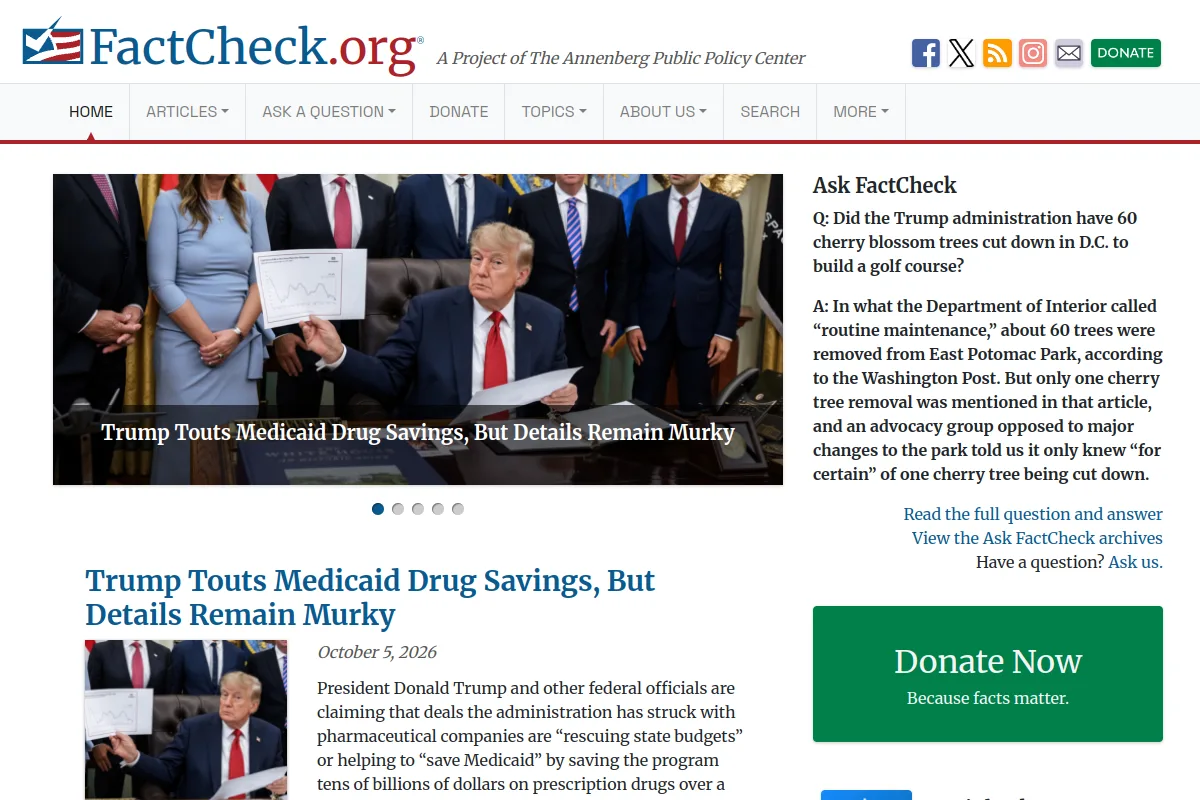
*FactCheck.org adds SciCheck and reader questions to political coverage.*
The Annenberg Public Policy Center at UPenn runs this project, and its fact checkers monitor TV ads, debates, speeches, interviews and news releases, according to the Washington State University Libraries guide.
Key features
- Ask FactCheck for reader questions, visible on the FactCheck.org search page, which is also the place to type in a science claim you keep seeing
- SciCheck, launched in January 2015 with a Stanton Foundation grant, according to the Mississippi State University Libraries guide
- Players Guide 2026, which profiles eight of the biggest spenders so far for the 2026 midterms, is listed on FactCheck.org, according to FactCheck.org.
Pros: real science coverage and a direct channel for reader questions.
Cons: the core focus stays US-centric, and we saw Spanish-language work only in a vaccination project.
Criteria verdicts
- Certification and independence: university backing gives it institutional grounding. IFCN status not confirmed in our research.
- Transparent method: monitoring a defined set of sources makes its scope clear.
- Coverage: US politics plus science; the only pick on this list with a dedicated science section, based on our research.
- Active in 2026: confirmed, with an article on FactCheck.org noting that Club for Growth aimed to raise and spend $175 million in the 2026 election cycle, according to FactCheck.org.
- Access and cost: free to read, with a free weekly newsletter.
- Workflow fit: lookup, plus the option to ask when no check exists yet.
Price context: a “Donate Now” prompt appears on FactCheck.org; the newsletter costs nothing.
Where to find it: FactCheck.org.
Stories don’t stop at the US border, and our next two picks don’t either.
Reuters Fact Check for International Claims Backed by IFCN Standards
Best fit: international news claims, where every reuters fact check comes from an IFCN signatory.
*Reuters Fact Check is operated by the Reuters news agency.*
Reuters is an international media agency, and Wikipedia’s list of fact-checking websites lists its fact-check operation as an IFCN signatory. That outside vetting is the headline strength.
Pros: outside certification that most US-only picks couldn’t show in our research.
Cons: a thin verified record beyond its IFCN listing.
Criteria verdicts
- Certification and independence: strongest point, since compliance with the IFCN code is reviewed annually by external independent assessors, according to Poynter.
- Transparent method: not confirmed in our research.
- Coverage: international news.
- Active in 2026: not confirmed in our research.
- Access and cost: not found.
- Workflow fit: lookup of global claims.
Price context: we found no price information.
Where to find it: Reuters Fact Check.
AFP Fact Check, a Global Wire Service Pick Indexed by Duke
Best fit: a second set of international fact checkers for cross-checking a claim against another IFCN signatory.
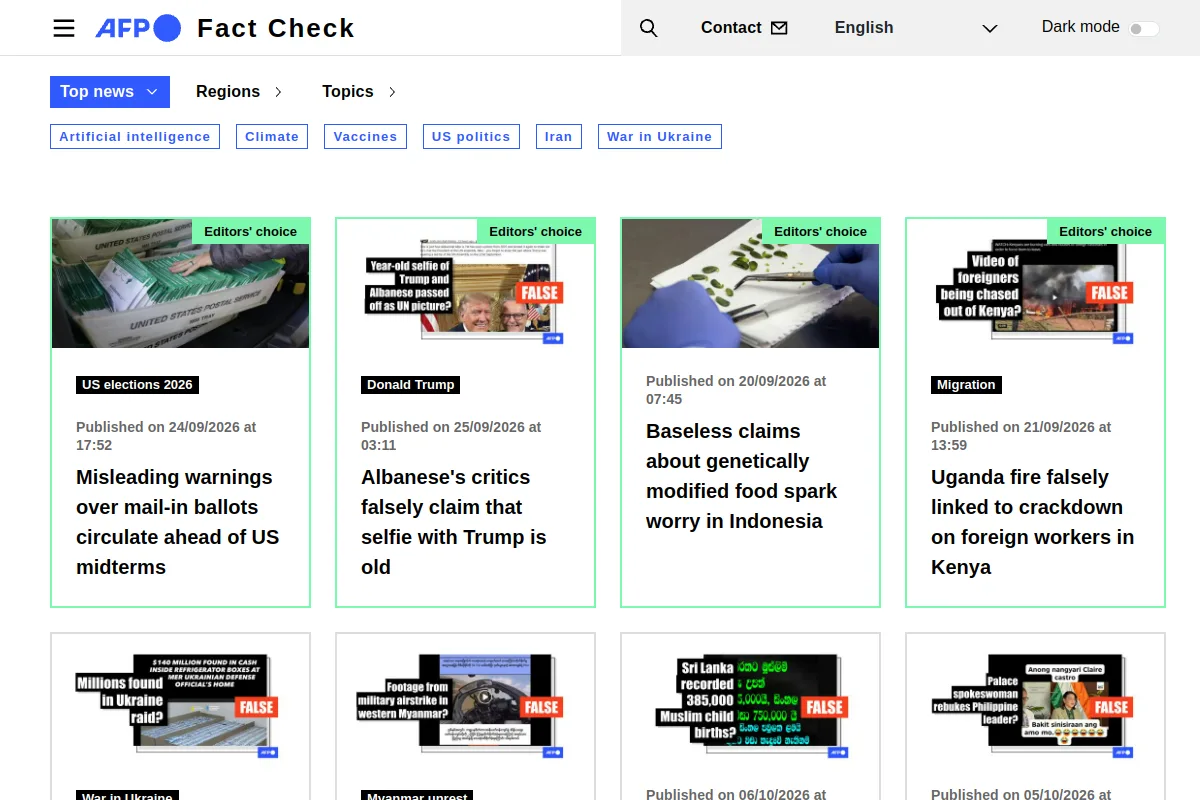
*AFP Fact Check is operated by Agence France-Presse, an international media agency, according to Wikipedia.*
Agence France-Presse runs this service. Wikipedia’s list of fact-checking websites identifies it as an IFCN signatory that is also indexed by Duke Reporters’ Lab.
Here’s a habit worth building. Read AFP and Reuters on the same claim and you’re doing the lateral reading the Wright State University Libraries guide recommends.
Pros: pairs naturally with Reuters for side-by-side cross-checking.
Cons: a thin verified record on method and current activity.
Criteria verdicts
- Certification and independence: two outside screens: IFCN review plus Duke’s inclusion criteria.
- Transparent method: not confirmed in our research.
- Coverage: international.
- Active in 2026: not confirmed in our research.
- Access and cost: not found.
- Workflow fit: lookup and cross-checking.
Price context: we found no price information.
Where to find it: AFP Fact Check.
Google Fact Check Tools: Best for a Quick Claim Search (Evidence Is Thin)
Best fit: a fast search for a claim you’ve seen, as a starting point only.
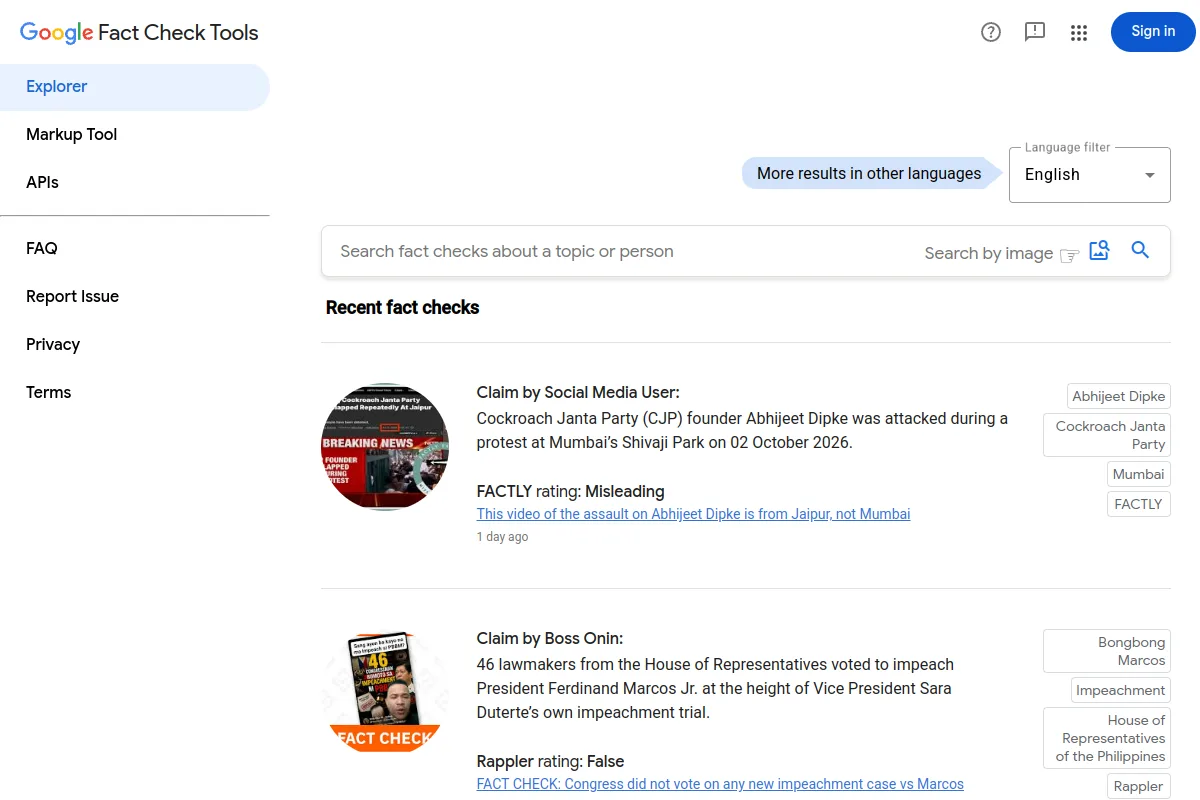
*Google Fact Check Tools opens to a simple search box.*
If you’re looking for Google fact checkers, this is Google’s own search tool, though we couldn’t verify whether Google writes its own checks or surfaces work from other publishers, so we’re claiming neither.
What we did verify is modest. The Google Fact Check Tools page shows the tool name, a sign-in option and a search function.
Pros: a minimal, fast entry point.
Cons: results are leads, not verdicts. Follow each one to the original publisher and judge that publisher on the six criteria above.
Criteria verdicts
- Certification and independence: no evidence either way.
- Transparent method: not shown on the retrieved page.
- Coverage: not shown on the retrieved page.
- Active in 2026: the search page was live in October 2026.
- Access and cost: sign-in appears; no price found.
- Workflow fit: quick claim search.
Price context: we found no price information.
Where to find it: Google Fact Check Tools.
Duke Reporters’ Lab, the Directory for Finding a Regional Fact Checker
Best fit: finding a regional checker anywhere in the world.
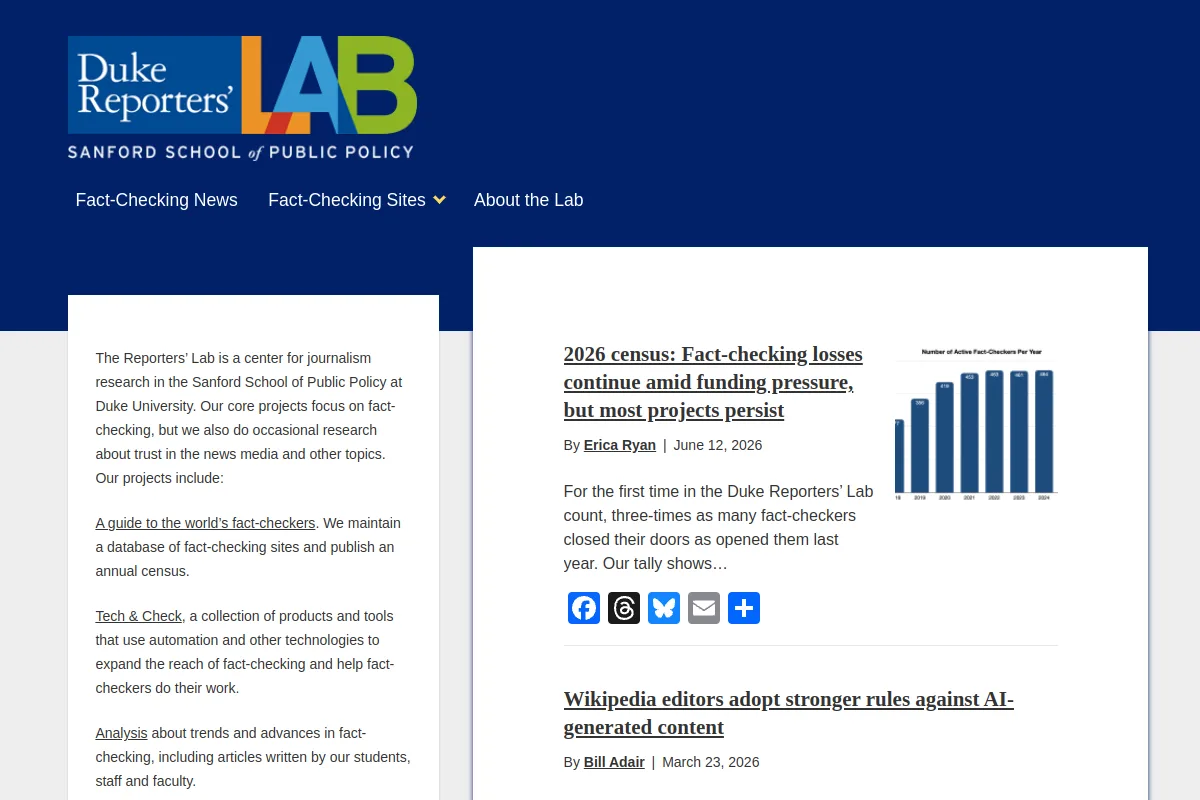
*According to Duke Reporters’ Lab, it maintains a global database and map of fact-checking projects.*
This pick doesn’t rate claims. It maintains a global database of fact checkers with map and list views, as the UC Berkeley Library guide describes, so you can find a credible outlet for a country our list skips.
Key features, per Duke Reporters’ Lab:
- The annual fact-checking census
- A Tech Check collection
- The Vault tool for saving social posts, introduced in late 2024
Pros: published inclusion criteria and global reach.
Cons: its FactStream app was discontinued December 31, 2024, according to Duke Reporters’ Lab. Anyone hunting for a fact check app from Duke should know it’s gone. It’s also a directory, so you’ll click through to read actual checks.
Criteria verdicts
- Certification and independence: its inclusion criteria (see the callout) are the screen other projects must pass.
- Transparent method: the database exposes who’s included and where.
- Coverage: global.
- Active in 2026: yes, with the 2026 census published by Duke Reporters’ Lab.
- Access and cost: not found.
- Workflow fit: directory, not a debunk archive.
Price context: we found no price information.
Where to find it: Duke Reporters’ Lab.
Full Fact Leads the Way on UK Claims
Best fit: UK claims and the UK information environment.
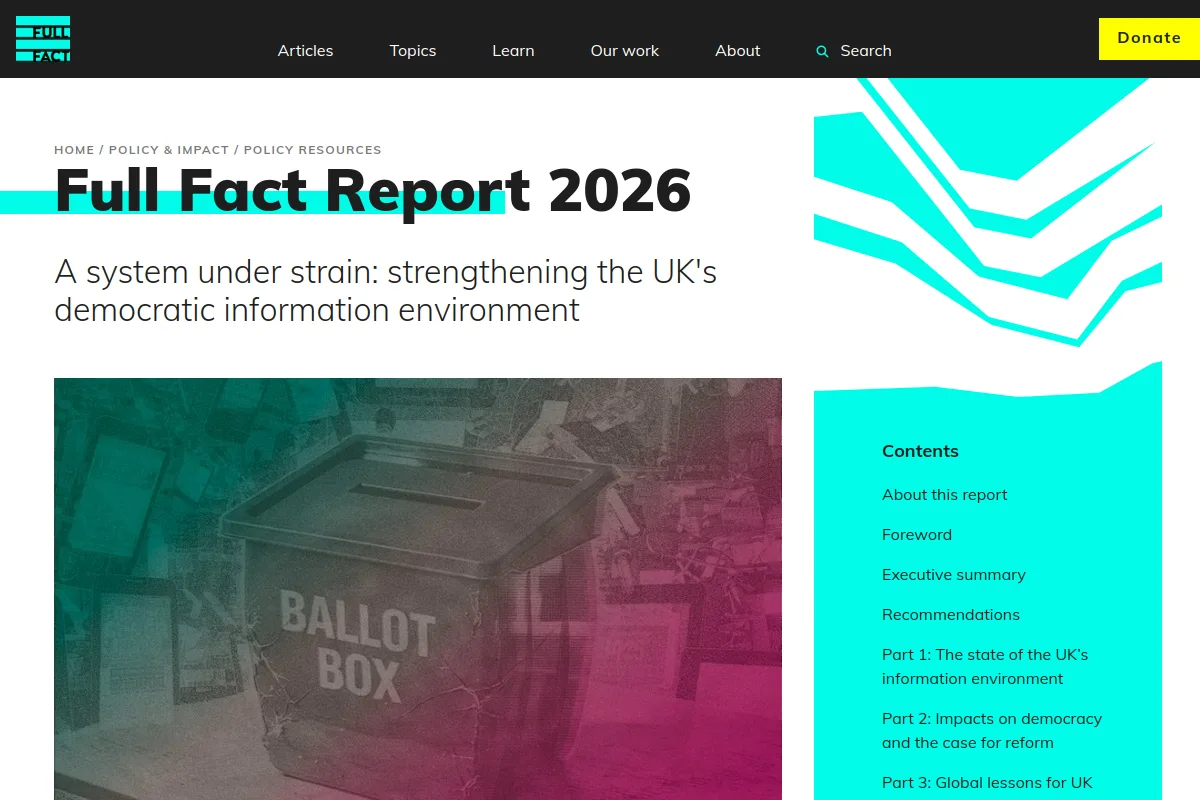
*Full Fact Report 2026 focuses on the UK information environment.*
In the Full Fact Report 2026, Full Fact describes itself as a team of independent fact checkers, technologists and researchers that asks people to correct the record and builds what it calls “world-leading AI tools.”
The 2026 edition is its seventh annual report, funded by the Nuffield Foundation, as stated in the Full Fact Report 2026.
Pros: a dedicated UK focus and fresh 2026 work.
Cons: the UK focus limits its value elsewhere.
Criteria verdicts
- Certification and independence: self-described; no outside certification retrieved.
- Transparent method: asking people to correct the record shows accountability beyond the rating itself.
- Coverage: UK politics and public life.
- Active in 2026: confirmed.
- Access and cost: not found.
- Workflow fit: lookup of UK claims.
Price context: we found no price information.
Where to find it: Full Fact Report 2026.
Notable Mentions Worth Bookmarking
- DUBAWA covers Nigeria, Ghana, Sierra Leone, Liberia and The Gambia as an IFCN signatory, per Wikipedia’s list of fact-checking websites. Visit DUBAWA.
- Roundcheck, a youth-led group based in Nigeria, has run a volunteer training network since 2022, according to Wikipedia’s list of fact-checking websites. Find it at Roundcheck.
- CBS News Confirmed fact checked claims from President Trump’s 2026 State of the Union address and one claim from Virginia Governor Abigail Spanberger’s Democratic response, giving ratings and context for those statements in its coverage after the address from CBS News via CBS News Confirmed.
- EFCSN, the network behind the two-assessor certification in our callout, announced it would co-host GlobalFact 2026 in Vilnius, according to the European Fact-Checking Standards Network.
Frequently Asked Questions About Fact Checkers
Who Fact Checks the Fact Checkers?
Independent networks do. IFCN certification lasts for one year, and fact-checkers must be re-examined annually to retain it, according to en.wikipedia.org‘s list of fact-checking websites. You can add your own layer of fact-checking the fact-checkers through lateral reading, which the Wright State University Libraries guide explains step by step.
What Are Fact Checkers, Exactly?
Fact checkers verify claims by public figures, debunk rumors and hoaxes, and review political promises, according to UNESCO World Trends in Freedom of Expression and Media Development. In that framing, the fact-checkers meaning has three parts: FactCheck.org handles public figures, a snopes fact check tackles hoaxes, and PolitiFact tracks promises. If you searched “what is fact-checkers,” that three-part job is the answer.
What Happened to Instagram Fact Checkers?
In early 2025, Meta ended its fact-checking program in the United States, a funding loss noted in the Duke Reporters’ Lab 2026 census, republished by Poynter. The partners in that program had to hold IFCN certification, per Wikipedia’s list of fact-checking websites. Spot a suspicious post today? Run it through one of the picks above.
Is There a Free AI Fact Checker?
Yes. Vee3.ai offers a free start, so you can try an AI fact checker free before choosing a plan, per the “Start building free” offer on the Vee3.ai homepage. Sourced figures also matter for AI search visibility, which our guides on AI search cover. We didn’t list plan limits here, so check current Vee3.ai plans before committing.
Final Thoughts: Pick by the Job, Then Check the Date
Start with one question: is today’s task checking someone else’s claim or protecting your own content? Public fact checkers handle viral and political claims, not the statistics inside your article, and those figures still need tracing to a source.
Whichever pick you use, look at the publish date on every check, because even well-known fact-checkers can stop publishing without much warning.
Old pages deserve the same scrutiny, so start with the search terms already hiding in content you’ve published. A pass for blind spots in your site can also flag older figures worth re-tracing.
Vee3.ai traces every figure in your draft to its original source and logs the evidence before you hit publish. Run your next draft through it today: try the Vee3.ai Fact Checker on a free start. Want the plan details first? See Vee3.ai pricing.