
A keyword report lands in your inbox. It’s thousands of rows deep and sorted by search volume, and nobody has told you which row matters. You scroll and filter, close the file, then open it again tomorrow.
Fit with your site is the step that’s easiest to skip. It’s also where wasted pages come from: new articles that duplicate old ones, or posts chasing terms an existing URL already ranks for.

Volume isn’t a plan, and the missing input has been sitting in your own published pages all along.
Table of Contents
- Your Published Pages Are the Dataset Nobody Pulls First
- What the Top Ten Results Reveal About Your Odds
- Choosing Rivals Who Truly Share Your Searches
- Keeping Your Roadmap From Fighting Itself
- Tracking Who Gets Cited in AI Answers
- Questions to Put to Any Provider Before You Sign
- Frequently Asked Questions
- Your First Step This Week
TL;DR
Your Published Pages Are the Dataset Nobody Pulls First
Most keyword research behaves as though your site has no pages yet. The result is a list padded with terms you already rank for and topics you already cover. A good keyword analysis service asks for a site inventory before it proposes a single new term. These are the inputs we’d request:
| Inventory input | Where it comes from | What to look for |
|---|---|---|
| Full URL list | XML sitemap | Forgotten pages and pages covering the same topic |
| Queries and impressions per page | Search Console | Terms you never targeted; impressions with almost no clicks |
| Sessions and conversions per page | Analytics | Pages that draw visits but never convert |
| Current ranking positions | Rank tracking | Pages sitting just outside page one |
| Editorial internal links in | Site crawl, excluding menu and footer links | Orphan pages with no editorial links pointing in |
| Backlinks per URL | Backlink data | Pages holding links worth protecting in any later merge |
How many of your pages are getting impressions for terms you never targeted? Agency Elevation’s keyword research guide describes a law firm whose estate planning services get searched in plainer customer language, such as looking for a will and trust attorney or asking how to set up a trust.
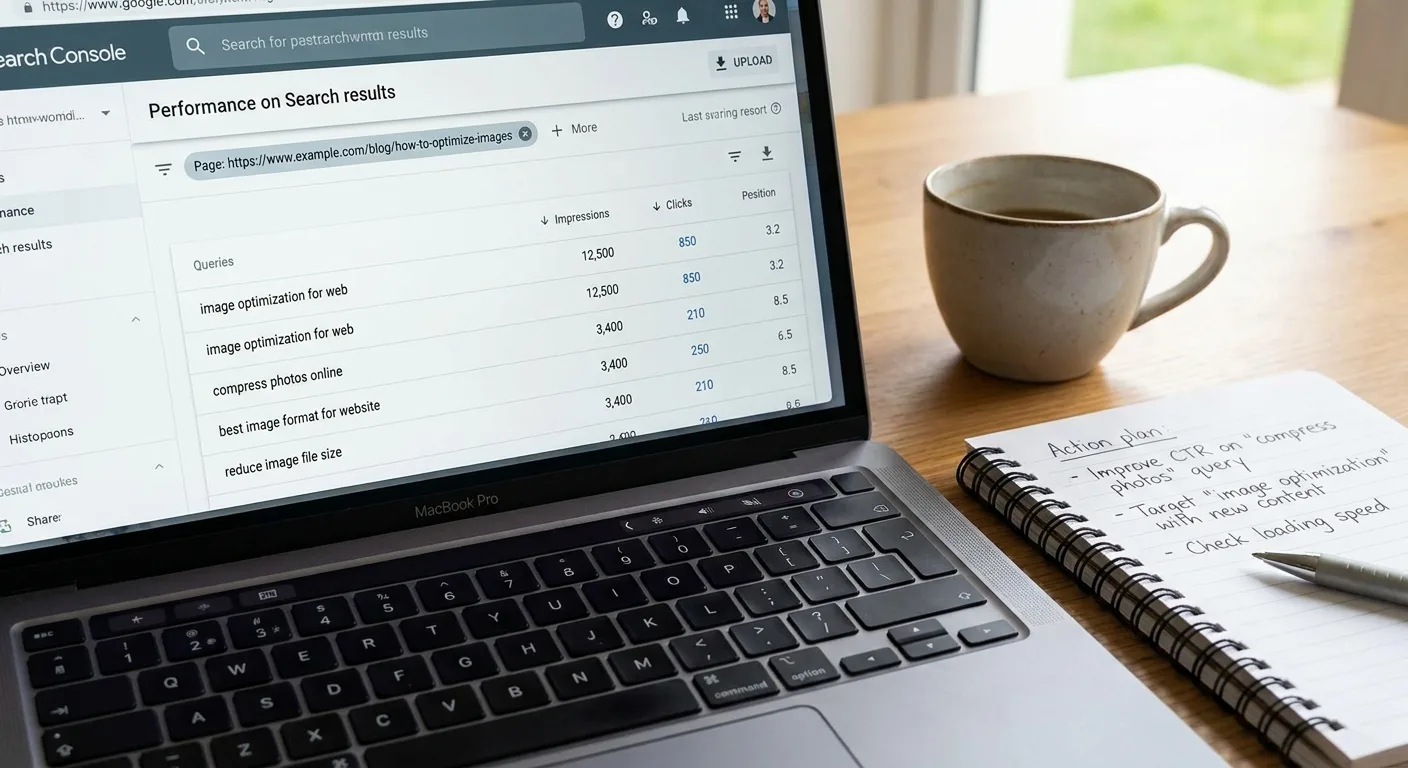
A filled-in inventory doesn’t need to be fancy. These illustrative rows show the shape:
| URL | Top query | Impressions | Clicks | Position | Internal links in | Backlinks |
|---|---|---|---|---|---|---|
| /pricing/ | Branded pricing query | High | Healthy | Page one | Several | A few |
| /blog/setup-guide/ | Question you never targeted | High | Almost none | Just off page one | One | Several |
| /resources/checklist/ | Long-tail checklist query | Low | Low | Page two | None | None |
Two patterns deserve attention first. Pages sitting just outside page one often need only a refresh and some internal links. Queries with impressions but almost no clicks usually signal a title or snippet that misses what the searcher wanted.
Orphan pages are a separate fix. Menu and footer links inflate internal link counts and hide them. To find them, run a full site crawl that counts editorial links only, then flag every page with none pointing in.
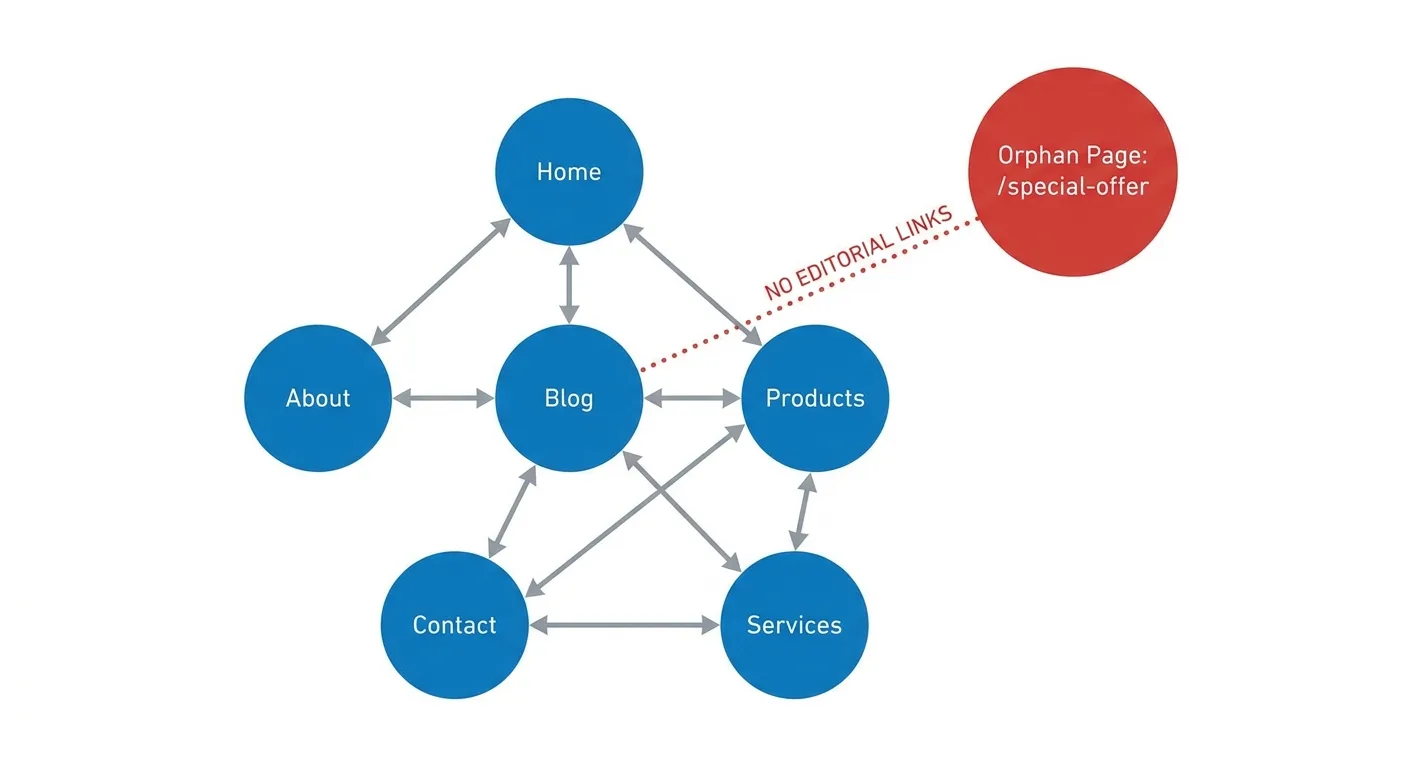
Search Console carries a blind spot of its own: it only reports queries that triggered impressions. A missing term hasn’t been proven to have zero demand; your page simply never surfaced for it.
What the Top Ten Results Reveal About Your Odds
Once you know what you own, the next question is which outside opportunities are winnable. Three metrics usually frame the first pass:
- Search volume estimates monthly searches.
- Keyword difficulty (KD) estimates ranking effort.
- Traffic potential estimates the total clicks a ranking page could earn across related queries.
Each one misleads when read alone. Volume figures are third-party estimates, and KD scoring differs by tool. Stellar Content’s keyword research tools review, published in January 2024, cites a comparison of search volume ranges across four tools: each reported a different number, yet all ranked “mountain bikes” as the most popular term and “gravel bikes” as the least. Relative order held while absolute numbers disagreed, which is why comparisons belong inside one tool. So check volume and difficulty together in one place before opening the live results page.
That results page is where the real decision gets made. Search intent shows up in what ranks: guides, product pages, tools or forums. A page-type mismatch rules a keyword out quickly: a results page packed with product listings won’t reward a long explainer, however good it is.
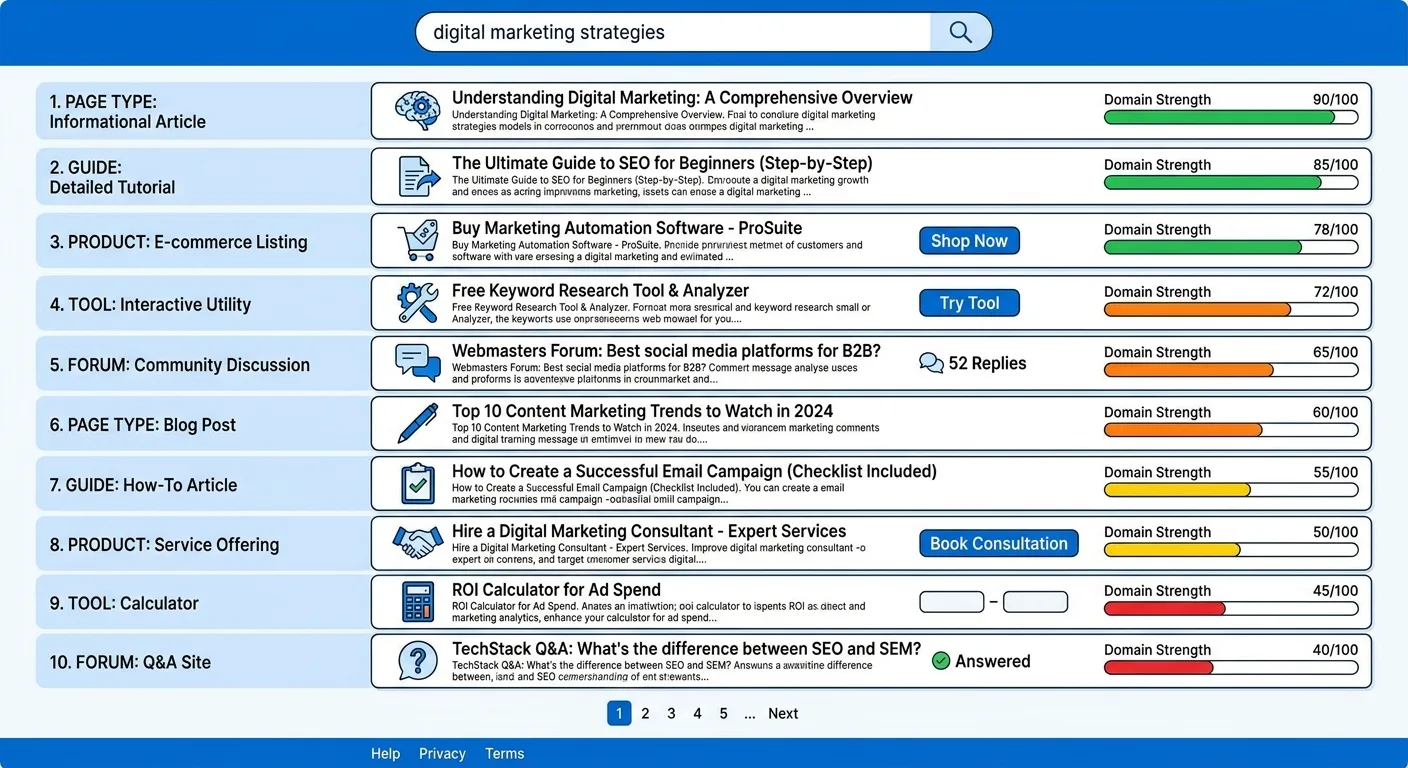
Does the top ten even contain the kind of page you’d build? If it doesn’t, a low KD score won’t make the term winnable.
Spotting the Weakest Domain Already Ranking
Compare authority scores side by side for all ten ranking domains and look for the outlier.
- Record the authority score of every domain in the top ten, using the same tool for all ten.
- Flag the lowest score and open that ranking page.
- Check why it holds the spot: topical relevance, freshness, a narrow niche or strong internal links. Only relevance signals an opening you can repeat.
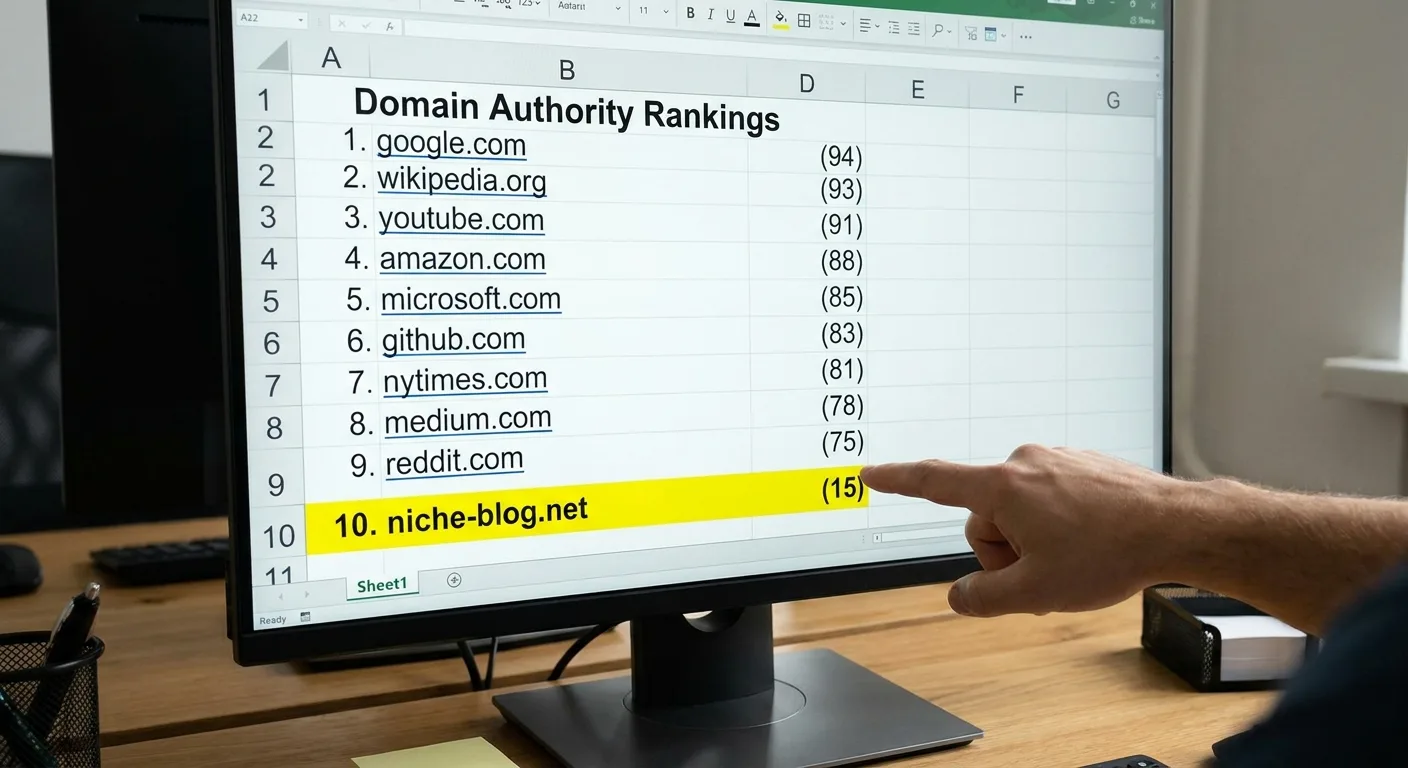
When relevance is what’s carrying that page, authority isn’t gating the result, and a well-built page from a smaller site can earn the same position.
Choosing Rivals Who Truly Share Your Searches
Knowing who ranks for one keyword raises a broader question: who competes with you across all of them? A keyword gap analysis service finds terms competitors rank for that you don’t.
The overlooked flaw sits upstream of the report. Default competitor lists are often built from whoever ranks, giants included, so marketplaces, directories and huge publishers end up defining your “gaps.”
A keyword analysis service worth paying for builds the competitor set deliberately. Skip the default list: score rivals by keyword overlap and set platforms and directories aside before running any gap report. Keep the set lean. A handful of true rivals yields a gap list your team can finish, while a sprawling set yields one nobody gets through.
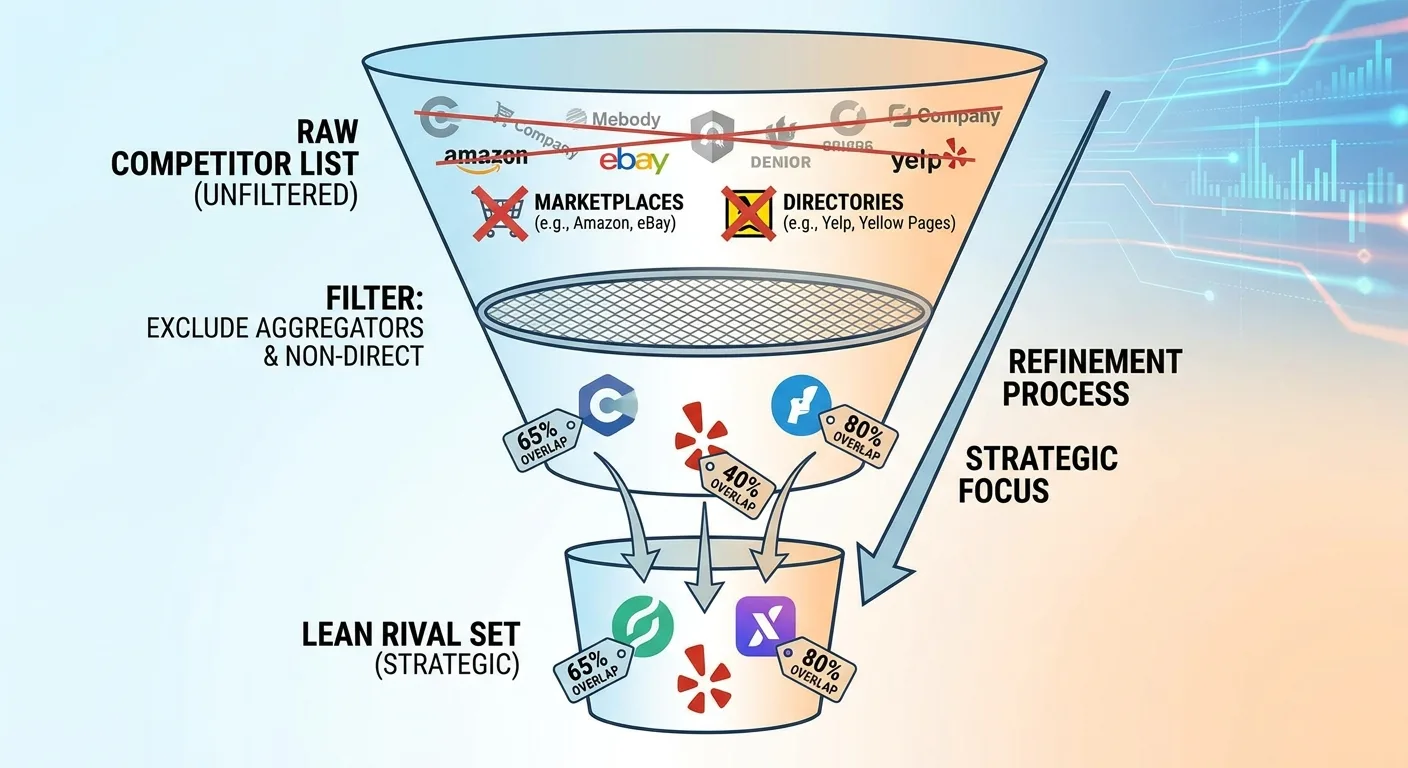
Would a customer ever choose between you and that marketplace? Probably not. Still, a marketplace can matter for specific commercial terms where it owns the results page, so exclude it from the competitor set, not from your awareness.
Historical data adds one more layer. Authority and traffic trends over several years show whether a rival is rising or fading, and that tells you whose gaps deserve urgent attention and whose can wait.
Keeping Your Roadmap From Fighting Itself
A clean gap list creates a new risk: add many targets at once and your own pages start competing with each other.
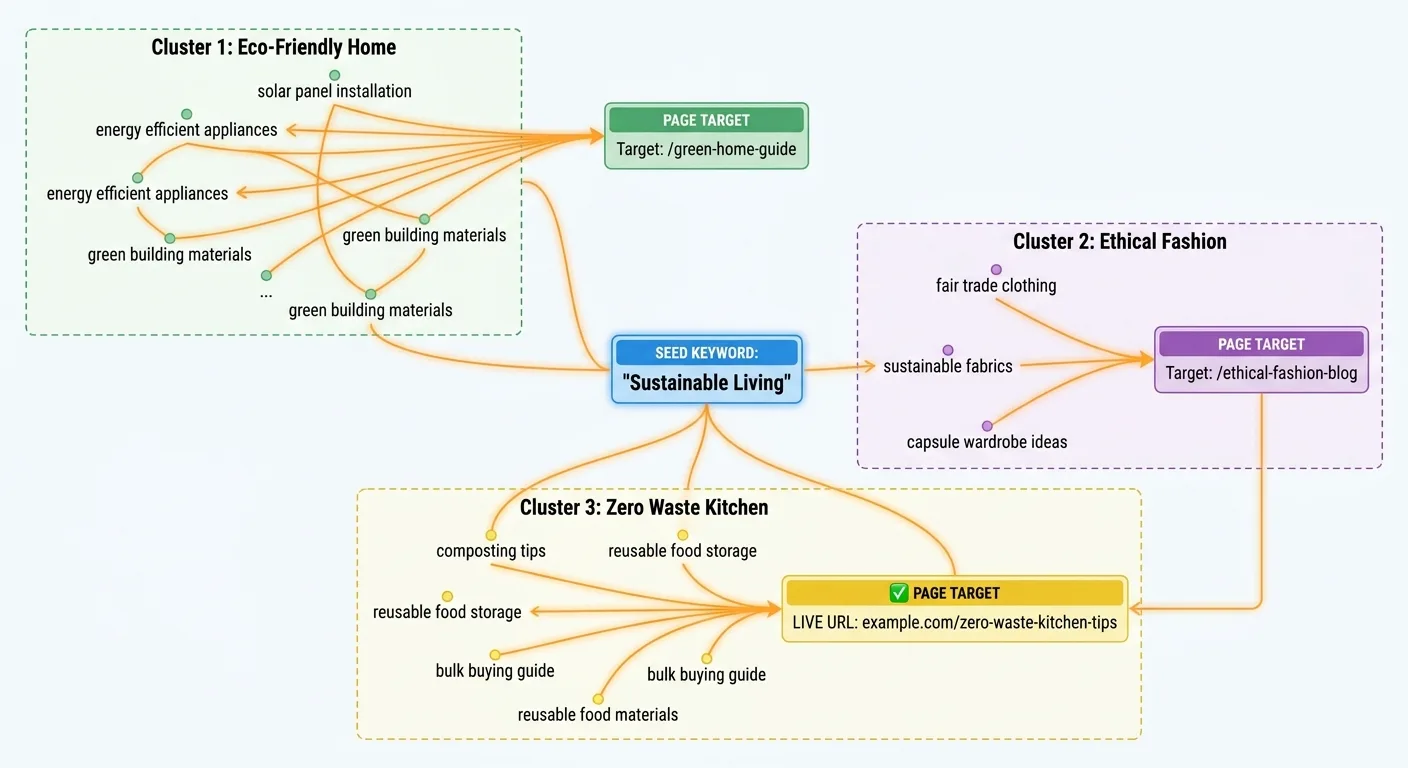
Keyword clustering prevents most of that. It means grouping queries a single page can satisfy, based on shared meaning and overlapping results. Sorting by hand gets slow, so group queries by shared results and let each cluster map cleanly to one URL. SimplyBook.me’s keyword mapping guide shows a California digital marketing agency grouping three phrasings of its service (a statewide company search, an online agency search and a best-agency search for Los Angeles) under one target: the homepage. Three phrasings, one intent, one URL.
Cluster tightness shapes the roadmap:
- Tight clusters produce many narrow pages.
- Broad clusters yield a few wide ones.
- The results page decides which fits, based on how it groups intent.
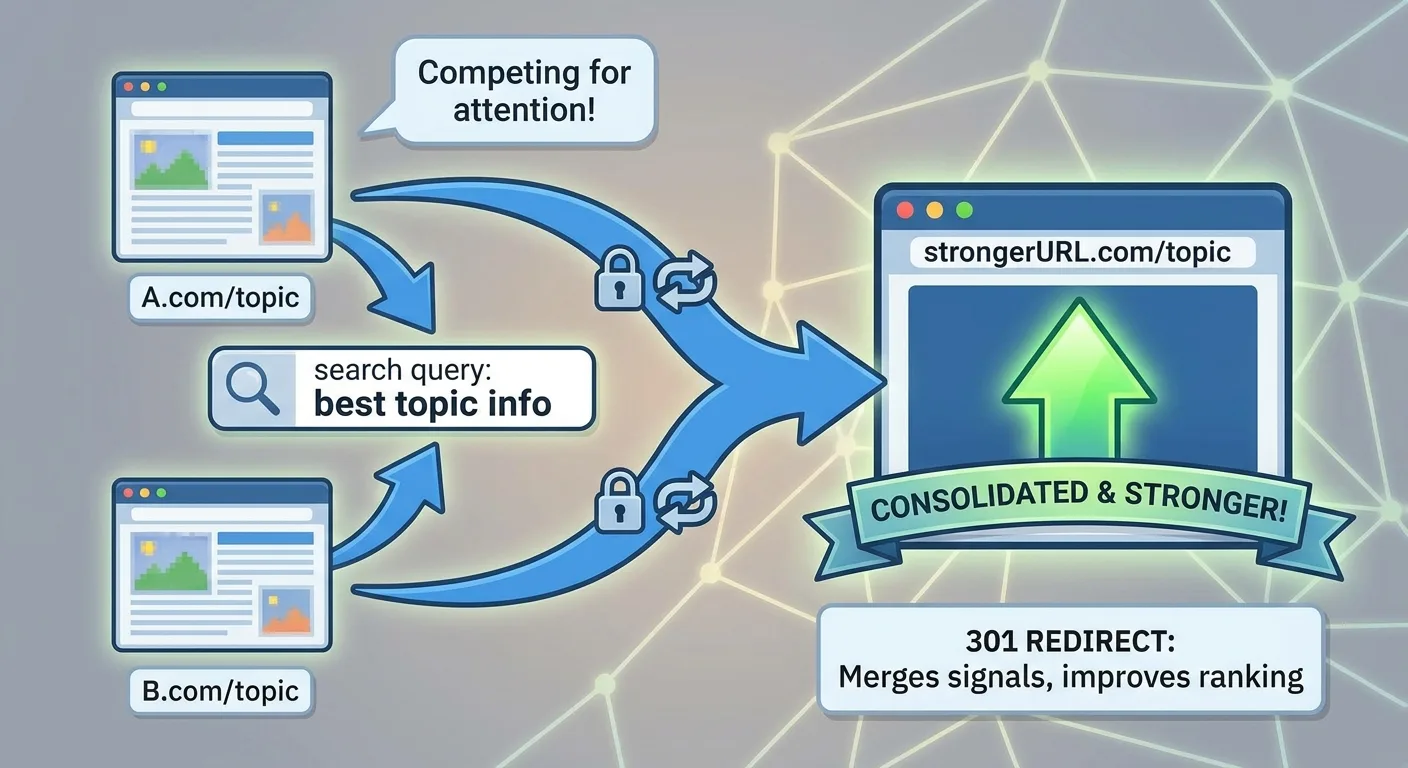
Keyword cannibalization happens when two of your URLs rank for the same query and split signals. Approve nothing new until you check for keyword cannibalization against your page inventory. Then pick a remedy:
- Merge the overlapping pages into one stronger page, keeping whichever URL holds the backlinks.
- Redirect the weaker URL to the page you keep.
- Re-target one page toward a distinct query set.
- Differentiate the pages so each serves a separate intent.
Drop terms that show no demand in both your volume tool and Search Console impressions, unless they carry clear buying intent. Then rank what’s left with a score you weight yourself across demand, difficulty, business value and existing strength. That weighted list becomes your content roadmap.
Tracking Who Gets Cited in AI Answers
A tidy roadmap still has to reach people who never click a classic result, and the keyword still names the question. What changes is the output: cited answers can appear alongside ranked links, and AI visibility depends on whether those answers credit you.
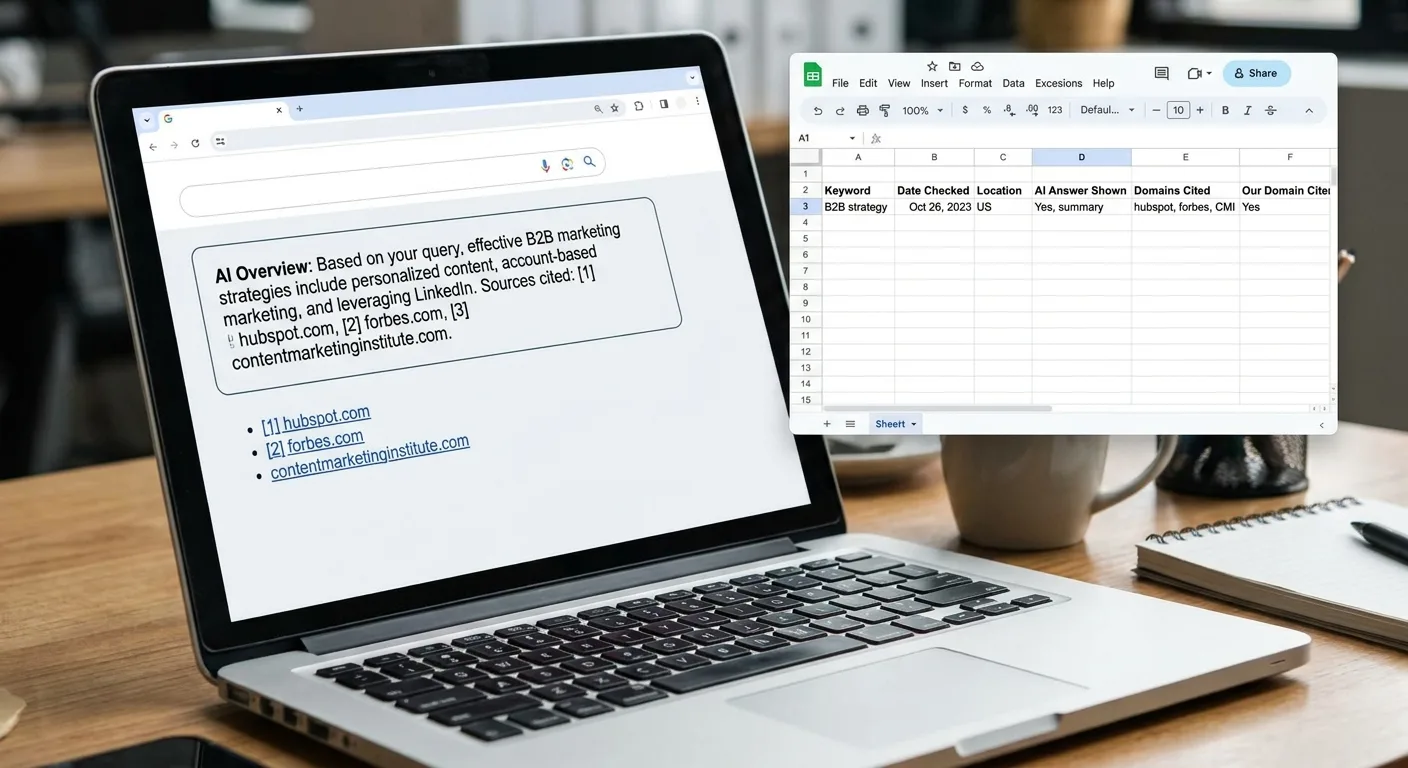
Track AI answer citations for each priority keyword by noting whether an answer appears and which domains it credits. This log works well:
AI Citation Check Log
Keyword:
Date checked:
Location and exact phrasing used:
AI answer shown? (yes / no):
Domains cited:
Our domain cited? (yes / no):
Competitor cited instead:
Page element to add (direct answer / key facts / FAQ / structured data):
Answer engine optimization (AEO) at the keyword level mostly comes down to making pages easy to cite. These elements help:
- A direct answer near the top
- A short key-facts block
- An FAQ section
- Structured data such as JSON-LD
None of this guarantees a citation, because AI answers vary by session, phrasing and location. That variability is exactly why the log captures those details. Treat each check as a sample, never a fixed ranking.
Which of your top keywords now trigger an AI answer that cites a competitor? That list tells you where to add structure first.
Questions to Put to Any Provider Before You Sign
Bring these six questions to any keyword analysis service you’re weighing:
| Question to ask | What a strong answer includes |
|---|---|
| 1. Do you audit our existing pages first? | A page inventory covering queries, traffic, rankings and backlinks before any new list |
| 2. How do you define competitors? | Rivals scored by shared keyword footprint, with marketplaces and directories excluded |
| 3. Do you read the top ten for each priority term? | A results-page review noting page types, intent and the weakest ranking domain |
| 4. How do you prevent cannibalization? | Every proposed page checked against live URLs, with merge, redirect, re-target or differentiate options |
| 5. Do you track AI answer citations? | Sampled checks logged by date, location and phrasing, showing which domains get cited |
| 6. Can we adjust how priorities are weighted? | A visible scoring model where you set the weight of demand, difficulty, business value and existing strength |
Vague answers to questions 1 and 4 are the biggest warning signs, because those steps keep a provider from proposing pages you already have.

Running this method by hand means exporting Search Console, analytics, rankings and backlinks into separate sheets and re-keying them for every step. Vee3.ai covers crawl, research, planning, writing, fact-checking, publishing and measurement in one workspace. To begin with the pages you already have, map your site in Vee3.ai.
Frequently Asked Questions
Is keyword research the same thing as gap analysis?
No: keyword research and gap analysis start from different inputs. Gap analysis is rival-led: it compares your rankings against chosen competitors to surface terms they hold and you don’t. Gap analysis depends on that competitor set, so it works best after research has defined your topic scope.
How often should keyword analysis be refreshed?
Refresh keyword analysis when a trigger appears, and review priority terms quarterly as a backup. Ranking drops are the clearest trigger, so monitor ranking drops on priority terms between scheduled reviews. New competitors in the top ten, a site migration, a product launch or new AI answers for priority terms also warrant a fresh look.
Should a keyword with zero reported volume ever get a page?
A zero-reported-volume keyword usually doesn’t justify its own page, though exceptions exist. Volume tools estimate, and they can miss new or niche queries. Check Search Console impressions before deciding, since real searchers may already be finding you. Some low-volume terms carry strong buying intent, and those often fit best folded into an existing cluster page.
Your First Step This Week
Pick one afternoon this week and export page-level query and performance data. Then look for two things: pages sitting just outside page one, and orphans with no editorial links pointing in. That’s the whole assignment.
Starting inside your own site gives the job edges: pages that exist, data you already own and fixes you can finish.
With that inventory in hand, you’ll also know what to expect from any keyword analysis service you hire. It should build on what you’ve published and explain its competitor choices. Above all, it should hand you decisions tied to URLs.
Begin at home, with the pages already in your hands.