
Many idea lists offer dozens of titles with no keyword analysis behind each idea and zero guidance on which ones will go stale next year. A generic list of accounting topics looks generous on day one. A year later, a rule changes and some of your posts are wrong, with your firm’s name on them.
We think about it this way: every accounting post carries a maintenance cost. Tax posts carry the heaviest; conceptual explainers carry the lightest. This list rates that cost for each idea and groups the twelve entries by reader.

*An accountant editing a blog post*
TL;DR
- Owner-facing posts win with practical steps a busy person can follow this month.
- Student and presentation topics land hardest when they commit to one clear example or one model and explore it in depth.
- Tax posts age well when the body explains the logic and a dated note links out to the official source for current figures.
The Two Filters Behind This List
Filter one is reader intent. Owners want fewer mistakes and less time spent on the books. Students want clarity and a better grade. Discussion groups want a real tension worth arguing about. Decide who reads the post first; one practical way to map topics to reader groups is to sort every idea by owner, student or discussion audience before rating its upkeep.
Filter two is refresh burden. Conceptual topics sit low. Software topics and fast-moving debates sit in the middle. Anything tied to tax years or rule changes sits high.
A high-upkeep topic still earns its place, provided the refresh is planned. The danger is publishing it and forgetting it. That’s why upkeep belongs in the selection step, not the cleanup step.
Which of these filters do your current drafts fail?
Here’s how we judged the accounting blog topics on this list:
| Topic | Main Reader | Upkeep Level |
|---|---|---|
| 1. Lean month-end close | Owners | Low |
| 2. Cash vs. accrual choice | Owners | Low |
| 3. Software migration pitfalls | Owners | Medium |
| 4. Busy-season tax questions | Owners | High |
| 5. Receipts and mileage records | Owners | Low to medium |
| 6. Revenue recognition walkthrough | Students | Low |
| 7. Ratio analysis on a known company | Student presenters | Low |
| 8. Cash flow statement deck | Student presenters | Low |
| 9. Management accounting models | Student presenters | Low |
| 10. Credential career paths | Students | Medium |
| 11. AI and audit judgment | Discussion groups | Medium |
| 12. Earnings management vs. fraud | Discussion groups | Low |
For Owners Who Just Want Clean Books and Fewer Surprises
Owners are task-driven and a little anxious about getting something wrong, and these five topics answer the questions owners search for before they ever book a call.
1. The Month-End Close, Shrunk to What an Owner Will Actually Do
An owner doing their own books, or splitting the work with a bookkeeper, needs a close with three jobs:
- Reconcile each bank and card account against its statement.
- Clear the uncategorized queue (the uncategorized queue is where good intentions go to die).
- Scan open invoices and unpaid bills so nothing overdue slips another month.
Those steps barely change from year to year, which makes month-end content one of the bookkeeping topics owners come back to again and again. Give readers a short list they can print or copy into their task app. Resist padding it into a sprawling controller checklist; no owner follows step 37.

*Reconciling a bank statement at month-end*
Add one caveat: businesses with inventory or payroll need extra steps. Tell those readers to flag them with their accountant. Pretending one list fits every business is how trust erodes.
Upkeep: low.
2. Cash or Accrual: The Decision Most Owners Make by Accident
Some owners never knowingly chose an accounting method. Their software picked a default, or a past bookkeeper did, and that choice now shapes every profit figure they see.
A strong post explains both methods through decisions, not definitions. Use one simple timeline. Picture a designer who finishes a big project in March, invoices on the 28th and gets paid in mid-April. On an accrual basis, March looks like a great month. On a cash basis, March shows nothing and April carries the whole job. Same business, same work, two very different pictures of profit.
End the post with three questions readers can bring to their accountant:
- Which method am I on now, and did anyone choose it on purpose?
- Would switching change what I owe, or when I owe it?
- What would my reports look like on the other basis?
Eligibility rules and tax treatment vary by jurisdiction and business size, so keep the explanation conceptual and point readers to official guidance or their accountant for specifics. Upkeep: low, and it stays low as long as you resist adding thresholds and rules.
3. What Quietly Breaks When a Business Switches Accounting Software
Feature comparisons need edits every time a vendor ships an update. Migration pitfalls change far less often. That’s why we’d pitch a switch-focused post over the typical accounting software blog review, which starts aging the week it goes live.
The useful material sits in what goes wrong:
- Opening balances that don’t match the old system.
- Duplicated transactions after bank feeds reconnect and pull history twice.
- A chart of accounts that doesn’t map cleanly, leaving orphaned categories behind.
Skip naming or rating products; the value is in the process.
Upkeep: medium, since software workflows and terminology still shift.
The Migration Checklist Readers Bookmark
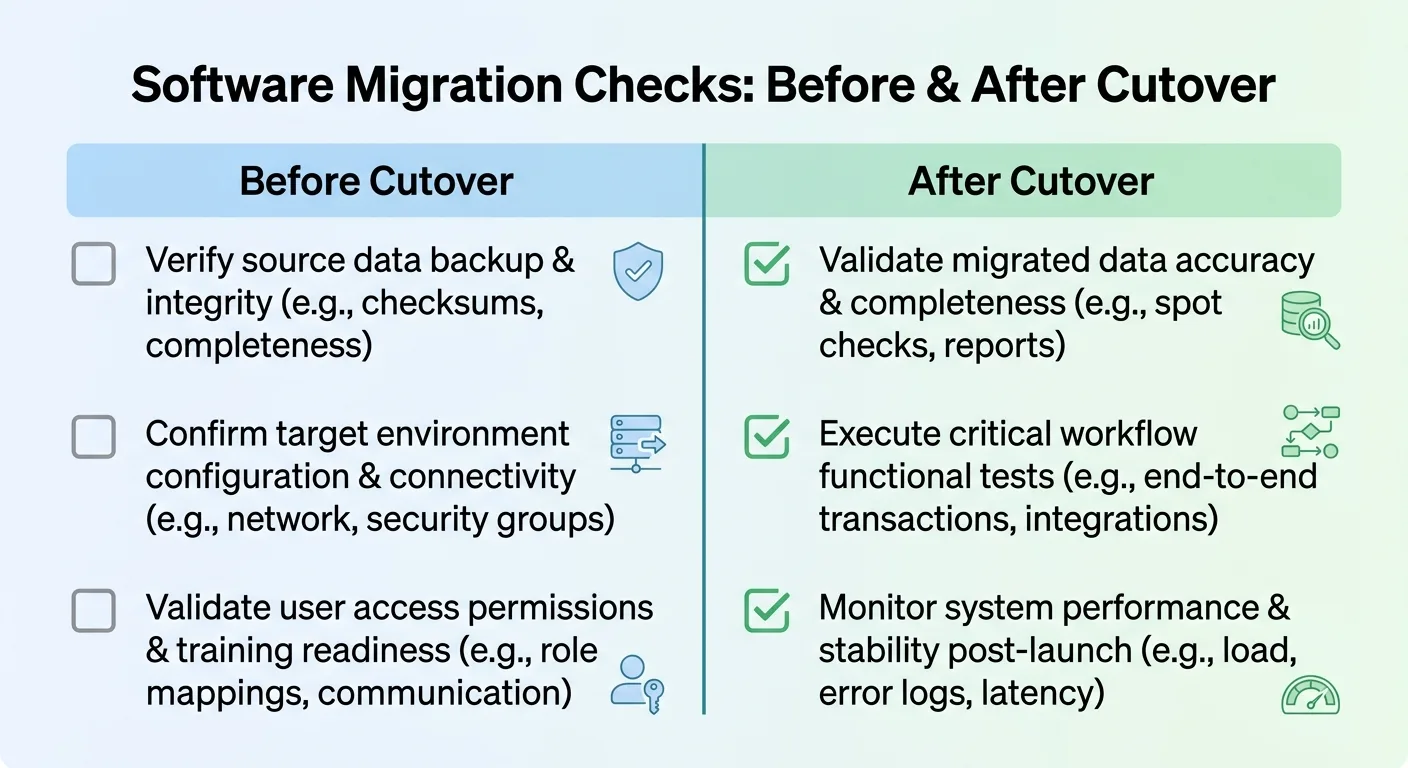
*Before and after cutover: the migration checklist*
Before cutover: lock the closing period, export key reports, and record every opening balance.
After cutover: tie out balances against those exports, review the feed for duplicates, and rebuild recurring transactions.
4. Tax Questions Clients Ask in March, Answered Before Next Busy Season
Tax content often gets written during busy season, which is precisely when nobody has time to write. We’d flip the timing. Capture client questions in March, draft a brief for each during the quieter months, then publish before demand peaks so the posts are indexed and waiting.
The best tax blog topics come straight from your inbox. Home office deductions, estimated payments and whether a side gig changes someone’s filing all show up every year. Take “Can I deduct my home office?” and explain the reasoning: what the space is used for, how regularly, and why the answer depends on the details. Leave the figures out of the body.
Tax rules vary by jurisdiction and year, so every post should tell readers to confirm their situation with a professional.
Upkeep: high.
Writing Tax Posts Without Hard-Coding Numbers That Expire
Explain the logic of a rule in plain language throughout the body. Keep year-specific figures in one clearly dated “current figures” box that links to the official source, and put an “as of” label on every figure in that box. A refresh then means editing one box, not rereading the whole post.
5. Receipts, Mileage and the Records That Hold Up When a Notice Arrives
Records often get attention only once a letter shows up. A good post leads with relief, not fear: here’s what to keep, here’s how to capture it, and here’s how to find it fast if a tax authority asks questions.
Capture habits do most of the work. Photograph receipts at the moment of purchase. Log trips the same day, while the destination and purpose are still fresh.

*Capturing a fuel receipt at the point of purchase*
Then give readers a structure to copy, such as a folder or tag for each year, a subfolder for each expense category, and a file name that starts with the date. Simple beats clever here, because the owner has to keep doing it in a slow week.
Skip retention periods and penalty figures unless you source them from official guidance at the time of writing. Those details change, and a wrong one does real damage.
Upkeep: low to medium.
For Students Cramming, Presenting or Picking a Path
The best accounting blogs for students offer clarity, assignment-ready structure and honest career guidance. These five topics serve student bloggers hunting for student-friendly topic ideas as well as the firms or educators who write for them. Upkeep stays low for the concept entries; the career entry runs medium.
6. Revenue Recognition Explained Through One Messy Transaction
One worked transaction, followed from start to finish, shows every judgment call in the order it happens.
Our pick is a software subscription bundled with onboarding services. The customer pays one price, but the seller has made two promises with different timing.

*Splitting a bundled software contract on a whiteboard*
From there, it can help to walk through the decisions roughly in sequence: identify the contract, separate the obligations, set the price, split it between the promises, and recognize each part as it’s delivered. Readers see why the onboarding revenue and the subscription revenue land in different periods.
Close with a “try it yourself” variation of the same deal, perhaps with a longer term or an added support tier.
Standards differ between frameworks, so name the one the post follows, check terminology against the version your readers study, and avoid quoting paragraph numbers you haven’t verified. Upkeep: low, unless the standard is amended.
7. Ratio Analysis on a Company the Class Has Heard Of
Among accounting topics for presentation slots, this one pairs real data with analysis anyone in the room can follow. Calculate liquidity, profitability and leverage ratios from one public company’s published annual report.
Audiences stay with a company they recognize. A retailer or consumer brand with public filings works well.
Keep it to three ratios:
- Current ratio for liquidity
- Net margin for profitability
- Debt-to-equity for leverage
Compare two consecutive years and explain what changed. Reporting a number is easy. Explaining why it moved is what earns the grade.
Cite the exact filing and fiscal year on your slides. Ratios pulled from different years or data providers won’t match, and someone in the audience will notice.
Upkeep: low, because the analysis is pinned to one cited fiscal year.
8. The Cash Flow Statement as a Ten-Slide Walkthrough
Students searching for accounting topics for presentation ppt decks want something that converts straight into slides, and a slide-by-slide skeleton does exactly that:
- Title
- Why cash differs from profit
- The statement at a glance
- Operating activities
- Investing activities
- Financing activities
- Reconciling net income to cash
- Red flags worth spotting
- Summary
- Questions
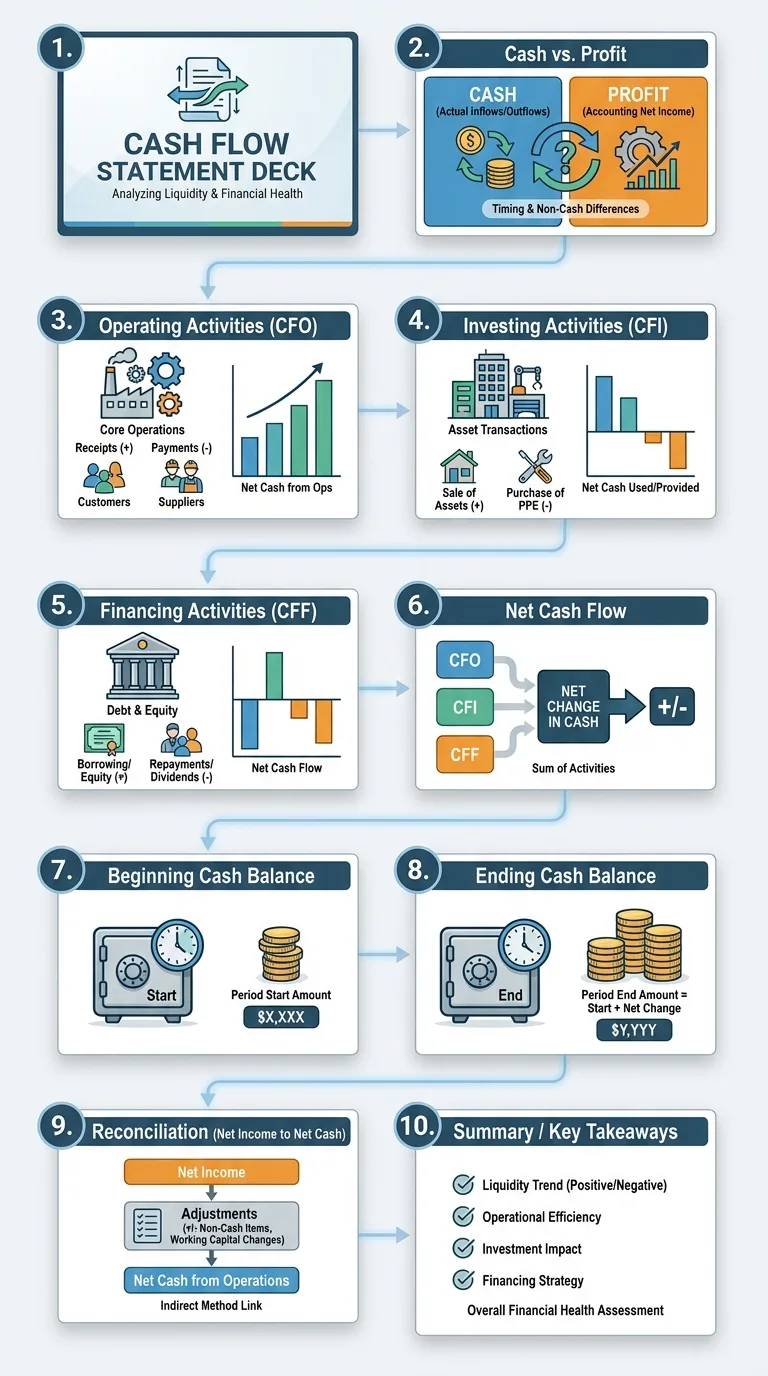
*A ten-slide cash flow statement deck*
Put one idea on each slide. Highlight the handful of line items that matter and leave the full statement in an appendix.
The indirect and direct methods look different on the page, so pick one and say which you’re using. Slide 7 assumes the indirect method, since that’s where the net income reconciliation lives.
Upkeep: low.
9. Break-Even, Variances and ABC: Management Accounting That Presents Well
Three management accounting topics for presentation work stand out: cost-volume-profit and break-even analysis, budget variance analysis, and activity-based costing.
Build the whole talk around one hypothetical decision, such as whether a small bakery should add a product line, and let the model do the explaining. The audience follows a decision far more easily than a formula.
Picking One Model Over Three
Surveying all three models in one talk spreads you thin, so match one to your time and audience:
| Model | Decision Question It Answers | Best Fit | Trade-off |
|---|---|---|---|
| Break-even (CVP) | How many units before we profit? | Short slots, mixed audiences | Quickest to explain, least depth |
| Budget variance analysis | Why did we miss budget? | Sessions where budget and actual data exist | Needs a believable dataset |
| Activity-based costing | Which product really costs us most? | Longer sessions, finance-literate audiences | Impresses most, takes the most setup time |
How many minutes do you really have?
Upkeep: low.
10. CPA, CMA or Neither: Career Posts That Skip the Hype
Credential content often leans on salary claims that are hard to verify. Compare CPA (Certified Public Accountant) and CMA (Certified Management Accountant) paths by the kind of work each leads to: according to Research.com, CPAs tend to move toward audit, tax and reporting, while CMAs tend to move toward planning, analysis and decision support. A useful post also gives honest space to careers that don’t need a credential at all.

*Comparing credential paths*
Students feel pressure to choose early. Tell them plainly that switching later is possible.
Exam structures, eligibility rules and requirements change and vary by jurisdiction. Link to each credentialing body’s current pages and let them carry those details. Leave out pay figures and pass rates you can’t source.
Upkeep: medium; linking to each credentialing body instead of restating requirements keeps refreshes small.
For Rooms That Need a Good Argument
These two accounting discussion topics suit seminars, study groups and LinkedIn-style thought pieces because reasonable professionals disagree about them. Their value comes from giving both sides a fair hearing.
11. Can AI Exercise Professional Judgment in an Audit?
The question is live inside the profession itself.
One side argues that automation lets auditors analyze entire transaction populations rather than selecting samples and extrapolating results, according to Fieldguide.
The other side asks who signs off and who is accountable. It raises the risk of explaining away anomalies the software flags, and the risk of overtrusting outputs nobody fully understands.

*Reviewing AI-flagged transaction anomalies*
The richer framing is where judgment lives, not humans versus machines. Close with three open questions for the group:
- Which audit decisions should never leave a person’s hands?
- How should an auditor document reliance on a tool’s output?
- What does professional skepticism look like toward software?
Describe positions generally and avoid claims about specific regulators, firms or adoption rates. Upkeep: medium, because the AI-in-audit debate moves quickly, so flag it for review as new guidance appears.
12. Earnings Management Versus Fraud: Where Students Draw the Line
Students often walk into an ethics session expecting a clear rule. This topic denies them one, and that discomfort is the point. Acknowledge it early so the room stays open.
Use a hypothetical: a manager delays a discretionary maintenance expense into next quarter to hit a target. Nothing is hidden or invented. Is it still acceptable?
Hand the group four framework questions:
- Is the choice disclosed?
- Is it consistent with past practice?
- Who benefits from it?
- Would it survive scrutiny from an outsider?
Adjusting estimates near period end makes a good second scenario once the group finds its footing. Stick to hypotheticals and make no allegations about real organizations. The goal is building judgment, and a named scandal pulls the discussion toward recall.
Upkeep: low.
Keeping Accounting Content Accurate Without Rechecking Every Figure by Hand
Once a firm publishes several high-upkeep posts, maintenance becomes real work. Every figure in a tax or software post needs tracing back to its source. Planning a growing library of accounting blog topics also creates overlap: three home office posts can end up competing for the same searches.

*Sorting a growing library of accounting posts*
Vee3.ai can help firms plan and fact-check accounting content they run in-house. It brings crawling, research, planning, writing, fact-checking, publishing and measurement into one workspace. Vee3.ai is an SEO platform built for AI search, so the accounting and tax judgment stays with you and your team.
Start building with Vee3.ai and map your next batch of accounting posts before you write them.
Frequently Asked Questions About Picking Accounting Topics

*Reviewing a draft for outdated figures*
How often should I update accounting blog posts?
Refresh each accounting post when a trigger fires, matched to its upkeep level. Rule changes, new tax years, major product updates and new professional guidance should prompt a review; conceptual posts can wait longer. Once a trigger prompts an update, track how refreshed posts rank so you can see whether the edit kept the page visible. The dated “current figures” box from entry 4 keeps each edit fast.
Can one blog serve both business clients and accounting students?
Yes, one blog can serve both audiences if each post targets only one of them. Lead with the audience that matches your business goal, so a firm chasing clients should prioritize owner topics. Student content can support recruiting as a secondary, clearly labeled section. Blending both in one post usually serves neither, and when client and student posts cover similar ground, check for keyword cannibalization so the two versions don’t compete for the same searches.
How do I know if a topic is too technical for my readers?
Count the defined terms a reader needs before reaching your main point. More than a couple means you should narrow the topic or move it to a more advanced audience. After that count, run an on-page check to confirm the heading and opening lines state that point plainly. Client emails and class questions also show where confusion sits.
Your Next Step: One Reader, One Durable Post
Nobody writes twelve posts in a month, and starting small is a legitimate strategy.
This week, pick one reader group for your accounting blog topics, group related topic ideas for that audience so each post has its own job, then publish the lowest-upkeep one first. Schedule a high-upkeep topic only once its refresh plan exists, with a date on the calendar and a dated figures box in the draft.
One audience, one durable post, one planned refresh. That’s enough to build a blog readers trust next year too.