
What are the market research methods that hold up when a real decision is on the line?
Your market has already told you a lot. Most of it never made it into a survey.
Plenty of teams build polished research decks that still miss what customers care about. The importance of market research rests on evidence customers produced on their own terms. A deck built only on answers to our own questions can drift from that evidence without anyone noticing. Surveys still matter (we’re not here to bury them). They earn their keep once you’ve listened first.

The method you pick shapes the answers you hear.
Key Takeaways
What Market Research Measures Depends on How You Ask
What is market research? In one sentence, it’s the structured collection and interpretation of evidence to reduce risk in a business decision.
The types of market research sort out quickly:
- Primary research is collected by you, for this decision.
- Secondary research already exists. Competitor materials are one rich source, and a structured competitor analysis for marketing turns those pages into evidence you can compare, so market research and competitive analysis share one evidence base.
- Exploratory, descriptive and causal research describe a study’s purpose: finding the problem, sizing it or proving what drives it.
The split we care about most cuts across every type above. Stated data typically comes from surveys and interviews, and it can be affected by recall gaps, social desirability bias and the risk of leading questions. Observed data comes from analytics, purchase logs and search behavior. It shows action and hides motive.
Neither one is “truer.” Each answers a different question. The spot where they disagree often holds the most useful insight, because a gap between what people say and what they do often points at something nobody has named yet.
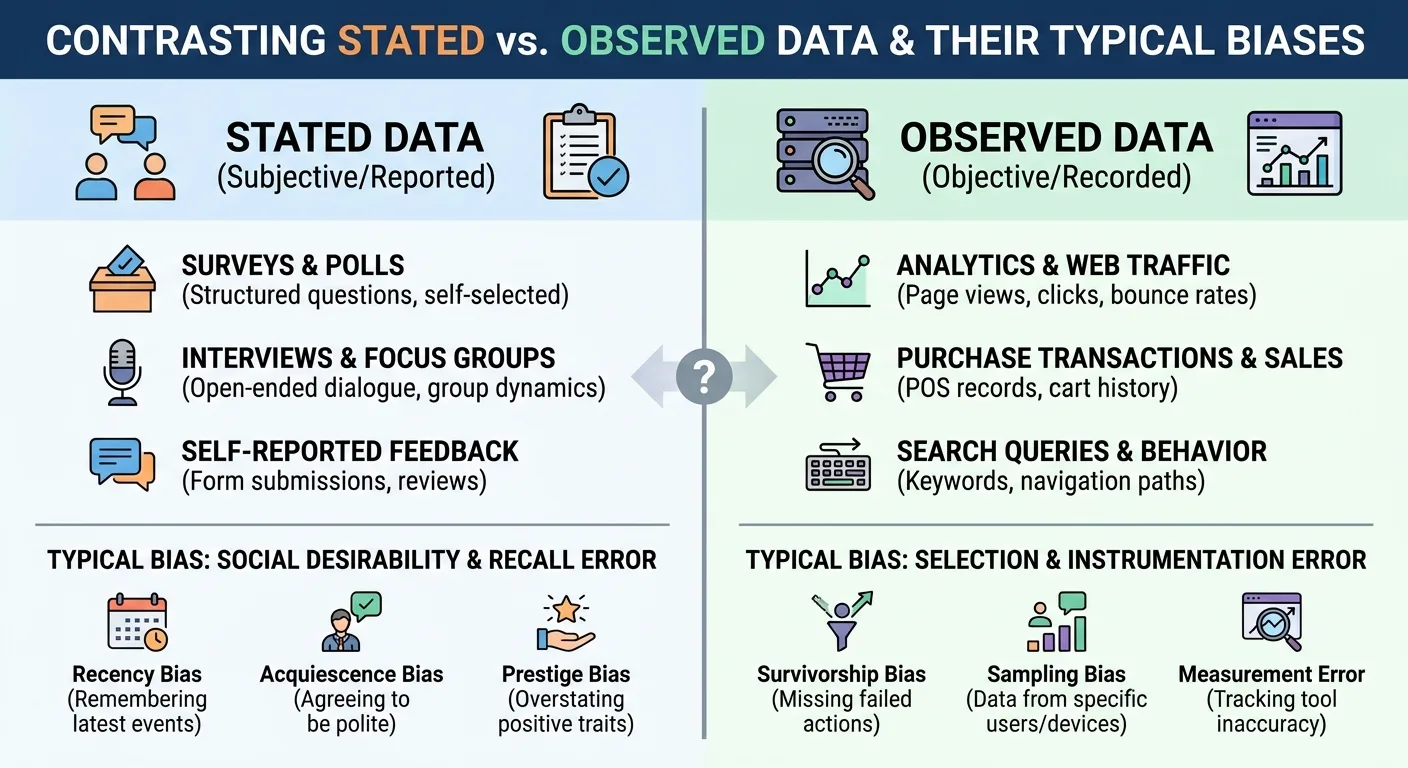
Here’s a question worth sitting with: which of your current findings rest only on what people told you?
It’s unsettling to realize a confident finding might reflect question wording and not customer reality. Noticing it is the first step toward research you can defend.
Picking From the Types of Market Research Methods by the Question on Your Desk
Start from the decision, then choose the method. A method picked first tends to produce findings that answer a question nobody on the team was asking.
People use market research methods and techniques interchangeably, yet a method is the approach and a technique is the specific execution, such as laddering in interviews or MaxDiff (best-worst scaling, where respondents pick the most and least important items from each set) in surveys.
Examples of market research methods, matched to the question each one answers
| Method | Question it answers | What you need | Watch out for |
|---|---|---|---|
| In-depth interviews | Why do people act the way they do? | A purposeful sample and an open discussion guide | Treating a few voices as the whole market |
| Focus groups | How does a group react to an idea or message? | A skilled moderator and a well-screened group | Mistaking group consensus for market consensus |
| Observation or ethnography | What do people do in their real setting? | Access to the setting and permission to watch | Your presence changing the behavior you’re watching |
| Diary studies | How does behavior unfold over days or weeks? | Committed participants and simple prompts | Participants dropping off or entries thinning out |
| Surveys | How many people hold a view or report a behavior? | A clear sampling frame and tested questions | Leading wording and unrepresentative samples |
| Conjoint or MaxDiff | Which features or trade-offs matter most? | Survey software that supports the design and a defined attribute list | Attributes that don’t match how buyers think |
| A/B or in-market experiments | Does this change shift real behavior? | Enough traffic or customers and a controlled test | Calling a winner before the test has run its course |
| Desk research | What is already known about this market? | Access to reports, datasets and competitor materials | Outdated, sponsored or untraceable figures |
| Search and AI answer analysis | How does the market describe its problems, and who gets named? | Query data, results pages and repeated AI prompts | Estimates read as counts, and single answers read as fixed |
A caveat worth stating plainly: one method rarely settles a high-stakes decision.
Qualitative Methods for the Messy Why
The “why” rows in that table are qualitative market research methods. Sample size follows saturation. You stop when new themes stop appearing, and no fixed number decides it for you.
A reliable rule: ask about the last time someone did the thing, and skip hypotheticals. One of the simplest primary market research examples is a single swap. Replace “Would you pay for a tool that tracks team workload?” with “Tell me about the last time a deadline slipped on your team. What did you try first?” The second version surfaces real workarounds, tools already in use and who felt the pain. The hypothetical never gets there.

Focus groups can drift toward the loudest participant, so use them for reactions and save depth for interviews. Record and transcribe everything, with participants’ consent.
Quantitative Methods When You Need a Defensible Number
Sizing and prioritizing call for quantitative market research methods: surveys, conjoint analysis and experiments. Validity lives in the details. A clean sampling frame, careful screening and randomized answer order protect it. Borrow item wording from your interviews or search work, and watch the gap between statistical and practical significance, since a real difference can still be too small to matter.
Experiments reveal behavior; surveys reveal stated preference.
Report ranges and margins of error, not single point estimates. The margin of sampling error is the measure of statistical uncertainty for probability-based polls; nonprobability opt-in polls instead sometimes report a model-based credibility interval (AAPOR). For opt-in panels, present ranges as indicative. Honest market research and analysis shows uncertainty openly.

Stakeholders often want one clean number. Give them the range anyway, plus one sentence on what it means for the decision.
Secondary Research Someone Already Paid For
Industry reports, government and trade datasets, competitor materials and academic work all count as secondary market research. Four questions settle whether a figure deserves your trust:
- Who funded it?
- How did they sample?
- When did they collect the data?
- What did they define as the market?

A widely quoted figure may trace back to one unverified estimate. Follow it to the original publisher, and lean on reliable fact-checking sites when the citation trail goes cold.
The freshest input often sits in plain view: the queries people type today.
Reading Search Queries and AI Answers Before You Survey
In many organizations, research and search teams sit apart, so query data may never reach the people writing surveys.
These online market research methods come down to four moves:
- Gather the queries around your category and group them by meaning. Keyword clustering tools group queries by intent, which exact-string grouping misses. Use volume only to compare clusters with each other; the table below explains why.
- Read the top-ranking pages for a cluster to see how the market currently frames the problem and the solution.
- Collect the recurring questions on results pages as seed wording for interview guides and survey items.
- Ask several AI assistants the category questions a buyer would ask. Record which brands, sources and criteria appear.
The phrasing people type is often blunt (and blunt is useful). Picture a survey answer option that reads “integration challenges.” In the same category, typed queries might read “contacts not syncing with calendar” and “how to stop duplicate leads after import.” The typed versions name specific failures an interview guide can probe and a survey item can measure. For a look at search language feeding real decisions, read a search engine marketing case study before you draft your guide.
Strong research often starts with the market’s own words, and this layer is where those words live.
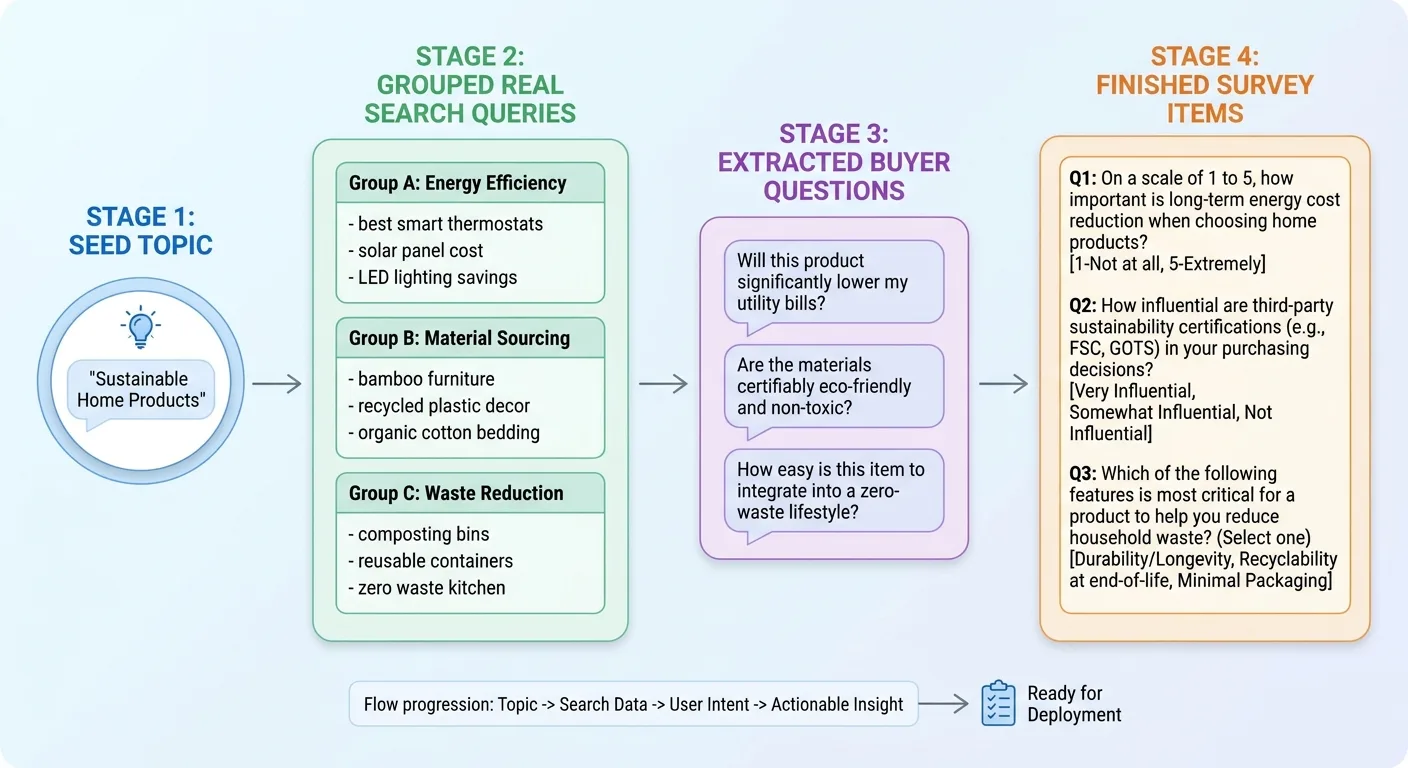
What each unprompted signal can and can’t tell you
| Signal | What it reveals | Limitation | How to use it in research |
|---|---|---|---|
| Grouped search queries | The words buyers use for a problem | Volumes are modeled estimates, not exact search counts (The SEO Handbook). Some buyers never search, and some searchers never buy. | Seed language for interview guides and survey items |
| Top-ranking pages | How the market currently frames the problem and the solution | Shows what ranks, which may differ from what buyers believe | Map the competitors and framings your study should test |
| Recurring questions on results pages | The questions the market keeps asking | Low-volume questions can still matter in niche or B2B categories, so don’t discard them on volume alone | Turn them into open interview prompts |
| AI assistant answers | Which brands, sources and criteria get named | Answers can shift with conversation history, retrieved documents, routing and model updates (techbloat.com). | Repeat each prompt, log the date and treat any one answer as a sample |
One privacy line belongs here: use aggregated data only, and avoid anything that identifies individuals.
When did you last check whether an AI assistant mentions you when a buyer asks about your category?
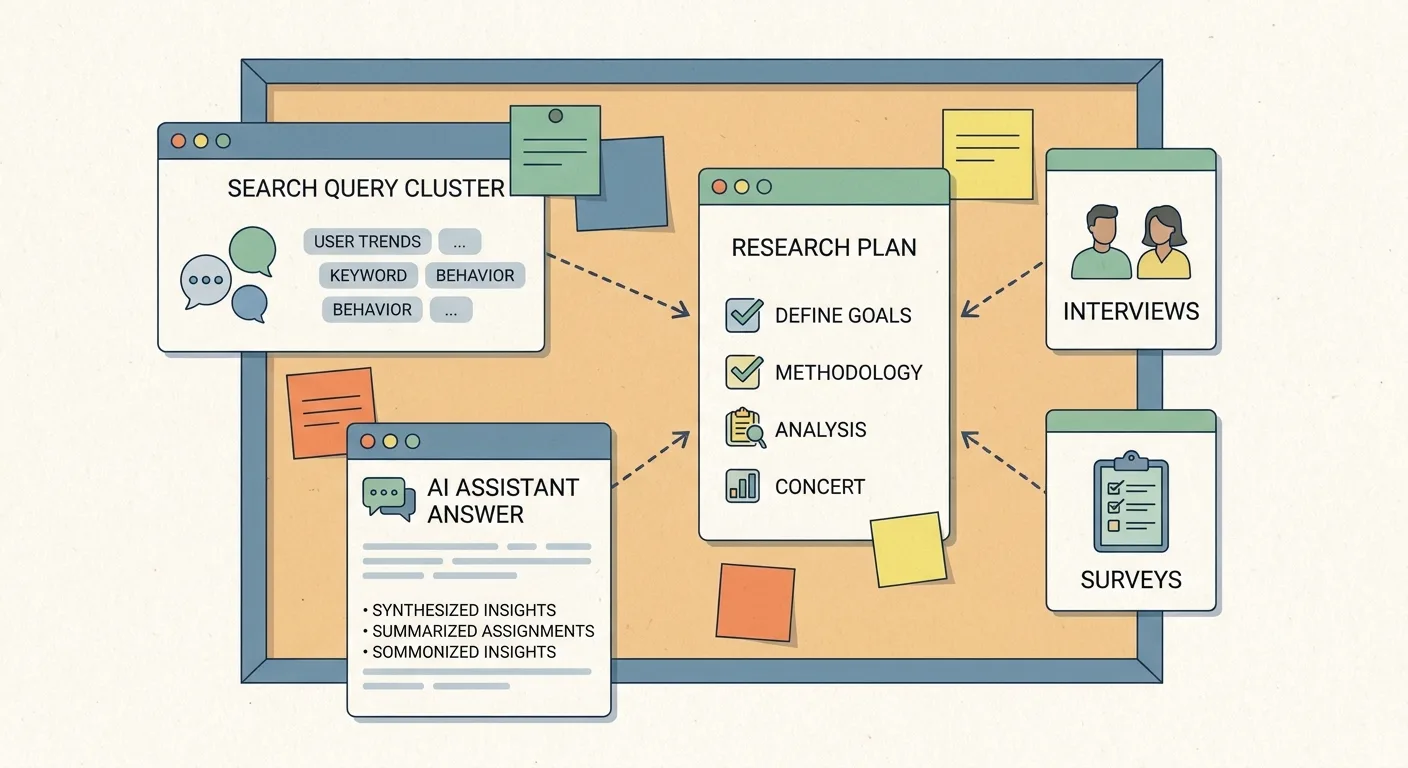
Stacking Methods So Each Round Sharpens the Next
Here are the methods to conduct market research in the order we’d run them:
- Write the decision and the assumption that would change it. A decision gives the study a target. A broad topic doesn’t.
- Mine existing evidence. Pull language, competitors and open questions from secondary sources plus search and AI answer data, then drop the competitors into a simple competitor analysis chart so later rounds test the right alternatives.
- Run interviews to explain the patterns you found.
- Quantify with a survey or experiment written in the market’s own words.
- Synthesize the findings and assign a confidence level to each.
Together, those rounds combine different market research methods into one study. Small or low-risk decisions may stop after step 3, and that’s fine.
The template below keeps planning to a single page.
One-page market research template
| Field | What to record |
|---|---|
| Decision | The choice this study informs |
| Assumption to test | The belief that would change the decision if it proved wrong |
| Method | The approach used in this round |
| Sample or source | Who you heard from, or which dataset or query set you used |
| Date collected | When the evidence was gathered |
| Confidence level | High, medium or low, with a one-line reason |
| Limitation | What this evidence can’t tell you |
| Owner | The person accountable for the finding |
To see the template in use, take a hypothetical market research example. A scheduling software team weighing a move into clinics finds query clusters about missed appointments. Interviews reveal that front-desk staff own the problem. The team then surveys clinic managers on priority, wording each item in the front-desk language the interviews captured.

Keeping Every Finding Traceable
The template’s “Date collected” and “Limitation” fields matter most once a stakeholder starts pushing back. A finding that can’t be traced to its source, date and method loses credibility the moment someone questions it.
Keep an evidence log for every finding, whichever market research methods produced it. The template covers the study, and the log covers each claim inside it.
AI-assisted research adds a specific risk. A study reported by Yahoo found that a third of AI assistants’ responses showed serious sourcing errors such as missing, misleading or incorrect attribution, so run each summary through a practical fact-checking workflow before it reaches a slide. The first two items below handle this directly.
Pre-slide evidence check
- Open the original document behind the figure or quote.
- Confirm the exact number and wording match the original.
- Record the source, collection date, method and sample in the evidence log.
- Note one limitation the finding can’t overcome.
- Name the person who verified it.
Market research tools that support each stage fall into six categories:
- Survey and panel platforms
- Interview recording and transcription
- Product and web analytics
- Search demand and keyword tools
- AI answer monitoring
- A shared spreadsheet or repository for the evidence log
Tools speed up collection across all your market research methods, but even the best tools can’t decide what counts as evidence. That judgment stays with the researcher.

Where Vee3.ai Fits When Search Demand Is the Blind Spot
When the search layer of your market research methods is assembled by hand, teams export a keyword list, sort by volume and guess what it means about demand.
The Vee3.ai product overview describes a workspace built for SEOs and ready for AI search, covering crawl, research, planning, writing, fact-checking, publishing and measurement.
Scope matters here. Vee3.ai is built for SEO and AI search work, so treat its output as the search input among your methods for market research. It doesn’t replace surveys or interviews.
Bring your category’s search research into one workspace when you start building in Vee3.ai.
Frequently Asked Questions
Can I run useful market research with almost no budget?
Yes, many early decisions can be informed on almost no budget, because interviews, public datasets and search data cost time rather than money. Read your category’s search results and AI answers, starting with a plain-language keywords primer if search data is new. Free survey tiers cover small samples; use them for direction-setting, never market sizing.

Do market research analyst jobs now call for search and AI skills?
Search, analytics and AI-generated data are useful additions for market research analyst jobs, but survey design, sampling, qualitative synthesis and clear reporting remain the core of the role. Market research analyst salary varies by region, seniority and industry, so check your national labor statistics agency for current figures.
How often should I rerun my research?
Rerun each signal on its own cadence: AI answers change fastest, so spot-check them on a dated schedule, while segmentation from quantitative work can hold until a major market or product shift. Pair those spot checks with a habit of tracking AI visibility over time. Before any high-stakes decision, a quick round of market research qualitative methods checks whether old findings still hold.
Final Thoughts
Pick one upcoming decision and fill in the template for it. The Method field is where you choose which methods of market research that decision needs, and we’d start with the unprompted layer before writing a single question.
One question deserves an honest answer from you: which belief about your customers has never been checked against what they search for or do?
Research doesn’t need to be perfect to be useful. Your market research methods earn trust by staying traceable and honest about their limits, and any team willing to write things down can meet that standard.