
Your strategy deck names the usual rivals. Deals and attention keep drifting to names that never made the slide.
We think the frameworks hold up fine. The weak spot is the input: who gets counted as a competitor in the first place. Most teams pair a sound competitive analysis and strategy process with a rival list built from habit, and the output inherits every gap in that list.

The fix starts with the toolkit most competitive strategy work still borrows from: Porter’s.
Key Facts
What Porter Mapped Out, and Why It Still Earns Its Place
Most strategy meetings still run on the vocabulary of Porter’s competitive strategy, whether anyone in the room cites him or not. Michael E. Porter’s competitive strategy work gave teams shared terms for cost, distinctiveness, and industry pressure. That shared language matters, since a plan nobody can describe in common terms rarely survives the budget meeting.
Generic competitive strategy asks you to pick a route: win on cost, win on distinctiveness, or win by serving a narrow segment exceptionally well.
Porter’s Generic Routes at a Glance
| Route | What You Commit To | Trade-off You Accept | Warning Sign |
|---|---|---|---|
| Cost leadership | The lowest structural cost in your market | Fewer frills and a tighter scope | Price cuts with no cost edge behind them |
| Differentiation | Value buyers can see and name | Extra cost to build and prove that value | Buyers can’t explain why you cost more |
| Focus | Deep fit for one narrow segment | Turning away buyers outside it | The segment keeps quietly widening |
Porter’s sharpest warning targets companies that chase every route at once. They end up stuck in the middle, with blurred trade-offs and no clear reason to be chosen. Practitioners still debate hybrid models, and some firms make them work. The warning stays useful as a check either way.
His article “The Five Competitive Forces That Shape Strategy” names the pressures acting on any industry: rivalry, new entrants, substitutes, buyer power, and supplier power. The framework isn’t the problem here.
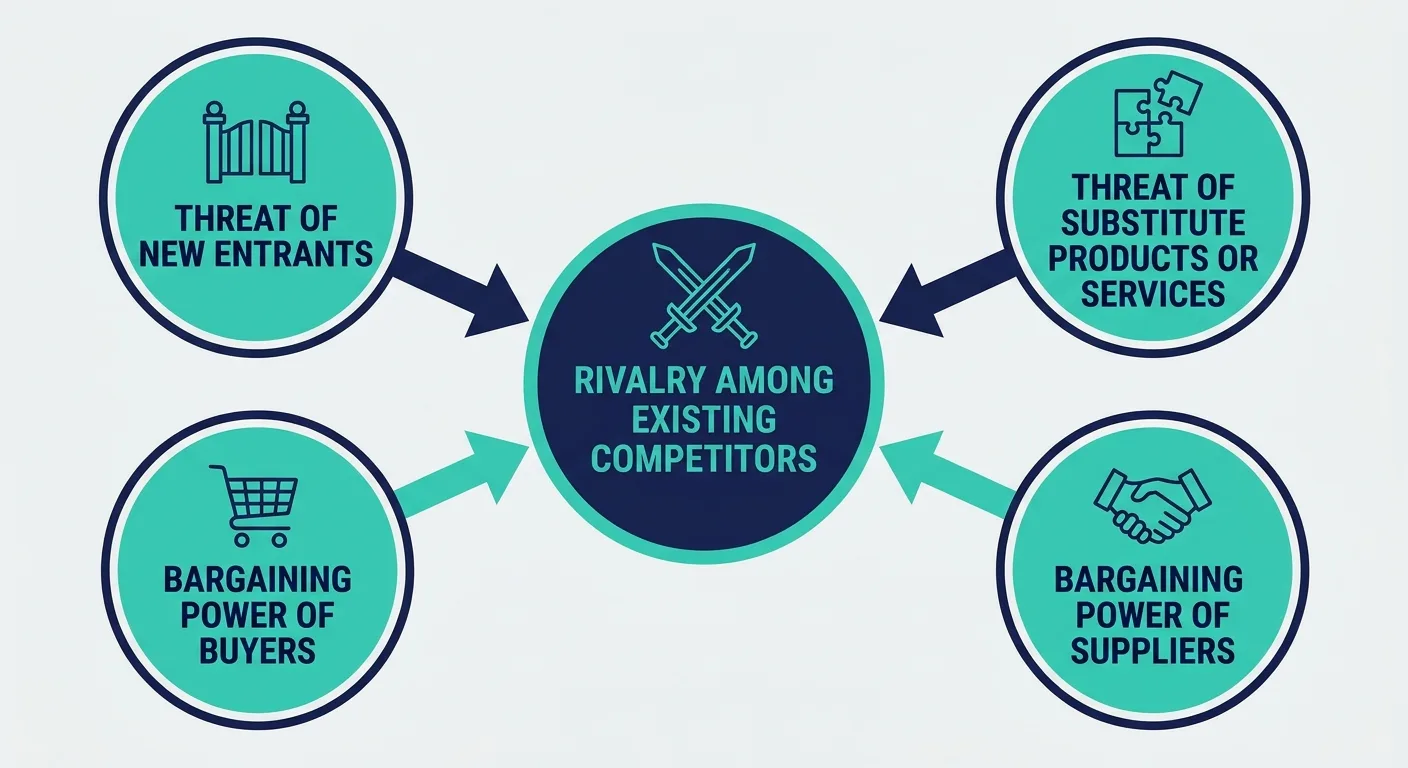
Teams usually go thin in two boxes: rivalry and substitutes, which tend to get filled from memory. When did you last check who sits in your substitute box?
Demand Decides Who Your Competitors Are
Michael Porter on competitive strategy already covers this in principle through buyer power and substitutes; the gap is execution.
Our working definition: a competitor, for the purposes of your competitive strategy, is any entity that appears when your buyer searches, asks, or evaluates options for the problem you solve. Teams that already run competitor analysis for marketing can widen the same lens to every name a buyer meets, including ones outside their category label.
Emerging markets show why category labels fall short. The case study “Robotaxi Wars: Uber vs. Waymo vs. Zoox vs. Tesla,” listed as of November 2026 on HBR’s Strategy topic page (Harvard Business Review), examines emerging competition in the robotaxi industry and the contrasting strategies of those four companies. In our reading, they pursue the same rider from very different starting points, and no single industry label captures all four.
The conventional split uses two buckets. Simon-Kucher’s guide Advanced strategies for effective competitive analysis (Simon-Kucher), published September 12, 2025, separates direct competitors from indirect ones. Direct rivals offer similar products to the same audience; indirect rivals meet similar needs with different products. We add a third role, because some of the most influential names sell nothing you sell:
- Head-to-head rivals: same buyer, same problem, similar offer.
- Intermediaries: marketplaces, directories, and big publishers that shape the choice without selling your exact offer.
- Substitutes: different solutions to the same job, including doing nothing or doing it for free.
Not every name that ranks is a rival, though. A giant publisher ranking for an informational query usually plays the intermediary role. Treat it as one, and you may decide you want a mention in its content, not a fight over its spot.

A small specialist site that owns your core term is useful input: it shows exactly where buyer attention went.
This is Porter competitive strategy thinking applied to search demand. The forces stay the same, and buyer behavior decides which names fill them.
The Rival With No Logo: AI-Generated Answers
Tools such as ChatGPT and Google AI Overviews generate answers and may list sources, which users can check by clicking the links provided, if any (Semrush). A cited brand enters consideration, which makes citation part of your competitive position. An uncited brand may never surface at all.
We place AI answers inside the five forces of competitive strategy Porter mapped out, and they land in two spots at once. Read through that lens, the answer is a substitute when it replaces a site visit and an intermediary when it picks whom to cite.

One caveat: citation behavior shifts and isn’t fully transparent, so we won’t pretend to know precise shares or traffic effects.
Which brands get named when your buyer asks an AI tool about your category? The answer layer stops being a guess once you start tracking your AI visibility for the buyer questions that matter most.
Pricing That Survives an Open Browser Tab
A competitive pricing strategy sets price with deliberate reference to rival prices and to the route you chose. One practical mapping links three postures to Porter’s routes: premium, parity plus value-adds, and penetration.
Pricing Postures Mapped to Porter’s Routes
| Posture | Route It Serves | Works When | Risk If Misused |
|---|---|---|---|
| Premium | Differentiation | Buyers can see and name the distinct value | Value story weakens and buyers defect to cheaper options |
| Parity plus value-adds | Focus | A narrow segment rewards tailored extras | Extras get copied and parity turns into a price war |
| Penetration | Cost leadership | A structural cost advantage supports the low price | Margin drains with no distinct signal to show for it |
A competitive price strategy that copies the cheapest rival without a structural cost edge runs straight into the penetration risk shown above.
Rival price pages tell only part of the story. Free content, free tools, and AI-generated answers quietly set an anchor for what buyers expect to pay for basic help. Your paid offer has to begin where that free layer stops.

Public pricing is where pricing and competitive strategy meet in front of the buyer. It builds trust, and it also invites instant matching from any rival with a spreadsheet and a free afternoon. Hiding prices behind “contact sales” is also a pricing signal. Public pricing pages can surface for buyer comparison queries, which is why guides on SEO for SaaS teams treat the pricing page as a competitive asset and a sales page at once.
A Five-Step Competitive Strategy Analysis Built Around Demand
Here’s how we run a competitive strategy analysis that starts with buyers instead of categories.
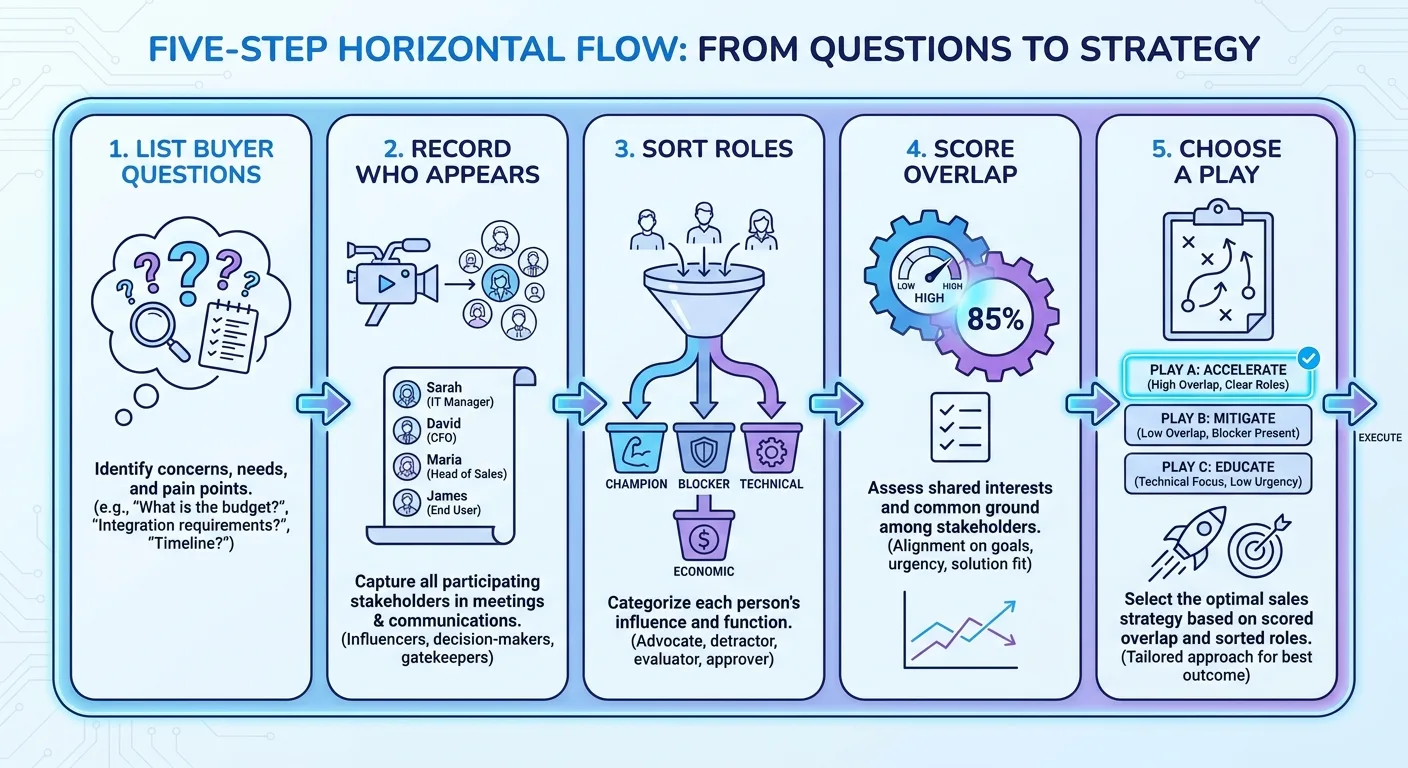
- Write down the buyer questions: problems, queries, and evaluation criteria, with your product category label left out. Porter’s Competitive Strategy: Techniques for Analyzing Industries and Competitors begins with the industry; this method begins with the buyer. Write the questions in your buyer’s own words, then lean on a guide to turning buyer questions into keywords so step 2 has searchable inputs.
- Who appears for each question? Record every name across search results, AI answers, marketplaces, and review sites.
- Every name then gets sorted into head-to-head, intermediary, or substitute. Keep intermediaries on a separate watch list and drop the true noise.
- Overlap comes next. Score how many priority questions each rival owns, and note where its weakest openings sit.
- The last step is choosing a play for each question (attack, defend, or deliberately ignore) and writing down the trade-off each play requires.
Once the sort is done, ask: how many of your “top rivals” survived it?
The Demand-Side Rival Map below turns these steps into a working sheet, and anyone who prefers a visual format can build a competitor analysis chart from the same rows once the map is filled in.
Demand-Side Rival Map
| Buyer Question | Who Appears | Role | Overlap With Us | Planned Move |
|---|---|---|---|---|
| “How do I [solve core problem] for [segment]?” | Rival A; Directory B; AI answer citing Rival A | Head-to-head; intermediary; substitute | High: Rival A owns most priority questions | Attack: publish a deeper guide and pursue the AI citation |
| “Best [tool type] for [use case]” | Marketplace C; Publisher D; Rival E | Intermediary; intermediary; head-to-head | Medium | Defend: secure listings on C and D, watch E |
One limit matters here. Demand data shows attention, and attention isn’t revenue. Pair the map with win-loss notes and sales feedback, a habit with deep roots: a 2007 post on sources of competitive information from Branding Strategy Insider shows teams were already cataloguing where competitive intelligence comes from.
Turning a Lead Into Something Rivals Can’t Copy Overnight
Winning a position and holding it are separate jobs, and the link between competitive advantage and strategy lives mostly in the second one. Operational effectiveness, the efficiency gains every team chases, gets copied fast. Positioning built on trade-offs rivals refuse to make does not, a distinction at the heart of Porter’s work.
A sustainable competitive strategy is a system of activities that fit together, so copying one piece never replicates the whole. Run this check on any advantage you plan to defend.
Copy-Resistance Check
- Does it depend on a trade-off your main rivals refuse to make?
- Does it connect to at least two other activities you already run?
- Would a rival who copied only this piece still fall short of your result?
- Did it take months of consistent work to build, such as topical depth or cited-source status?
- Would you notice within one review cycle if it started to erode?
Demand-side assets score well on item four, and the build time itself protects you. Strategy thinking keeps returning to what is hard to replicate. Giovanni Gavetti, Hart Posen, James Siderius, and Zia Zaman’s article “What Sets Great Strategists Apart in the AI Era,” listed as of November 2026 on HBR’s Strategy topic page (Harvard Business Review), examines what distinguishes strong strategists as AI tools spread. Our view: knowledge your team builds in context over months is harder for rivals to copy than any single tactic.

No advantage is permanent, and complacency is the usual failure point. Erosion rarely announces itself, so tie each demand-side asset to the SEO KPIs worth watching and review them on a set cycle.
Mapping Search Rivals Without the Spreadsheet Marathon
Steps two through four take serious manual effort. Pulling results for dozens of buyer questions, then clearing out platforms and directories, can eat days, and it’s the slowest part of demand-side competitive strategy work.

That’s the workload we built Vee3.ai to shorten, with one workspace to crawl, research, plan, write, fact-check, publish and measure. Its SEO Competitor Analysis Tool helps gather who appears for your buyer questions in search and separate head-to-head rivals from the platforms around them. Its AI Visibility Tool helps you track whether AI answers cite you or a competitor. Anyone who wants to weigh options first can compare AI visibility tools and judge which citation view fits their workflow.
Spotting direct rivals is only part of the job; intermediaries still deserve their own watch list, as step 3 suggests. The tool handles the gathering and leaves every decision that matters with you.
Run your own domain through it, see your real search rivals for the demand you care about, and start building.
Frequently Asked Questions on Competitive Strategy
Is Michael Porter’s Book on Competitive Strategy Still Worth Reading?
Yes, Michael Porter’s Competitive Strategy has long been the starting point for managers analyzing competition, and its five competitive forces are still considered as relevant today as they were in 1980 (TIME). Read Competitive Strategy: Techniques for Analyzing Industries and Competitors for its Five Forces framework, a tool for analyzing an industry’s structure and competitiveness, then pair it with your own rival map (macropraxis.org). Anyone hunting a competitive strategy Michael Porter PDF should use the publisher, a library, or a licensed ebook service. Many competitive strategy books build on his foundations.

Can a Company Switch Its Competitive Strategy Midstream?
Yes, a company can switch strategies midstream, but only by reworking pricing, operations and messaging together; a half-switch lands you in the blurred middle. M. Porter’s competitive strategy thinking explains why. “Lessons from UPS’s Transformation” by Marc Levinson, filed under HBR’s Strategy topic among others, examines how leaders can transform an eroding business model without sacrificing profitability or employee support (Harvard Business Review). A change in who appears for priority buyer questions is a fair trigger. Test on one segment first.
Do Competitive Strategy Board Games Build Real Strategic Skill?
Competitive strategy board games build some real strategic habits, but not the full skill set. They sharpen forecasting opponent responses, committing scarce resources, and accepting that one path closes others. Their rules are fixed and visible, though. Real markets hide information and buyer preferences shift, which real demand data can teach and a game can’t.

How Often Should I Refresh My Competitor List?
Refresh your competitor list quarterly, and immediately when a trigger hits. Watch for three triggers: a new name climbing across several priority questions, which consistent rank tracking over time will surface; AI answers citing a different brand; or a rival pricing move that forces a response. This reflects Porter’s point that positioning must hold against shifting forces. Fast-moving categories may need monthly checks.
Final Thoughts: Start With One Buyer Question
Pick one buyer question tied to revenue this week. Run steps two and three of the method on it, then set the result beside your current rival slide. The first pass will be messy: expect duplicate names, odd directories, and at least one site you’ve never heard of.
Now ask the hard question: does your chosen route still make sense against the names that showed up? A wobbly answer means your competitive strategy needs attention before the next planning cycle arrives.
Rethinking who you compete with can feel unsettling, but that’s where the clearest openings tend to appear. One question, sorted honestly, is enough to start.