
Do you know what ChatGPT says when someone asks for a tool like yours? Buyers now turn to ChatGPT, Perplexity and Google AI Overviews for recommendations, and ai visibility tools exist because most brands have no idea whether they’re named, skipped or swapped for a competitor.
Entry prices run from $25/mo billed annually for Otterly Lite, per That Marketing Buddy, up to $295/mo for AthenaHQ, per Analyze AI. Price dates vary by source, and each profile states its source and date where one is given. We build SEO and AEO software, so we judged these top ai visibility tools on one question: does the tool help you act on what it finds? Vee3.ai sits first on the list and faces the same seven checks as everyone else.
TL;DR: The Right AI Visibility Tool Depends on What You’ll Do Next
Short on time? Here are the best ai search visibility tools matched to the job you actually need done.
- Need citation gaps turned into published, fact-checked pages → Vee3.ai (one workspace from gap to CMS)
- Need specialist tracking for a big team → Peec AI (unlimited seats on all plans, according to appscribed.com)
- Need enterprise intelligence → Profound AI (each answer stored as a complete snapshot, according to tryanalyze.ai)
- Need the cheapest way to start → Otterly AI (7-day no-card trial, then Lite at $29/mo, according to meev.ai)
- Already paying for an SEO suite → Semrush AI Visibility Toolkit or Ahrefs Brand Radar (same login you already use)
- Need traffic attribution → Analyze AI, which per tryanalyze.ai connects to your GA4 account to label AI-referred visitors
- Need LLM tracking next to classic rankings → Nightwatch (both in one report)
- Need mid-market GEO with an action layer → AthenaHQ (content agents)
- Need keyword-first tracking on a budget → LLMrefs (keywords become prompts)
- Evaluating Amplitude AI Visibility → check its C1 and C6 details directly before shortlisting (see its entry)
The 11 Picks Side by Side: Engines, Starting Prices and Trials
Every figure below comes from the cited roundup or vendor page. Engine counts for most ai visibility tools depend on the plan you buy, so read the second column carefully.
| Tool | Engines (base plan noted where known) | Starting price | Trial | Best fit | Source |
|---|---|---|---|---|---|
| Vee3.ai | ChatGPT and Google AI Overviews | see current Vee3.ai pricing | Guest workspace before sign-up | Gap-to-published-page execution | Vee3.ai homepage overview; Vee3 About page |
| Peec AI | Starter: choose 3 engines | $80/mo billed annually | No published trial | Specialist tracking | That Marketing Buddy |
| Profound AI | Starter: ChatGPT only; Growth adds Perplexity and Google AI Overviews, according to Maintouch | $99/mo | No trial | Enterprise | Minineo; Contentpen |
| Otterly.AI | ChatGPT, Google AI Overviews, Perplexity, MS Copilot | $25/mo billed annually | 7-day trial | Budget monitoring | That Marketing Buddy |
| Semrush AI Visibility Toolkit | Engine lists vary by source | $99/mo per domain | 7-day trial | Semrush users | Traffic Think Tank; Connor Gillivan |
| Ahrefs Brand Radar | Each platform priced separately | $199/mo per platform | No trial | Ahrefs users | Minineo; Contentpen |
| Amplitude AI Visibility | Not verified in our research set | Not verified in our research set | Not verified in our research set | Not verified in our research set | No source retrieved |
| Analyze AI | 6+ engines (self-reported) | $99/mo | Free trial | Agents plus attribution | Analyze AI (vendor-authored) |
| Nightwatch | 4 platforms | From $32/mo | 14-day trial | LLM plus rank tracking | Nightwatch blog; Contentpen |
| AthenaHQ | 8 engines | $295/mo | No standard trial | Mid-market GEO | Analyze AI; Contentpen |
| LLMrefs | 10 platforms, varies by plan | $79/mo | Sources disagree | Keyword-first tracking | Scalenut; Contentpen |
“Trial” means a standard trial as each source describes it, and the profiles carry the nuance.
Criteria Breakdown Summary: The Seven Checks Behind Every Pick
We held all the ai visibility tracking tools on this list to the same seven checks. Each pick gets a short verdict per check, with no star ratings or invented scores.
One disclosure belongs here: several roundups we drew on come from vendors that sell AI visibility software. We’ve flagged self-reported claims where they matter and cited every source inline.
Four Facts That Change How You Should Read Any AI Visibility Report
What We Checked (and What You Should Check Too)
Use this table on any of the ai search visibility tools a vendor pitches you, including ones that aren’t on our list.
| Check | What to look for | Source |
|---|---|---|
| C1: Engine coverage | Which engines sit in the base plan? A tool that lists six platforms but locks four behind add-ons is a different purchase entirely. Peec AI’s Starter, for example, asks you to choose engines. | Contentpen |
| C2: Cadence and repeatability | Is it daily, weekly or snapshot, and does it rerun and average prompts? Profound AI’s stored responses sit at the deep end. See our guide on how rank tracking works. | Analyze AI; Nathan Ojaokomo |
| C3: Citation and source analytics | Can you see which URLs engines cite? Depth ranges from basic citation counts to full URL-level logs. (The FAQ covers mentions versus citations.) | Minineo; Scalenut |
| C4: Competitors, share of voice, sentiment | How often do rivals appear on the same prompts, and how is your brand framed? Strong ai brand visibility tools help you run a competitor analysis on the prompts that count. | Nightwatch; Dageno |
| C5: Actionability | Does the tool tell you what to fix, or only report the gap? An ai visibility audit with fix guidance counts here. | Connor Gillivan; Analyze AI |
| C6: Attribution and integrations | Does visibility connect to GA4 sessions and ROI? Look for a way to connect GA4 and Search Console. | Analyze AI |
| C7: Pricing transparency and trials | Are prices published, and can you get value before paying? Otterly AI’s no-card trial is the easy example. | Marketer Milk; Connor Gillivan |
Three more decision points deserve your attention before you sign anything:
- Prompt discovery: Most tools only track prompts you supply, so look for keyword-to-prompt generation, per Marketer Milk.
- Security: Marketer Milk also advises checking for SOC 2 compliance if the tool requests data integrations.
- Prompt-list fit: A mismatched prompt list skews any ai visibility score and produces charts about the wrong questions, per That Marketing Buddy. Are your prompts the ones your buyers type?
Vee3.ai: Best for Turning Citation Gaps Into Published, Fact-Checked Pages
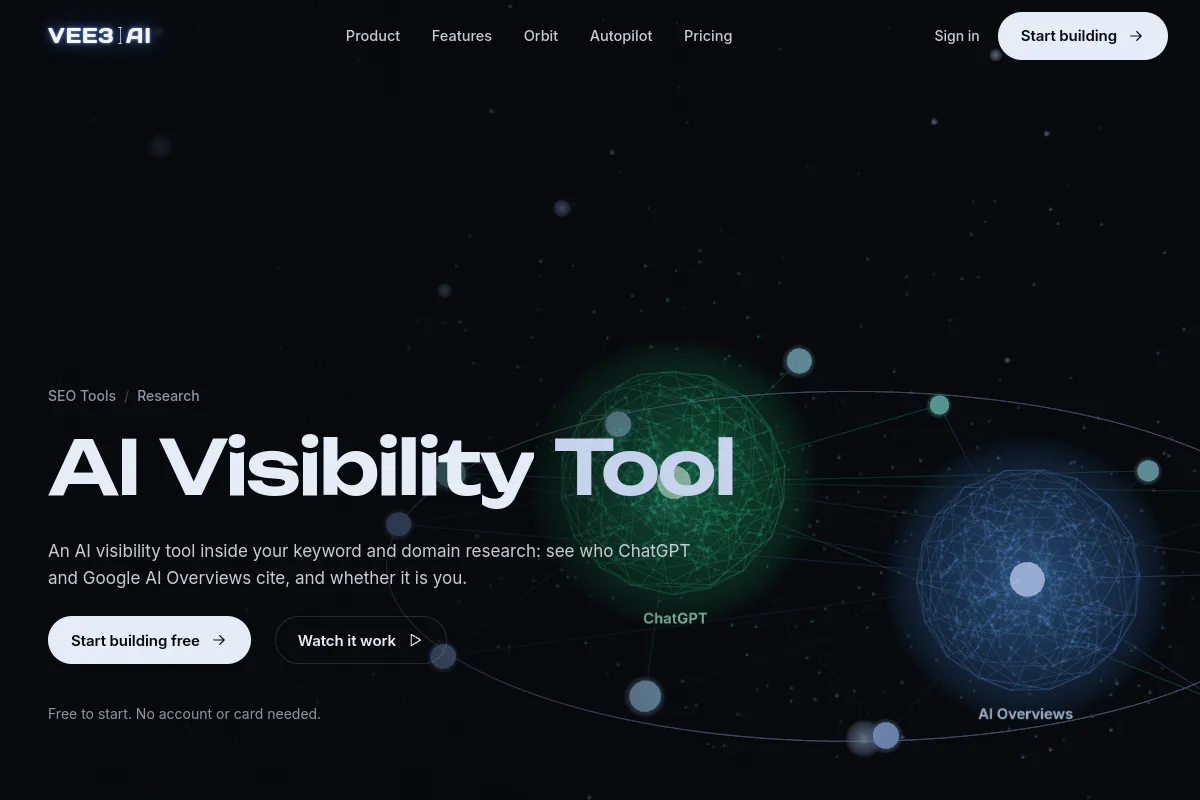
Vee3.ai links each citation gap to a brief, a fact-checked draft and a published page.
Where to find it: Vee3.ai AI Visibility Tool
Vee3.ai runs SEO automation from crawl to rank in one workspace built for AI search, per the Vee3.ai homepage.
Best fit: SEO and content teams that want one workspace from AI citation gap to published, measured page.
What it does: The Vee3.ai AI Visibility Tool reveals whether ChatGPT and Google AI Overviews cite your brand or a rival. It fits teams comparing the best answer optimization tools for ai visibility when the bottleneck is shipping the fix rather than finding it.
Key features:
- Crawler that audits your website’s pages
- Research step that surfaces AI citations alongside keyword data
- Evidence ledger that logs every source used in a brief
- Fact Checker that checks drafted claims against their cited sources
| Check | Verdict |
|---|---|
| C1 | ChatGPT and Google AI Overviews only, narrower than the dedicated trackers. |
| C2 | Cadence isn’t stated for the AI Visibility Tool, though a separate keyword rank tracker sits in the toolset. |
| C3 | AI citations surface in Research, and an evidence ledger logs every source. |
| C4 | Shows where engines cite a competitor instead of you and ranks competitors by keyword-footprint overlap. |
| C5 | The strongest point (details below). |
| C6 | Joins GSC and GA4 data to page type and intent, using read-only Google access, per the Vee3 About page. |
| C7 | A guest workspace works as a free ai visibility checker before you create an account. |
C5 breaks into three parts:
- A content brief generator, drafts and a built-in Fact Checker
- AEO blocks: direct answer, key facts, FAQ and a JSON-LD schema markup generator
- The option to publish straight to your CMS on WordPress, Webflow or Shopify, as drafts or live
Pricing: Figures weren’t retrieved for this roundup, so see current Vee3.ai pricing directly.
Pros: Gap-to-publish workflow in one place; drafted claims checked against cited sources.
Cons: Two engines; no published AI-tracking cadence.
Fit note: Teams that need Perplexity, Gemini or Claude coverage should pair the tool with a broader tracker such as Peec AI.
Peec AI: Best for Specialist Tracking With Room for Your Whole Team
Where to find it: Peec AI documented by That Marketing Buddy
Peec AI earns its reputation for clean, specialist tracking, according to Rankability.
Best fit: Marketing teams that want pure AI search analytics without paying per seat.
What it does: The standout with Peec AI is unlimited competitors and seats, per That Marketing Buddy, so the whole team can log in.
| Check | Verdict |
|---|---|
| C1 | Peec AI covers 6 platforms per Contentpen, but coverage depends on the plan, since Starter lets you choose 3. |
| C2 | Daily tracking, per Analyze AI. |
| C3 | Basic citation analytics, per Analyze AI. |
| C4 | Competitor benchmarking with citation insights, per Dageno. |
| C5 | You may need separate tools for content and technical fixes, per Dageno. |
| C6 | No GA4 attribution, per Analyze AI. |
| C7 | Pricing is published, but no trial is listed, per That Marketing Buddy. |
Pricing: Peec AI Starter costs $80/mo billed annually or $95/mo monthly, covering 1 brand, 50 prompts and 3 engines of your choice, with prices verified 2 Oct 2026 by That Marketing Buddy.
Pros: Unlimited seats; daily cadence.
Cons: No trial; no attribution; fixes need a separate execution stack.
Profound AI: Best for Enterprise Teams That Want Every Answer on Record
Where to find it: Profound documented by Minineo
Profound AI sells enterprise AI search intelligence. Its standout tool is Conversation Explorer, a feature that surfaces AI search volume, per Minineo.
Best fit: Enterprise brands that need deep, stored response data and topic-level share of voice.
| Check | Verdict |
|---|---|
| C1 | Starter covers a single engine, and higher tiers reach up to 10 platforms, per Contentpen. |
| C2 | Daily tracking, with every response stored, per Minineo. |
| C3 | Citation logs with domain and page stats, per Traffic Think Tank. |
| C4 | Share of voice by topic, platform and location, per Traffic Think Tank. |
| C5 | Has an optimization workspace, though Analyze AI, a competing vendor, rates its content features as limited. |
| C6 | CDN-based GA4 traffic, per Analyze AI. |
| C7 | Entry pricing is public, Enterprise needs a sales call, and there’s no trial. |
Pricing (per Minineo, citing Profound’s pricing page in July 2026):
- Starter, entry-level price: ChatGPT only, a small prompt allowance, a limited monthly response cap, a single seat
- Growth, $399/mo: ChatGPT, Perplexity and Google AI Overviews, 100 prompts, 9,000 responses, 3 seats, according to get-ryze.ai
- Enterprise: custom pricing
Pros: Stored responses; deep share-of-voice cuts.
Cons: Single-engine Starter; no trial. Before you buy, ask whether ChatGPT alone answers the question you’re trying to settle.
Otterly.AI: Best for Starting Small Without Handing Over a Card
Where to find it: Otterly.AI documented by That Marketing Buddy
Otterly AI focuses on monitoring with change detection, per Limy.
Best fit: Small teams or solo marketers who want a low-cost ai visibility tracker before committing budget.
| Check | Verdict |
|---|---|
| C1 | According to geohats.com, every base plan covers the same four engines: ChatGPT, Google AI Overviews, Perplexity and Microsoft Copilot. Google AI Mode, Gemini and Claude are paid add-ons, per That Marketing Buddy. |
| C2 | Continuous prompt testing with stored history, per Limy. |
| C3 | Tracks citation sentiment, per Nightwatch. |
| C4 | Visibility scoring and position within responses, per Limy. |
| C5 | Monitoring needs pairing with an execution tool, per Dageno. |
| C6 | Not documented in our sources. |
| C7 | Otterly AI offers new users a free trial with no credit card needed, according to OtterlyAI. |
Pricing (verified 2 Oct 2026 by That Marketing Buddy):
- Lite: $25/mo billed annually or $29/mo monthly, 15 prompts, per Trakkr
- Standard: $160/mo billed annually ($189 month to month), 100 prompts, according to ZeroRank
Pros: Lowest verified entry price in this roundup; no-card trial.
Cons: Gemini, Claude and Google AI Mode cost extra; Lite covers only 15 prompts.
Worth knowing: Insights are confined to predefined prompt sets, according to Limy. Keep in mind that Limy is itself a vendor in this space.
Semrush AI Visibility Toolkit: Best for Teams Already Living Inside Semrush
Where to find it: Semrush AI Visibility Toolkit documented by Connor Gillivan
Semrush AI visibility features put SEO and AI tracking under one roof, and Connor Gillivan ranked the toolkit best overall.
Best fit: SEO teams that already run Semrush and want AI visibility in the same login. Weighing suites more broadly? Start with our broader SEO tools roundup.
What it does: It works as a Semrush AI visibility checker backed by a 130M+ US prompt database, per Connor Gillivan. It also includes an AI Visibility Score (the FAQ explains what it measures).
| Check | Verdict |
|---|---|
| C1 | Gillivan lists ChatGPT, AI Overviews, AI Mode, Perplexity and Gemini. Semrush’s Enterprise AIO tier extends coverage to Claude, DeepSeek and Grok beyond the core toolkit’s engines, according to Position Digital. The lists don’t match. |
| C2 | Traffic Think Tank describes real-time brand tracking, while Analyze AI lists a weekly cadence. |
| C3 | Source domain and URL insights, per Traffic Think Tank. |
| C4 | Quote-level sentiment and share of voice, compared against up to 4 competitors, per Gillivan. |
| C5 | AI Search Health Audit, Prompt Research and Content Toolkit, per Gillivan. |
| C6 | Ties into the full SEO suite. GA4 isn’t cited in our sources. |
| C7 | The standalone toolkit has no trial (only Semrush One has a 7-day trial), according to Sightivo. |
Pricing:
- Per Traffic Think Tank: AI Visibility Toolkit $99/mo per domain, Semrush One $199/mo, Enterprise AIO on request
- Semrush One tiers per Connor Gillivan (May 2026): Starter $199/mo (5 sites, 50 prompts), Pro+ $299/mo, Advanced $549/mo, extra 50 prompts $60/mo
Pros: One login for SEO and AI data; trial available.
Cons: Conflicting engine and cadence claims; prompt overages; the Starter plan lacks JavaScript rendering in Site Audit, per Gillivan.
Ahrefs Brand Radar: Best AI Visibility Checker for Existing Ahrefs Users
Where to find it: Ahrefs Brand Radar documented by Minineo
Brand Radar’s calling card is scale: a 402M+ prompt dataset plus 2,500 custom checks/mo, per Minineo.
Best fit: Ahrefs subscribers who want broad AI share-of-voice data more than daily alerts.
Analyze AI, cited below, is a competing vendor.
| Check | Verdict |
|---|---|
| C1 | 5 to 6 platforms, each priced separately, per Minineo. |
| C2 | No daily tracking, per Analyze AI. |
| C3 | Limited citation analytics, per Analyze AI. |
| C4 | AI share of voice, per Dageno. |
| C5 | Large datasets need separate prioritization work, per Dageno. |
| C6 | No GA4 attribution, per Analyze AI. |
| C7 | No trial, per Contentpen. |
Pricing: $199/mo per platform (AI Overviews, AI Mode, ChatGPT, Perplexity, Copilot/Gemini) or $699/mo for All Platforms, per Minineo citing Ahrefs’ page. Do the math before you click “add”: three platforms at $199 each already lands at $597/mo.
Pros: A very large dataset, and you buy only the platforms you need.
Cons: No daily tracking and no trial.
Amplitude AI Visibility: What to Confirm Before You Shortlist It
People search for amplitude ai visibility, but none of the roundups we reviewed documented this product.
Where to find it: No vendor page was retrieved for this roundup.
Best fit: Not documented in our research set.
| Check | Verdict |
|---|---|
| C1 | Not documented in our research set. |
| C2 | Not documented in our research set. |
| C3 | Not documented in our research set. |
| C4 | Not documented in our research set. |
| C5 | Not documented in our research set. |
| C6 | Not documented in our research set. |
| C7 | Not documented in our research set. |
Pricing: Not documented in our research set.
Pros: None we could verify.
Cons: No documented engine coverage, pricing or trial details to compare against the other picks.
Start with engine coverage (C1) and attribution (C6) in the vendor’s own materials, then judge amplitude ai visibility on the same seven checks as every other pick.
Analyze AI: Best for Agent Workflows Backed by GA4 Traffic Data
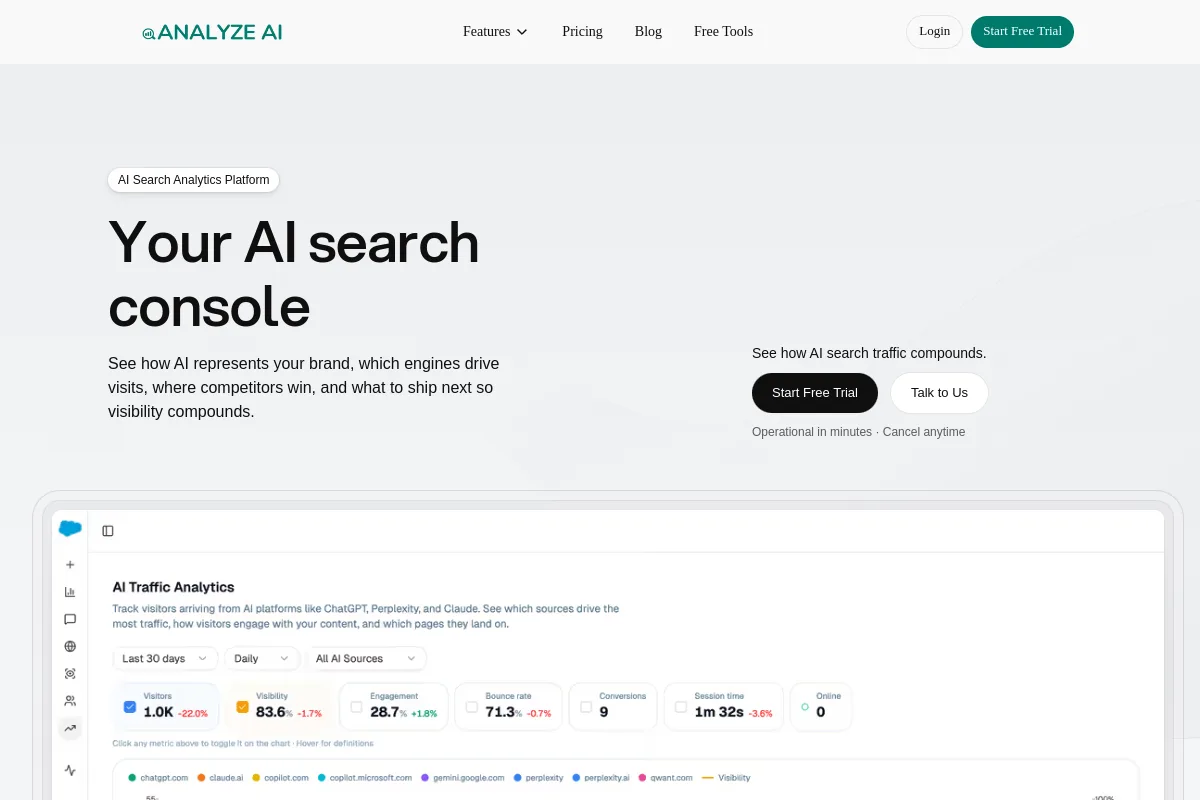
Analyze AI pairs tracking with GA4 traffic data (vendor-reported).
Where to find it: Analyze AI
Analyze AI pitches automation plus attribution, and this profile relies entirely on Analyze AI’s own article.
Best fit: Teams that want automation and traffic attribution in one tool.
Best known for: Agent Builder, with 180+ nodes and 34 data recipes, per Analyze AI. Its own article frames it among the leading ai visibility optimization tools.
| Check | Verdict |
|---|---|
| C1 | Covers ChatGPT, Perplexity, Claude, Gemini, Copilot, DeepSeek and other major AI answer engines, according to Analyze AI. |
| C2 | Daily tracking. |
| C3 | Cited sources per prompt. |
| C4 | Competitor Intelligence dashboard with share of voice. |
| C5 | AI Content Writer and Content Optimizer. |
| C6 | GA4 AI Traffic Analytics, with Agent Builder integrations for GA4, Google Search Console, HubSpot, WordPress, Notion, Contentful and Mailchimp, according to tryanalyze.ai. |
| C7 | Published price and a free trial. |
Pricing: the plan includes 3 AI engines, 25 tracked prompts daily, and AI traffic analytics with GA4, according to tryanalyze.ai.
Pros: Attribution and content tools in one place; trial available; adds the GA4 attribution Peec AI lacks.
Cons: All claims self-reported, with no independent corroboration in our research set; run the trial before committing.
Nightwatch: Best for Pairing LLM Tracking With Classic Rank Tracking
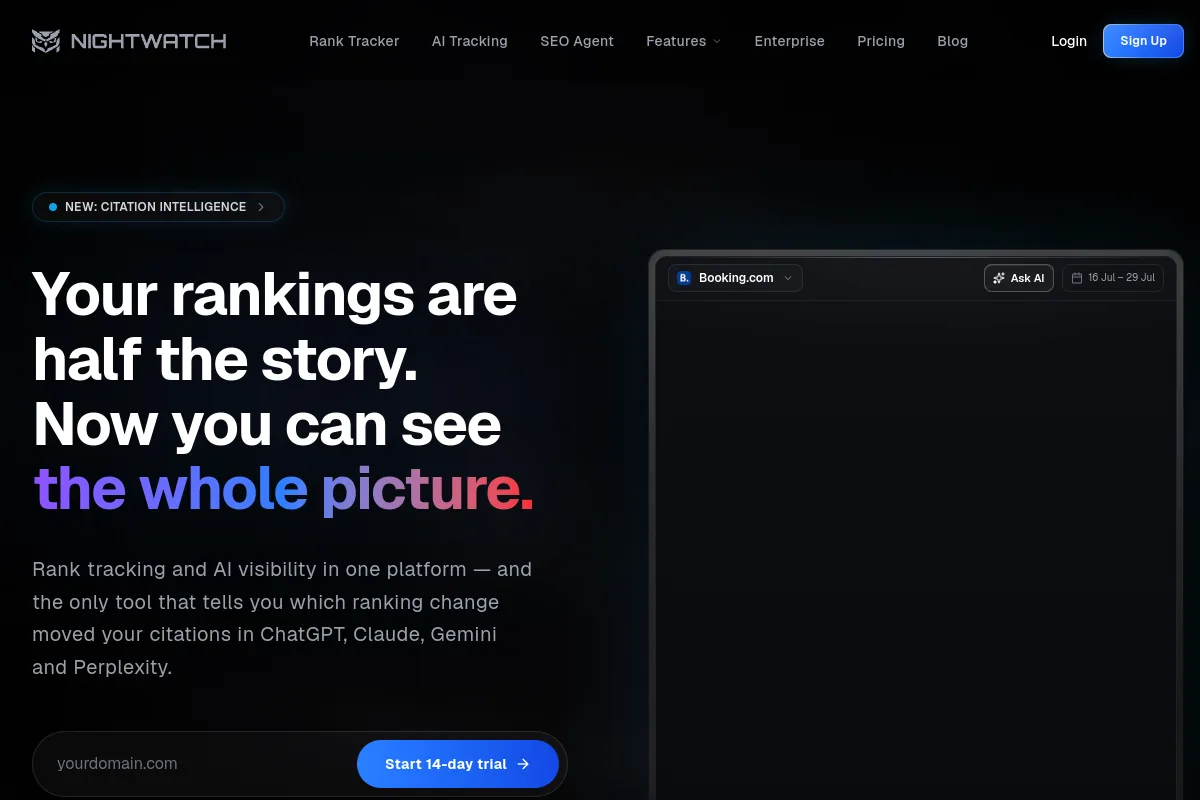
Nightwatch keeps classic rankings and LLM tracking side by side.
Where to find it: Nightwatch
Nightwatch combines LLM tracking with traditional rank tracking, and Nightwatch’s own blog is the main source for this profile.
Best fit: SEO teams and agencies that report on both channels.
What stands out: It also tracks the real-time web searches that AI models perform to gather current information, according to Nightwatch.
| Check | Verdict |
|---|---|
| C1 | 4 platforms, per Contentpen. |
| C2 | Positions itself on real-time and daily monitoring. |
| C3 | Citation-level sentiment via its SEO Agent. |
| C4 | Prompt-level performance tracking. |
| C5 | Prompt research and a content writer appear in the product menu. |
| C6 | Looker Studio reporting. |
| C7 | According to Nightwatch, it offers a 14-day free trial with full access to all features, no credit card required. |
Pricing: Nightwatch says “from $32/mo,” and Rankability echoes “around $32.” Contentpen lists $131/mo combined with a 14-day trial. Check the exact plan you need before budgeting.
Pros: Rankings and AI answers in one report; trial available.
Cons: Conflicting price reports; vendor-sourced claims; engine coverage narrower than the broadest trackers.
AthenaHQ: Best for Mid-Market GEO Teams Who Want an Action Layer
Where to find it: AthenaHQ documented by Analyze AI
Rankability describes AthenaHQ as a GEO platform that combines tracking and benchmarking with an action center for fixing visibility gaps, according to rankability.com.
Best fit: Mid-market brands, including Shopify stores, that want recommendations plus revenue-side attribution.
| Check | Verdict |
|---|---|
| C1 | 8 engines, per Analyze AI. |
| C2 | Daily tracking is possible, but according to tryanalyze.ai, tracking three prompts across five engines daily uses 450 credits a month. |
| C3 | Tracks citation frequency, per Limy. |
| C4 | Tracks how brands appear across major LLMs, including competitor presence, according to Limy. |
| C5 | Content agents and framework-driven recommendation workflows, per Analyze AI and Limy. |
| C6 | GA4, GSC and Shopify integrations, though the conversion story still has to be assembled by your team, per tryanalyze.ai. |
| C7 | No paid-tier trial is offered, though a free tier with 5 engines and 300 credits is available, according to aeolabs.ai. |
Pricing: $295/mo with no trial and a $95 first month, per Contentpen. That’s several times Peec AI’s $80/mo annual Starter, per That Marketing Buddy.
Pros: Broad engine set; revenue-side attribution.
Cons: A real commitment for smaller teams. Will anyone on your team use the attribution piece every month?
LLMrefs: Best for Keyword-First Tracking on a Lean Budget
Where to find it: LLMrefs documented by Scalenut
LLMrefs earned Rankability’s rating as the best low-cost tracker. Rankability also lists it as bootstrapped / private.
Best fit: SEO practitioners who think in keywords and want broad engine coverage cheaply.
| Check | Verdict |
|---|---|
| C1 | 10 platforms per Contentpen; Scalenut says coverage varies by plan. |
| C2, C3, C4, C6 | Not documented in our sources. |
| C5 | A keyword-to-prompt workflow that turns target keywords into prompt variations, which answers the prompt-discovery point from our criteria, per Scalenut. |
| C7 | Published price. |
Pricing: $79/mo per Scalenut, which also lists a 7-day trial, while Contentpen says there’s no trial. That sits just below Peec AI’s $95/mo monthly Starter, per That Marketing Buddy.
Pros: Keyword-led setup; wide engine list.
Cons: Thin documentation; trial status unclear, so ask for a demo or trial before buying.
Notable Mentions: Four Tools Worth a Look for Specific Needs
A few more ai visibility tools fill specific needs the main picks don’t cover, though each claim below comes from the vendor’s own article. Treat it as self-reported.
- Limy: CDN-level and pixel tracking of real agent behavior, with prompt-to-conversion attribution, per Limy.
- Dageno AI: Hyper-local regional tracking and a free market explorer, per Dageno.
- Contentpen: Built for content-first teams, at $49/mo with 7+ platforms and a 7-day trial, per Contentpen.
- Rankability: Built for agencies, with plans from $97/month and API/MCP access on all paid plans, according to Rankability. It ranks itself #1 in its own article, with disclosure, per Rankability.
Frequently Asked Questions About AI Visibility Tools
Is There a Free AI Visibility Checker?
Yes, a few ai visibility tools free of charge exist, but with limits. Hall’s free Lite plan is the closest thing to an ai visibility checker free plan, and Llumo charges a $0 platform fee with bring-your-own-key, per Contentpen. Manually, run 20 to 30 buyer prompts weekly and log the results, per Gareth James; see our rank tracking guide first. Otterly AI’s free trial is another low-cost start, with no credit card required, according to OtterlyAI. Free options won’t rerun prompts at scale (C2).
What Does an AI Visibility Score Measure?
An ai visibility score benchmarks how often and how prominently AI engines surface your brand on the prompts you track. The Semrush AI Visibility Score runs on a 0-100 scale, per Connor Gillivan. Mention rate is the share of tracked prompts where the brand appears, per Dageno. Any score reflects only your prompt list, so check that it matches what buyers actually type.
Mentions or Citations: Which One Should You Watch?
Watch both, because they tell you different things. Mentions show awareness and citations show authority, per Connor Gillivan, and a brand can be named without its domain being cited, per Minineo. Citations point to the pages engines trust, which is where content work pays off. If engines mention you but cite a rival, use on-page SEO checker tools to find what’s holding your pages back.
Final Thoughts: Pick the Tool That Matches Your Next Move
Write down the 20 or so prompts your buyers actually ask, and bring that list into every trial. Then judge ai visibility tools on two things: whether those exact prompts get tracked, and whether the tool helps you act on the results.
Paying for an AI visibility checker that stops at the gap list gets old fast, and as That Marketing Buddy notes, trackers on their own don’t fix anything. The Vee3.ai workspace turns cited gaps into schema-ready pages published to your CMS after fact checking your own words. It then measures them in GSC and GA4, per the Vee3 About page.
Start building free and turn your next citation gap into a published, measured page.