
Your rival outranks you, outbids you on ads and keeps showing up in ChatGPT answers. Do you know why?
We built this list from 2026 roundups and vendor pages, checking each competitor analysis tool online against the same six criteria. We assigned no scores of our own. Prices move fast, so we cite where each figure came from.
TL;DR: The Right Competitor Analysis Tool for Your Team in 60 Seconds
- Organic and AI citation research through publishing and client reporting: Vee3.ai
- One login for SEO, paid and AI search: Semrush
- Backlink and content gap depth: Ahrefs
- Rank tracking plus AI answer visibility: SE Ranking
- Traffic and audiences, or enterprise market research: Similarweb or AlphaSense
- Paid search history on a lean budget: SpyFu
- Sales battlecards: Crayon
- Content and PR, or social channels: BuzzSumo or Sprout Social
Side-by-Side Comparison: All 10 Picks at a Glance
Treat this table as a worked competitors analysis example: fit, price, access and AI support for all 10 picks. For a reusable competitors analysis template, build your own competitor chart with our guide.
| Tool | Best for | Starting price (source) | Trial or free access | AI search tracking |
|---|---|---|---|---|
| Vee3.ai | SEO and AI citation research through publishing | Plan figures on the Vee3.ai pricing page | “Start building free” (Vee3.ai homepage) | Yes, ChatGPT and Google AI Overviews (Vee3.ai homepage) |
| Semrush | All-in-one digital visibility | From $139.95/mo Pro (OptinMonster) | Free account with limited searches (OptinMonster) | Yes (OptinMonster) |
| Ahrefs | Backlink analysis | From $129/mo Lite per OptinMonster; thecmo lists from $29/mo with a free plan | $29/mo paid trial per OptinMonster | Not documented in our sources |
| SE Ranking | Rank tracking plus AI visibility | From $103.20/mo billed annually (thecmo); $65/mo (OptinMonster) | Free 14 days, no credit card (SE Ranking) | Yes (SE Ranking) |
| Similarweb | Traffic and market insights | From $125/mo (thecmo); custom pricing per OptinMonster | Free trial (thecmo) | Limited (Indexed) |
| SpyFu | PPC competitor data | From $39/mo (OptinMonster) | No free plan; 30-day money-back guarantee (OptinMonster) | Limited (Indexed) |
| AlphaSense | Market intelligence research | Pricing on request (thecmo) | Free demo (thecmo) | Not documented in our sources |
| Crayon | Competitive enablement and battlecards | Not published in our sources | Not published in our sources | Not documented in our sources |
| BuzzSumo | Content performance | $199/mo billed annually (thecmo) | Free trial (thecmo) | Not documented in our sources |
| Sprout Social | Social competitor analysis | $199/seat/mo billed annually (OptinMonster) | 30-day trial (OptinMonster) | Not documented in our sources |
Prices reflect listings at the time of our research in November 2026, so confirm them on each vendor’s site.
How did we decide these fits? Six tests did the sorting.
Criteria Breakdown Summary: The Six Tests Every Tool Had to Pass
These six tests form a lightweight competitor analysis framework you can reuse when weighing the best SEO tools we recommend for competitor analysis against specialist platforms.
- Competitive job coverage. Which jobs does the tool handle: keyword gap, backlinks, content, paid, social, market or financial research, or sales enablement? Figr sorts the main types of competitor analysis tools into competitive enablement, digital market intelligence and product/UX benchmarkers, and warns that buying the wrong category leaves the same gap you started with.
- Data depth and accuracy. Index size, history and freshness sit at the core of seo competitor analysis. Search Atlas lists accurate data as a test of whether a tool is worth paying for. You can check any domain’s authority to sanity-check a rival before trusting any dashboard.
- AI search visibility tracking. Does the tool show competitor mentions in ChatGPT, AI Overviews, AI Mode, Gemini or Perplexity? This test separates the best AI tools for competitor analysis from suites that track only classic rankings. Our AI visibility tool shows what that tracking looks like in practice.
- Workflow fit. Integrations, API access and alerts decide whether insight reaches the people who act on it. Curo advises checking integrations with tools such as Salesforce or Slack, plus the vendor’s ethical data practices.
- Ease of use and team fit. Solo users need speed and breadth, while teams need shared dashboards, exports and API access (Indexed). AlphaSense notes that some tools suit individual marketers and small teams, while others suit enterprise workflows.
- Pricing transparency and trial access. Price tiers track seats and data limits, so verify vendor pricing before you budget (Indexed).
Vee3.ai: Organic and AI Citation Research That Flows Straight Into Publishing
Best fit: SEOs and agencies that want research, writing, publishing and reporting in one place. The Vee3.ai homepage calls it SEO automation from crawl to rank. We count it among the best competitor analysis tools for teams whose rivals are defined by search overlap rather than a hand-picked brand list.
Key features (per the Vee3.ai homepage):
- The SEO Competitor Analysis Tool ranks rivals by search overlap, with up to five years of authority and traffic history (Vee3.ai homepage).
- Rivals get scored on keyword-footprint overlap, and platforms and directories are excluded.
- The AI Visibility Tool shows where ChatGPT and Google AI Overviews cite you or a competitor.
- The Keyword Analyzer helps you find the weakest top-ten domain, at 500 keywords per batch (Vee3.ai homepage).
- The crawler handles up to 10,000 URLs, GSC and GA4 data are fused, and a Fact Checker is built in (Vee3.ai homepage).
- Pages publish to WordPress, Webflow and Shopify.
- Client reporting offers per-screen access, a public Orbit link and a Dashboard PDF you can send as a competitors analysis pdf, so you can share live client dashboards without exporting anything by hand.
- Google connections are read-only and a guest workspace is available (About Vee3), and the Vee3.ai blog notes you can start a workspace without an account.
Pros: competitor lists skip marketplaces and directories, AI citation tracking sits beside classic research, and research flows into publishing and client reports without re-keying.
Limitations: its documented focus is organic and AI search. Our sources show no paid ad intelligence or social benchmarking.

Vee3.ai homepage, showing the crawl-to-rank workspace.
| Criterion | Verdict |
|---|---|
| Coverage | SEO, competitor overlap and AI citations |
| Data depth | Up to five years of authority and traffic history |
| AI search | Yes, ChatGPT and Google AI Overviews |
| Workflow fit | Crawl through publish and report in one workspace |
| Ease and team fit | Built for SEOs and agencies |
| Pricing | Free start; confirm plan figures on the pricing page |
Verdict: choose Vee3.ai if your competitive gap is organic and AI search and you want research to flow straight into published pages and client reports. Add a separate tool if paid or social channels matter.
Pricing: we retrieved no plan figures. The homepage offers a “Start building free” button and a “See plans for agencies” link, and you can see current Vee3.ai plans for the latest numbers.
Where to find it: the Vee3.ai competitor analysis tool page.
Semrush: The All-in-One Pick for Teams Juggling SEO, Paid and AI Search
Best fit: teams running SEO and PPC together who want organic, paid, display and AI search research in one account (OptinMonster). Semrush, now marketed as Semrush One, covers organic SEO, paid search, display advertising and content analysis from one dashboard (OptinMonster).
Key features:
- Organic Research, Traffic Analytics and Market Explorer (OptinMonster)
- Advertising Research with competitor PPC keywords and ad copy (OptinMonster)
- Keyword Gap and Domain Overview spanning organic, paid and display, plus years of ad copy history (Indexed)
- AI search visibility tracking in ChatGPT and Google AI Mode (OptinMonster)
Pros: the broadest channel coverage of the SEO suites here, AI search tracking beside organic and paid research, and a free account for light checks (OptinMonster).
Limitations:
- Dense interface and data volume can overwhelm beginners and junior staff (OptinMonster; Indexed).
- Indexed says its backlink index is “generally considered slightly behind Ahrefs in freshness.”
- The entry price is premium, and historical data, API access and white-label sit on higher tiers (Indexed).
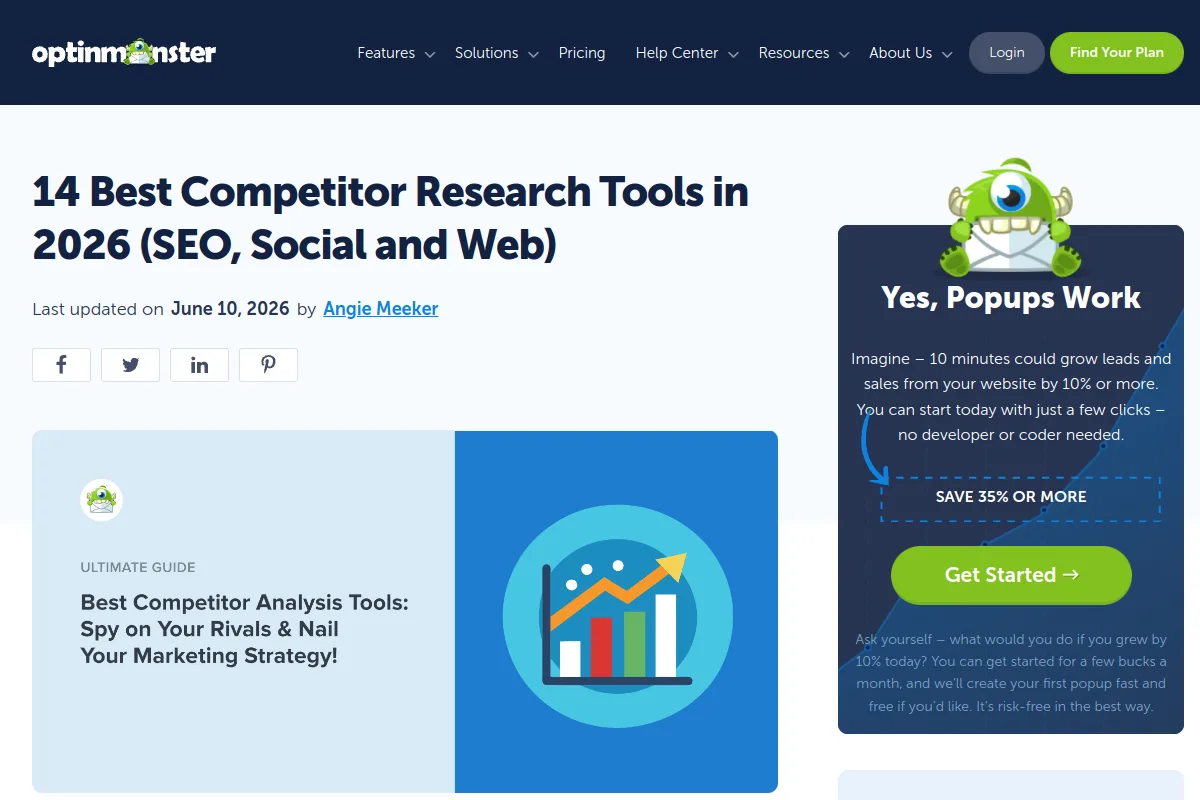
OptinMonster’s competitor research roundup, our source for Semrush features and pricing.
| Criterion | Verdict |
|---|---|
| Coverage | Broadest of the SEO suites here: organic, paid, display and traffic |
| Data depth | Strong overall; backlink freshness trails Ahrefs per Indexed |
| AI search | Yes, ChatGPT and Google AI Mode |
| Workflow fit | API on higher tiers |
| Ease and team fit | Steep for beginners; best with an experienced owner |
| Pricing | Transparent, with a free tier |
Verdict: Semrush rewards teams that will use most of its breadth across SEO, paid and AI search, while solo users chasing one job may overpay.
Pricing: plans start from $139.95/mo for Pro per OptinMonster, while thecmo lists “From $139/month” with a 14-day free trial. The free account offers limited searches, capped at 10 queries/day per Indexed, so it doubles as a free competitor keyword research tool for light checks.
Where to find it: the OptinMonster Semrush profile.
Ahrefs: The Backlink Specialist for SEOs Who Live in Link Data
Best fit: SEO specialists and content teams who care most about links and content gaps, which sit at the heart of ahrefs competitor analysis. OptinMonster calls it the best all-around SEO competitor pick.
Key features:
- Site Explorer, the Organic Keywords report and Top Pages (OptinMonster)
- Content Gap, which Indexed says works well across multiple competitors at once
- Backlink profiles with link quality metrics (OptinMonster)
- AI Keyword Clustering on Standard and above (OptinMonster)
- Ahrefs Webmaster Tools, a free competitor analysis tool only in a narrow sense, since it covers your own site alone (Indexed)
Pros: a backlink index that Indexed rates “Best-in-class” and frequently updated, plus content gap research that compares several rivals in one pass.
Limitations: it offers no PPC data comparable to Semrush (OptinMonster), and Indexed calls its paid intelligence “relatively thin,” with no creative-level detail.
OptinMonster’s competitor research roundup, our source for Ahrefs features and pricing.
| Criterion | Verdict |
|---|---|
| Coverage | SEO and content; weak on paid |
| Data depth | Strongest backlink data in this list, per Indexed |
| AI search | Not documented in our sources |
| Workflow fit | Not documented in our sources |
| Ease and team fit | Built for SEO specialists over generalists |
| Pricing | Paid trial; free Webmaster Tools covers your own site only |
Verdict: choose Ahrefs if links and content gaps drive your SEO plan. Is paid search a big part of that plan too? Pair Ahrefs with a PPC tool, since even the best SEO competitor analysis tools rarely cover ads well.
Pricing: plans start from $129/mo for Lite per OptinMonster, which also lists a $29/mo paid trial. thecmo lists “Free plan available, From $29/month.” The sources conflict, so confirm on the vendor’s site.
Where to find it: the OptinMonster Ahrefs profile.
SE Ranking: Rank Tracking Plus AI Answer Visibility Without the Premium Price Tag
Best fit: agencies and in-house SEOs who track rankings closely and want AI answer visibility on top. thecmo labels it best for rank tracking, and OptinMonster frames it as competitor rank tracking. Need a standalone option? You can also track keyword rankings against rivals with our tracker.
Key features (as SE Ranking describes them):
- Competitor visibility in AI Overviews, AI Mode, ChatGPT and Gemini, including the prompts that trigger competitor mentions
- Paid and organic traffic, top keywords and pages, and traffic cost
- Data via API and MCP inside Claude, ChatGPT and Gemini
- Alerts through Make.com, n8n and Zapier, with dashboards in Data Studio and AgencyAnalytics
thecmo adds integrations with Google Analytics, Search Console, Google Ads, HubSpot, Zapier, Trello and others.
Pros: Indexed argues its AI search tracking across AI Overviews, ChatGPT and Perplexity is “a capability that neither Semrush nor Ahrefs has matched at the same price point,” and API, MCP and automation options carry that data into existing workflows.
Limitations: thecmo flags basic reporting features and notes it may require technical knowledge.
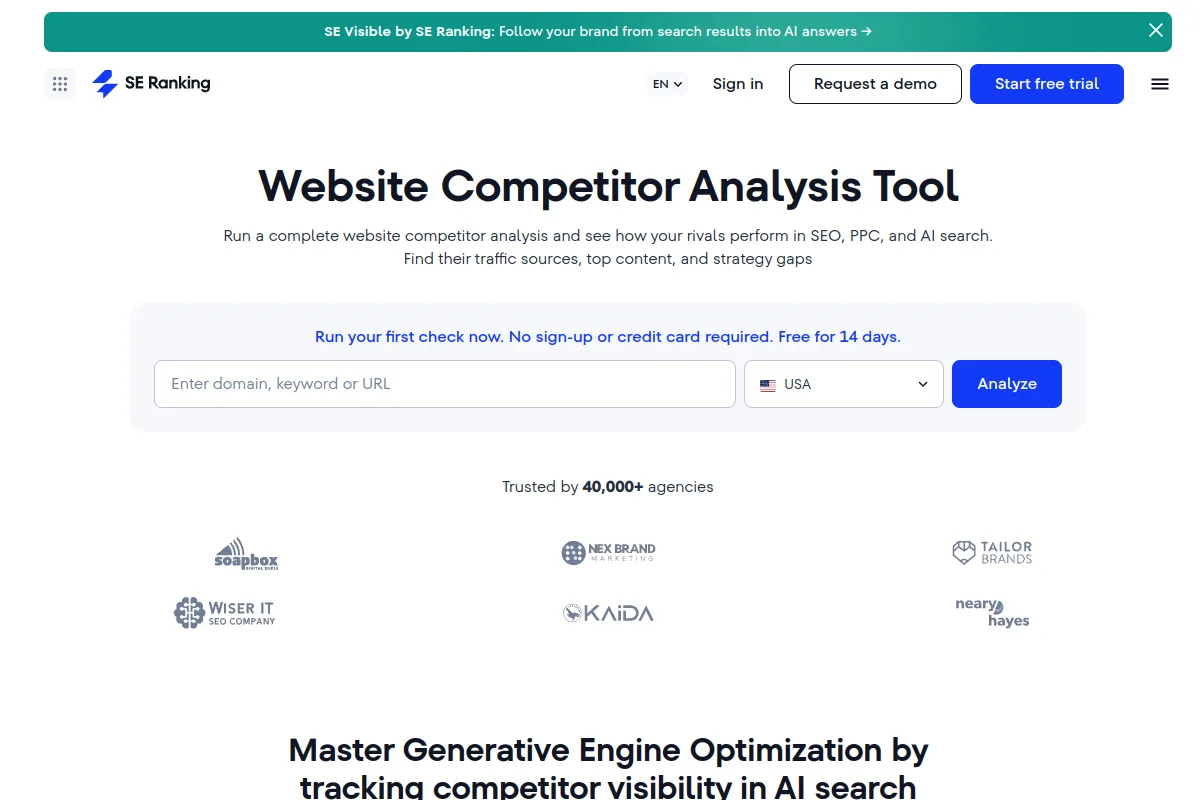
SE Ranking tracks competitor mentions across AI answers alongside classic rankings.
| Criterion | Verdict |
|---|---|
| Coverage | SEO, PPC and AI search |
| Data depth | Traffic, keywords, pages and traffic cost, per the vendor |
| AI search | Strongest documented coverage among our picks |
| Workflow fit | API, MCP and automation tools |
| Ease and team fit | Some technical knowledge needed |
| Pricing | Transparent, with a 14-day trial |
Verdict: choose SE Ranking if rank tracking and AI answer visibility both matter and someone on the team is comfortable with a little technical setup.
Pricing: thecmo lists plans from $103.20/mo billed annually, while OptinMonster lists $65/mo. The sources conflict, so confirm current pricing with SE Ranking. SE Ranking offers a free 14 days with no credit card required.
Where to find it: the SE Ranking competitor traffic research page.
Similarweb: Traffic and Audience Intelligence for Market Researchers
Best fit: market researchers and strategists sizing up rival audiences. thecmo labels it best for market insights, and OptinMonster frames it around website traffic analysis. It is the audience-level pick among the best tools for competitor analysis here.
Key features:
- Traffic estimation and audience overlap (Indexed)
- Visitors, engagement and audience demographics, which lead Curo to call it “a preferred tool for market researchers”
Pros: the clearest view of who visits rival sites and how they engage, plus paid intelligence that Indexed rates good.
Limitations: Indexed rates its keyword gap moderate, backlinks weak and AI features limited, and its free tier carries limited data.
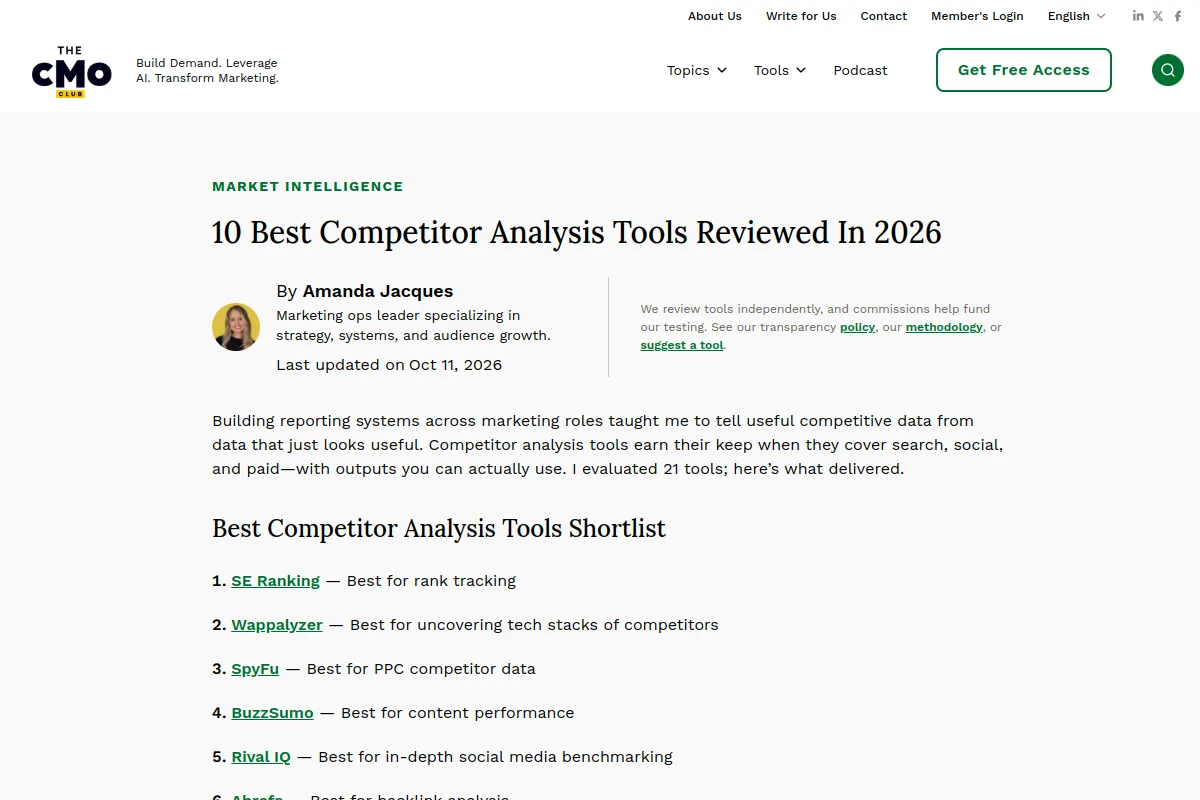
thecmo’s roundup, our source for Similarweb pricing and fit.
| Criterion | Verdict |
|---|---|
| Coverage | Traffic and market level; not a backlink tool |
| Data depth | Audience-oriented |
| AI search | Limited, per Indexed |
| Workflow fit | Not documented in our sources |
| Ease and team fit | Suits researchers more than hands-on SEOs |
| Pricing | Unclear, since sources conflict |
Verdict: choose Similarweb for audience and market sizing questions, and plan on a second tool for backlink and keyword work.
Pricing: thecmo lists plans from $125/mo with a free trial, while OptinMonster lists custom pricing through sales with limited free access.
Where to find it: the thecmo Similarweb profile.
SpyFu: Deep Paid Search History for Budget-Conscious PPC Teams
Best fit: PPC managers, startups and small businesses. thecmo and OptinMonster both label it best for PPC competitor data, and Curo calls it a strong choice for startups and small businesses.
Key features:
- Organic and paid keyword history back to 2006, plus an ad copy archive (OptinMonster)
- Kombat, a three-way keyword comparison (OptinMonster)
Pros: the lowest entry price among our priced picks, unlimited searches (Curo) and paid intelligence that Indexed rates excellent.
Limitations: Indexed rates its backlinks moderate and its free tier partial with limited exports (that “free tier” means limited free access, not a free plan).
OptinMonster’s competitor research roundup, our source for SpyFu features and pricing.
| Criterion | Verdict |
|---|---|
| Coverage | Paid plus organic keywords |
| Data depth | Longest history in our source set |
| AI search | Limited, per Indexed |
| Workflow fit | Not documented in our sources |
| Ease and team fit | Straightforward, per OptinMonster |
| Pricing | Lowest entry price among our priced picks |
Verdict: choose SpyFu if rival ad history matters most and the budget is tight, then add an SEO suite when link research becomes a priority.
Pricing: plans start from $39/mo with no free plan and a 30-day money-back guarantee (OptinMonster). thecmo also lists $39, with its trial marked “Not available.”
Where to find it: the OptinMonster SpyFu profile.
##AlphaSense: Enterprise Market Intelligence for Strategy and Research Teams
Best fit: enterprise strategy, corporate development and market research teams doing strategic competitors analysis. thecmo labels it best for AI-driven market intelligence research. It is a strategy and research platform rather than a marketing tool.
Key features (according to AlphaSense):
- Broker research, an expert interview library, public company financials, M&A deals, private funding rounds and peer sets (AlphaSense)
- An Ingestion API and connectors for Egnyte, Microsoft 365/SharePoint, Box, Google Drive and S3, so teams can search internal files beside market content (AlphaSense)
Pros: it combines financial, expert and market research in one place, and its document connectors let teams search internal files alongside that content (AlphaSense).
Limitations: our reading of its positioning is that it centers on enterprise financial and market research. SEO and social metrics fall outside that focus.
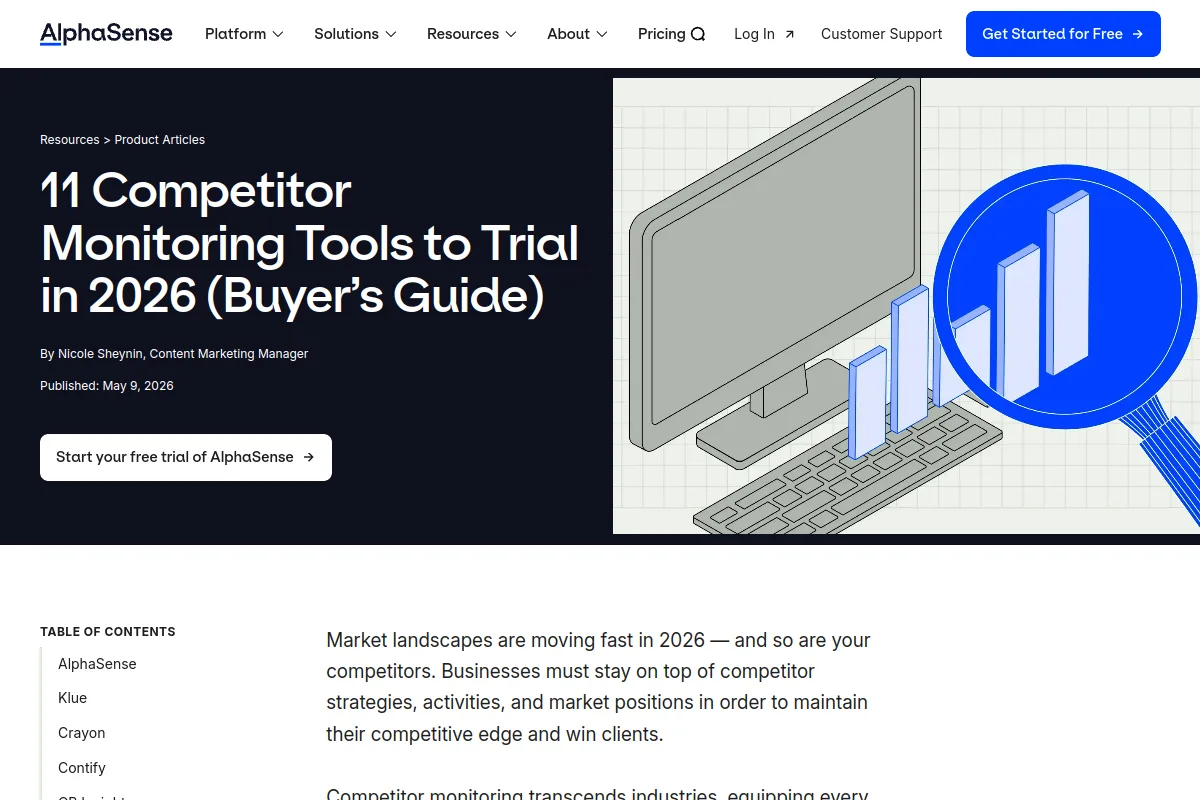
AlphaSense pairs market research content with your internal documents.
| Criterion | Verdict |
|---|---|
| Coverage | Market, financial and expert research |
| Data depth | Deepest qualitative research data here, based on AlphaSense’s own description |
| AI search | Not documented in our sources |
| Workflow fit | Strong document connectors |
| Ease and team fit | Built for enterprise teams |
| Pricing | Opaque |
Verdict: choose AlphaSense if your competitive questions concern markets, deals and financials rather than rankings or ads, and you have an enterprise budget.
Pricing: available on request, with a free demo (thecmo).
Where to find it: the AlphaSense competitor monitoring guide.
Crayon: Battlecards and Competitive Enablement for Sales-Led Teams
Best fit: product marketing and competitive intelligence teams supporting sales. Figr places it in the competitive enablement category. Crayon is the pick built for sellers.
Key features:
- Turns competitor moves into battlecards and talk tracks inside seller systems (Figr), which is where competitor analysis frameworks become something a rep can say out loud
- Signal triage and program visibility into asset usage (Figr)
- Tracks competitor product updates, pricing changes and customer reviews, with insights delivered to the inbox (Curo)
Pros: competitor insight reaches reps inside the systems they already use, and asset usage visibility shows which battlecards get used (Figr).
Limitations: Figr says Crayon works best when someone owns competitive intelligence; otherwise it becomes “an expensive stream of alerts.”
Figr’s competitive analysis roundup, our source for Crayon’s category and features.
| Criterion | Verdict |
|---|---|
| Coverage | Sales enablement plus product, pricing and review changes |
| Data depth | Curated signals |
| AI search | Not documented in our sources |
| Workflow fit | Strongest distribution to sellers in this list |
| Ease and team fit | Needs a dedicated owner |
| Pricing | Not disclosed in our sources |
Verdict: choose Crayon only if someone owns competitive intelligence and can keep battlecards current (Figr).
Pricing: our sources publish none, so request a quote.
Where to find it: the Figr Crayon profile.
BuzzSumo: Content and PR Intelligence for Teams Chasing Shareable Ideas
Best fit: content marketers and PR teams asking which rival articles earn shares and links. thecmo labels it best for content performance.
Key features (Curo):
- Content Analyzer and Content Ideas Generator
- Content gap analysis and a Backlink Analyzer
- Influencer identification and a media database for PR outreach (BuzzSumo)
Pros: content research, idea generation and PR outreach sit in one tool, so a content team can move from a rival’s top article to the people who amplified it (Curo).
Limitations: its documented focus is content and PR. It won’t replace a keyword or paid search suite, and it doesn’t try to.
thecmo’s roundup, our source for BuzzSumo pricing and fit.
| Criterion | Verdict |
|---|---|
| Coverage | Content and PR |
| Data depth | Content performance by topic and domain |
| AI search | Not documented in our sources |
| Workflow fit | Media database supports PR outreach |
| Ease and team fit | Suits content marketers |
| Pricing | Transparent |
Verdict: choose BuzzSumo if content and PR wins drive your strategy, and pair it with an SEO suite for keyword and ranking work.
Pricing: $199/mo billed annually with a free trial (thecmo; OptinMonster).
Where to find it: the thecmo BuzzSumo profile.
Sprout Social: Social Benchmarking for Brands That Win on Social Channels
Best fit: social-first brands and social media managers. OptinMonster calls it “the strongest option” for social media competitor analysis. That puts it at the top of the best social media competitor analysis tools in our source set.
Key features (Curo):
- Competitor tracking across Facebook, Instagram and X (Sprout Social)
- Share of voice and sentiment analysis
- Social listening
Pros: one dashboard benchmarks rivals across six networks, with share of voice, sentiment and listening built in (Curo), which replaces spreadsheet-based social tracking.
Limitations: per-seat pricing grows with team size, a planning point we infer from the seat-based price.
OptinMonster’s competitor research roundup, our source for Sprout Social pricing and fit.
| Criterion | Verdict |
|---|---|
| Coverage | Social only |
| Data depth | Listening plus sentiment |
| AI search | Not documented in our sources |
| Workflow fit | Single dashboard across networks |
| Ease and team fit | Suits social-first brands |
| Pricing | Transparent, seat-based |
Verdict: choose Sprout Social if social channels are where you win or lose against rivals, and budget for each seat your team needs.
Pricing: $199/seat/mo billed annually, with a 30-day trial (OptinMonster). That trial is the closest thing to a free competitor analysis tool for social media in our sources, since none documented a permanent free social option.
Where to find it: the OptinMonster Sprout Social profile.
Notable Mentions: Four Specialists Worth a Look
- Moz Pro: Domain Authority benchmarking with a weak paid side (Indexed). thecmo lists it from $79/mo billed annually with a 7-day trial, while OptinMonster calls it beginner-friendly and lists $99/mo with a 30-day trial.
- Rival IQ: a social benchmarking alternative to Sprout Social. thecmo lists it from $199/mo billed annually with a 14-day trial, and OptinMonster lists $239/mo.
- Klue: an enablement alternative to Crayon with role-specific distribution and conversational retrieval (Figr). Our sources show no pricing.
- Visualping: website change monitoring with AI change detection that filters minor code changes, AI summaries and alerts via email, SMS, Slack and Teams (Curo).
Frequently Asked Questions About Competitor Analysis Tools
Are There Any Free Competitor Analysis Tools Worth Using?
Yes, but the best free competitor analysis tools in our sources are capped versions of paid suites. Semrush’s free tier allows 10 queries/day, and Ahrefs Webmaster Tools covers only your own site (Indexed). Google Alerts and MozBar are free (OptinMonster). Our sources documented no YouTube competitor analysis tool free of charge; Sprout Social’s paid plan and trial include YouTube.
What Is Competitor Analysis, and How Does It Differ From Competitive Intelligence?
Competitor analysis is a structured comparison of specific rivals, according to Hurree. Competitive intelligence usually describes the ongoing monitoring that keeps that comparison current, which is why tools such as Crayon and Visualping center on alerts. Our guide to competitor analysis for marketing turns these definitions into a practical process.
Do I Need More Than One Competitor Analysis Tool?
Often, yes, especially when paid search matters, since even the best competitor analysis tools rarely cover every job. Indexed says teams needing paid intelligence “will likely need to combine platforms.” Start with the tool that covers your biggest competitive job, and add a second only when you can name a clear gap it fills.
Which Tools Track Competitors in AI Search Results?
Three of our picks document AI search tracking: Vee3.ai, SE Ranking and Semrush, making them the best rated competitor analysis tools for AI search optimization by documented coverage. SE Ranking tracks brand mentions and links across AI Overviews, AI Mode, ChatGPT and Gemini (SE Ranking). Our AI visibility tools guide compares dedicated trackers in more depth.
Final Thoughts: Pick the Tool That Matches Your Biggest Competitive Gap
Name your single biggest competitive gap this quarter: links, ads, social, sales deals, market research or AI answers. Trial the one tool from our list that covers it before adding another. The best competitor analysis tools are the ones your team will open every week.
If your gap is organic and AI search, Vee3.ai lets you score your real search rivals by keyword overlap, with marketplaces and directories excluded. Teams can then automate SEO reporting and share competitor progress through a live Orbit link (Vee3.ai).
Ready to see who your search rivals really are?
Start building free with Vee3.ai and track your AI citations today.